Air purifier vs diffuser
These are not two versions of the same appliance. One takes things out of the air at a rate somebody measured; the other puts things into it, and the peer-reviewed work on what it puts there is not reassuring.
#ad We earn a commission if you buy through this link, at no extra cost to you. How this site is funded. Prices last checked November 3, 2026.
They do opposite jobs, so this is really a decision about which one you want running. A certified purifier removes airborne particles at a measured Clean Air Delivery Rate. A diffuser has no removal mechanism at all — it adds an aerosol of water and oil, and the reviewed literature finds essential-oil products are significant indoor sources of terpenes, which can react indoors to form formaldehyde and secondary organic aerosols.
This page exists because the two machines look alike on a shelf, sit in the same corner of the same room, and are sold on the same promise of better air. Only one of them has a number attached to that promise.
How we judged it
The same three questions this site asks of anything claiming to improve indoor air. What does it remove, and at what measured rate? Who measured it? And what does it add to the room while it runs? A purifier answers all three. A diffuser answers the third one, and the answer is the subject of a peer-reviewed review.
What each one actually does
An air purifier moves room air through a filter. Its output is measured as Clean Air Delivery Rate under ANSI/AHAM AC-1 by a third party, in cubic feet per minute, against three test particles. The Honeywell InSight HPA4300 delivers 229 CFM and is certified for 354 square feet — what that number means and does not mean.
A diffuser breaks a liquid into an aerosol and blows it at you. Most consumer units are ultrasonic: a vibrating plate aerosolizes a mix of water and essential oil into a visible mist. There is no filter in the device and no stage at which anything is captured. Its entire function is dispersal, which is the opposite of the function CADR measures.
| Certified air purifier | Essential oil diffuser | |
|---|---|---|
| Removes airborne particles? | Yes, at a measured rate | No mechanism to |
| Independent performance figure | Certified CADR in CFM | None exists |
| Adds to the room | Nothing (a certified unit measures its own ozone) | Water aerosol, oil, terpenes |
| Standard test | ANSI/AHAM AC-1 | None |
| What it is genuinely for | Lowering airborne particle concentration | Making a room smell of something |
What the reviewed research found
The useful citation here is a 2020 critical literature review in Environmental Science and Pollution Research, whose title is the question this page is answering: Does the ubiquitous use of essential oil-based products promote indoor air quality? Angulo Milhem and colleagues pulled together the published work on essential-oil products indoors — emissions, monitoring, and what happens to the compounds afterward.
Two conclusions matter to a buyer. First, the products are significant sources of terpenes in indoor air, inducing a high exposure of occupants to terpenes, across experiments that otherwise disagreed with each other. Second, those terpenes do not simply sit there: indoor oxidants drive reactions resulting in secondary pollutants, such as formaldehyde and secondary organic aerosols.
We are not telling you a diffuser will make you ill, and the review does not say that either — it says these products are a meaningful indoor emission source and calls for standard protocols and real-scale studies, which is a researcher’s way of saying the full picture is not settled. What it rules out is the idea that running one improves your air.
The water half, which nobody mentions
Most diffusers are ultrasonic devices filled with tap water, and that mechanism has been studied for decades in its other application. EPA’s guidance on home humidifiers reports that studies by EPA and the Consumer Product Safety Commission have shown that ultrasonic and impeller (or “cool mist”) humidifiers can disperse materials, such as microorganisms and minerals, from their water tanks into indoor air, and names ultrasonic units among the two types producing the greatest dispersions of both. Researchers have documented them as very efficient at dispersing minerals in tap water into the air, which is where the white film on the furniture comes from.
Two honest qualifications. EPA studied humidifiers, not diffusers — the mechanism is the same and the tank is smaller, but nobody has run that test on a diffuser that we could find. And EPA is careful about the risk: the Federal government has not concluded that the dispersal of minerals by home humidifiers poses a serious health risk. The reason it still belongs on this page is narrower than a health warning — it is that a device marketed as improving air is documented to put particulate into it, which is the thing the machine in the other corner is being paid to take out.
The same guidance notes the other consequence: minerals build scale, and scale can be a breeding ground for microorganisms. That is the identical failure mode the humidifier page describes, and it applies to any small tank of standing water in a warm room — air purifier vs humidifier, including the maintenance trap.
The three kinds, and which changes the answer
Not all diffusers work the same way, and the differences matter more than the marketing suggests.
Ultrasonic is the common one: water plus a few drops of oil, aerosolized by a vibrating plate. It is the type EPA’s humidifier findings speak to, and the only type that also disperses whatever is dissolved in your tap water.
Nebulizing diffusers use no water at all — they atomize undiluted oil with an air stream. That removes the mineral question entirely and makes the other one worse, because the terpene load per hour is higher by design. If the reviewed concern is terpenes and their reaction products, this is the type that supplies most of them.
Passive reed diffusers and plug-ins have no aerosol and no fan. No particulate is added, which is a real advantage, but they are a continuous low-level VOC source for as long as they sit there — and EPA names air fresheners among household VOC sources without any reference to how they are dispersed.
Can the purifier clean up after the diffuser?
Partly, briefly, and only with carbon. This is the single most common misunderstanding in the category and it is worth being exact about: the CADR test measures particles. Smoke, dust and pollen. Odor molecules are gases, a HEPA filter does not remove gases at all, and the number on the box therefore says nothing about what a machine does to a smell.
Activated carbon does adsorb some of the gas phase. Then it saturates, and almost no manufacturer publishes how much carbon is in the cartridge, so the one figure that would let you predict how long it lasts does not exist — the carbon page, in full. Of the machines below, the Coway Airmega 400 and the LEVOIT Core 400S both carry a documented carbon stage; neither quantifies it.
The secondary organic aerosol is a different matter and slightly better news: that fraction is particulate, so a certified filter removes it the way it removes any other fine particle. You are still paying filter life to clean up something you introduced on purpose.
Running both, and when that is actually fine
It is not dangerous and plenty of households do it. It is just a closed loop with a filter bill attached: the diffuser adds terpenes and aerosol, the purifier removes the particulate half, the carbon handles some of the gas half until it stops, and you buy another filter sooner than you would have.
When it is fine: no respiratory conditions in the house, the diffuser runs occasionally rather than continuously, and you understand you are buying a smell rather than air quality. Say that out loud and the purchase is coherent.
When we would not: asthma, a child’s bedroom, or a cat in the room. Fragrance is a commonly reported trigger for asthmatic airways, and Cornell’s Feline Health Center names vapors from household cleaning solutions and aerosol sprays among the suspected triggers for feline asthma — air purifiers when the patient is the cat.
If the room genuinely smells, do this instead
Find the source. A litter box, a damp patch, a bin, a dog bed. EPA’s hierarchy for indoor air is source control first, ventilation second, filtration third, and that order is cheapest as well as most effective — what actually works on pet odor.
Open a window. EPA notes VOC concentrations are consistently higher indoors (up to ten times higher) than outdoors and advises increasing ventilation when using products that emit them. Outdoor air is the cheapest dilution there is, pollen season permitting.
Then buy carbon, with your eyes open. A machine with a real carbon stage will take the edge off while the carbon lasts. Buy it for the certified CADR, treat the odor performance as a bonus nobody has quantified, and budget for replacement — what filters actually cost.
Quick picks
Three certified machines for a room where the air is the problem, ranked on certified CADR against the room each is certified for. Every one measures 0.00 ppb of ozone.
| # | Product | Best for | Certified CADR | Price |
|---|---|---|---|---|
| 1 | 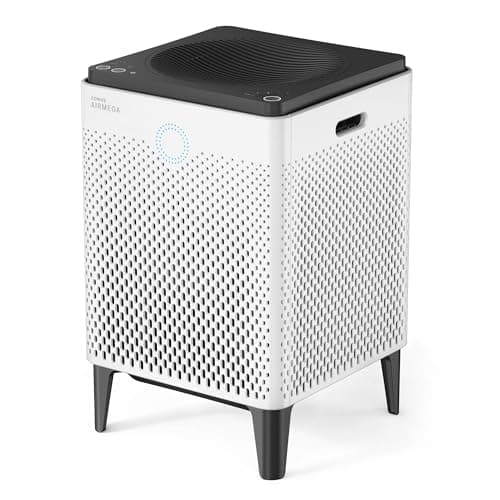 Best where odor is the real problem Coway Airmega 400 376 certified CFM, a carbon stage, washable pre-filters and 0.00 ppb measured. | Large rooms, verified Coway | 376CFM smoke ENERGY STAR verified | |
| 2 | 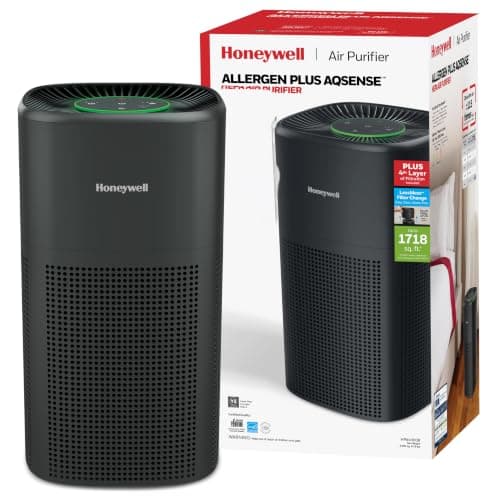 Best overall certified pick Honeywell InSight HPA4300 229 certified CFM at 7.4 CFM per watt, filter recorded HEPA, 0.00 ppb. | True HEPA on the lowest power draw | 229CFM smoke AHAM VERIFIDE | |
| 3 | 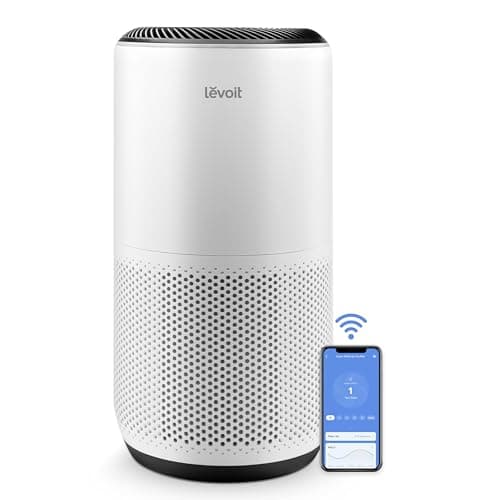 Best if you want the numbers published LEVOIT Core 400S 231 certified CFM, 0.00 ppb, 22-52 dB and a $49.99 filter. | Popular pick, mid-size rooms | 231CFM smoke ENERGY STAR verified |
#ad We earn a commission if you buy through this link, at no extra cost to you. How this site is funded. Prices last checked November 3, 2026.
The machines that do the measurable half
Coway Airmega 400
Coway · model Airmega 400 (AP-2015F)
#ad We earn a commission if you buy through this link, at no extra cost to you. How this site is funded. Prices last checked November 3, 2026.
The Coway that is actually in a certification register: 376 certified smoke CADR, 583 square feet, zero measured ozone. If you want a Coway, this is the one with third-party numbers.
376 smoke / 384 dust / 409 pollen CFM · 380 PM2.5
- Certified room size
- 583 sq ft
- Advertised coverage
- 3,120 sq ft in 60 minutes
- Energy / year
- 366 kWh
- Electricity / year
- $67
- Air per watt
- 6.1 CFM/W
- Power draw
- 66 W
- Noise
- 22-52 dB(A)
- Measured ozone
- 0 ppb
- Filter class
- Composite Filter
- AHAM rule, 500 sq ft
- Clears it (334 needed)
No ionizer — filtration only
ENERGY STAR classifies this unit 'Fan and Filter', 0.00 ppb measured ozone.
376 certified CFM across 583 certified square feet with 0.00 ppb measured and no ion stage, plus a documented carbon stage and washable pre-filters. It is also one of three machines here whose whole annual bill is knowable: $196 a year. Our full review.
The honest con: the most expensive machine here to buy and to own, the register declines to classify its filter HEPA or HEPA-Type at all, and Coway publishes no carbon mass — so its odor performance is as unquantified as everyone else’s.
Honeywell InSight HPA4300
Honeywell · model HPA4300B
#ad We earn a commission if you buy through this link, at no extra cost to you. How this site is funded. Prices last checked November 3, 2026.
The efficiency winner among true-HEPA units at living-room size: 229 certified smoke CADR on 31 watts, zero measured ozone, and a filter the register classifies as HEPA rather than HEPA-Type.
229 smoke / 238 dust / 245 pollen CFM · 233 PM2.5
- Certified room size
- 354 sq ft
- Energy / year
- 185 kWh
- Electricity / year
- $34
- Air per watt
- 7.4 CFM/W
- Power draw
- 31 W
- Noise
- Not published
- Measured ozone
- 0 ppb
- Filter class
- HEPA
- AHAM rule, 300 sq ft
- Clears it (200 needed)
No ionizer — filtration only
Both registers classify this unit as fan-and-filter only.
229 certified smoke CADR across 354 certified square feet at 7.4 CFM per watt — the best air per watt on this site — with the filter recorded HEPA, 0.00 ppb measured and no ion stage, for about $34 a year. Our full review.
The honest con: Honeywell publishes no noise figure, no filter price and no interval, so the recurring cost cannot be computed — and the registers describe its carbon layer without quantifying it, which makes it the weakest of these three on smell specifically.
LEVOIT Core 400S
LEVOIT · model Core 400S (LAP-C401S)
#ad We earn a commission if you buy through this link, at no extra cost to you. How this site is funded. Prices last checked November 3, 2026.
The best-selling unit in the category, and a clean example of the coverage gap: ENERGY STAR certifies it for 358 square feet while the box advertises 1,718.
231 smoke / 240 dust / 259 pollen CFM · 236 PM2.5
- Certified room size
- 358 sq ft
- Advertised coverage
- 1,718 sq ft at 1 air change per hour
- Energy / year
- 237 kWh
- Electricity / year
- $43
- Air per watt
- 5.8 CFM/W
- Power draw
- 38 W
- Noise
- 22-52 dB
- Measured ozone
- 0 ppb
- Filter class
- HEPA-Type
- AHAM rule, 300 sq ft
- Clears it (200 needed)
No ionizer — filtration only
ENERGY STAR classifies this unit 'Fan and Filter' and measures 0.00 ppb ozone. LEVOIT markets it as ozone free.
231 certified CFM across 358 certified square feet, 0.00 ppb measured, no ion stage, and the two figures most rivals leave blank: 22-52 dB and a $49.99 filter, with a carbon-weighted variant available. Our full review.
The honest con: the register classifies the filter HEPA-Type despite the “True HEPA” marketing, LEVOIT publishes no replacement interval to go with the price, and its advertised 1,718 square feet is nearly five times the certified figure.
Common questions
Does a diffuser purify the air?
Will an air purifier remove the smell from my diffuser?
Is it bad to run a diffuser and an air purifier in the same room?
Are essential oil diffusers safe for asthma?
What about the white dust from my ultrasonic diffuser?
Sources
- Angulo Milhem, Verriele, Nicolas & Thevenet (2020) — Does the ubiquitous use of essential oil-based products promote indoor air quality? A critical literature review, Environmental Science and Pollution Research 27:14365-14411
- EPA — Volatile Organic Compounds' Impact on Indoor Air Quality
- EPA — Indoor Air Facts No. 8: Use and Care of Home Humidifiers
- EPA — Guide to Air Cleaners in the Home
- AHAM — air filtration standards and the two-thirds rule
Figures were read on the dates shown against each source. If one has changed, or if we have got something wrong, tell us and we will correct the page.
Read next
- CADR & costAir purifier vs humidifierWhich appliance solves which problem, and when you genuinely need two of them.
- CADR & costAir Purifier vs DehumidifierParticles versus water vapor, and why mold and dust mites are humidity problems that filtration only treats downstream.
- CADR & costDo houseplants clean the air?No. The peer-reviewed review that converted plant chamber studies into CADR found them orders of magnitude slower than opening a window. What to buy if you wanted clean air rather than a plant.
- AllergiesThe Best Air Purifiers for VOCs and FormaldehydeCADR measures particles, not gases. Only activated carbon touches VOCs, nobody publishes how much they include, and ventilation beats all of it.
- CADR & costWhat CADR actually meansThe cornerstone explainer: what CADR measures, why it resists gaming, and certified versus claimed.