Coway Airmega 400 Review
The Coway with third-party numbers, read against the register rather than the box. We do not test units — and this is the one machine here whose whole running cost is publishable.
#ad We earn a commission if you buy through this link, at no extra cost to you. How this site is funded. Prices last checked September 23, 2026.
The Coway worth buying, with two asterisks. ENERGY STAR certifies 376 smoke CADR across 583 square feet with 0.00 ppb ozone and no ion stage, and Coway publishes a washable pre-filter, a noise range, a wattage and a filter price — enough that we can state the whole running cost, $196 a year, which we cannot do for any other machine on this site. The asterisks: the register declines to classify the filter, and the filters cost more than the electricity.
First, the disclosure that shapes everything below: we have not tested this unit. We own no air purifiers and run no laboratory. What follows is the certified record plus what Coway publishes, each labeled as such — our method, including where it runs out.
The certified record
| Specification | Figure | Source |
|---|---|---|
| Smoke CADR | 376 CFM | ENERGY STAR |
| Dust CADR | 384 CFM | ENERGY STAR |
| Pollen CADR | 409 CFM | ENERGY STAR |
| PM2.5 CADR | 380 CFM | ENERGY STAR |
| Certified room size | 583 sq ft | ENERGY STAR, at 4.8 ACH |
| Two-thirds-rule room | 564 sq ft | Our arithmetic on the CADR |
| Annual energy use | 366 kWh | ENERGY STAR |
| Electricity per year | $67 | Our arithmetic at a named rate |
| Air per watt | 6.1 CFM/W | ENERGY STAR |
| Measured ozone | 0.00 ppb | ENERGY STAR |
| Technology | Fan and Filter | ENERGY STAR |
| Filter classification | Composite Filter — not HEPA or HEPA-Type | ENERGY STAR |
| Power draw | 66 W | Coway |
| Noise | 22-52 dB(A) | Coway |
| Washable pre-filter | Yes, one per side | Coway |
| Filter set and interval | Max2 set, 12 months (page says “up to 6 - 12”) | Coway |
| Replacement filter price | $129 for the set of two | Coway |
| Advertised coverage | 3,120 sq ft in 60 minutes | Coway |
| Size and weight | 14.8 in square, 22.8 in tall, 24.7 lb | Coway |
Electricity costs on this page use 18.34¢ per kWh, the U.S. average residential price for June 2026 from the U.S. Energy Information Administration, Electric Power Monthly, Table 5.3. Your rate is on your bill and is probably not this one; multiply the kWh figure by your own rate and you have your number.
The only complete running cost on this site
An annual running cost is electricity plus filters. This site has been able to publish the electricity half for most machines and the filter half for almost none, because manufacturers publish a price or an interval, rarely both. Coway publishes both for the Airmega 400: a Max2 filter set at $129 for the pair, with a twelve-month life expectancy on the filter listing. That makes this the first machine we cover whose whole bill can be stated rather than half-stated.
| Assumed filter interval | Filters | Electricity | Total per year |
|---|---|---|---|
| 12 months (Coway's filter listing) | $129 | $67 | $196 |
| 6 months (the low end of Coway's own range) | $258 | $67 | $325 |
Two things follow. The filters cost more than the electricity, which is true of almost nothing else here and is the argument for keeping the pre-filters clean. And over three years the machine asks for about $588 in running costs at the twelve-month interval — a figure worth setting against the purchase price rather than against a rival’s purchase price alone.
What it is genuinely good at
A measured zero, from the brand whose famous machine has no measurement. ENERGY STAR records fan-and-filter and 0.00 ppb. No ion generator, no plasma stage, no UV lamp, nothing to remember to switch off. The AP-1512HH Mighty that outsells it ships a bipolar ionizing stage with no independent ozone figure anywhere — why we weight that so heavily.
A washable pre-filter on each side. The machine pulls air through both faces, and each has a rinsable mesh in front of the cartridge. In a household with a shedding animal this is the specification that protects the expensive part: coarse hair and dander load a HEPA cartridge far faster than fine particulate does. The units that document one are a short list, and at this size it is shorter still.
Real carbon, not a coating. Coway describes the Max2 as activated carbon plus HEPA in one cartridge. Odor is the complaint a particle filter cannot answer, and a litter box or a damp dog is a gas-phase problem — what carbon actually does and how fast it loads.
It publishes the boring numbers. 66 watts, 22-52 dB(A), a filter price, a filter interval, dimensions and weight. Blueair publishes no noise figure and no filter schedule for the 211i Max; Honeywell publishes neither for the HPA4300. For a machine that sits in a room people use all evening, the bottom of that dB range is knowable before you buy.
The two asterisks
The register will not classify the filter. ENERGY STAR records it as a “Composite Filter” — not HEPA, not HEPA-Type, not anything. Coway calls it HEPA on its own page and in its retail listing. The filter-grade comparison this site makes on every other machine simply cannot be made here, and we are not going to make it by taking the manufacturer’s word for the field the register left blank. What survives is the outcome measure: 376 CFM of certified clean air is certified regardless of what the filter is called — what the classifications do and do not promise.
Coway’s own CADR is lower than the certified one. Coway publishes 328 smoke CADR for this machine. ENERGY STAR certifies 376. That is the manufacturer understating its own product by 15%, which is the opposite of the direction these gaps usually run and means the box undersells the machine while the coverage claim on the same page oversells it.
The room it actually fits
Coway advertises 3,120 sq ft in 60 minutes. That is computed at one air change an hour, about a fifth of the rate the certification is built on, and it does not follow from either of Coway’s own CADR figures at an eight-foot ceiling. The number to size from is 583 — how coverage claims are manufactured from CADR.
| Room | ACH | Verdict |
|---|---|---|
| 350 sq ft | 8.1 ACH | More machine than the room can use |
| 470 sq ft | 6.0 ACH | Our 6 ACH pet-room target, exactly |
| 564 sq ft | 5.0 ACH | AHAM's two-thirds rule, exactly |
| 583 sq ft | 4.8 ACH | The register's own figure |
| 700 sq ft | 4.0 ACH | Too big — that is the Airmega 450 or ProX |
In a pet household the six-air-change row is the one to read. AHAM’s sizing is a general-purpose figure; a continuously shedding source is a continuous load, so this site sizes pet rooms higher and says so rather than presenting it as a standard. That puts the honest ceiling for this machine near 470 square feet, not 3,120.
Who should buy it
Buy it if your room runs from roughly 400 to 564 square feet, an animal sheds in it, you want a measured zero on ozone, and you would rather know the filter bill than discover it. It is the large-room machine on this site with the most complete published record.
Buy something else if the room is materially bigger — the Airmega 450 covers 687 certified square feet for about the same electricity — or if running cost is the deciding factor in a smaller room, where the Honeywell HPA4300 covers 354 square feet for $34 a year and is recorded HEPA. And if a bedroom under 350 square feet is the whole problem, this is more machine than the room can use.
Quick picks
The Airmega 400 against the two machines a buyer at this size should actually weigh it against.
| # | Product | Best for | Certified CADR | Price |
|---|---|---|---|---|
| 1 | 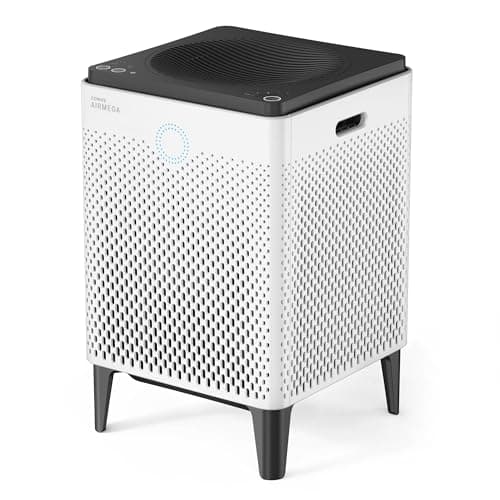 The unit reviewed Coway Airmega 400 376 certified CFM across 583 sq ft, 0.00 ppb, washable pre-filter, published filter price. | Large rooms, verified Coway | 376CFM smoke ENERGY STAR verified | |
| 2 | 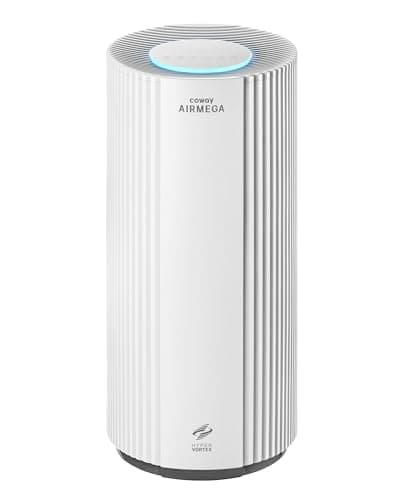 If the room is bigger Coway Airmega 450 443 certified CFM across 687 sq ft for about the same electricity. | Open-plan floors up to about 665 sq ft | 443CFM smoke ENERGY STAR verified | |
| 3 | 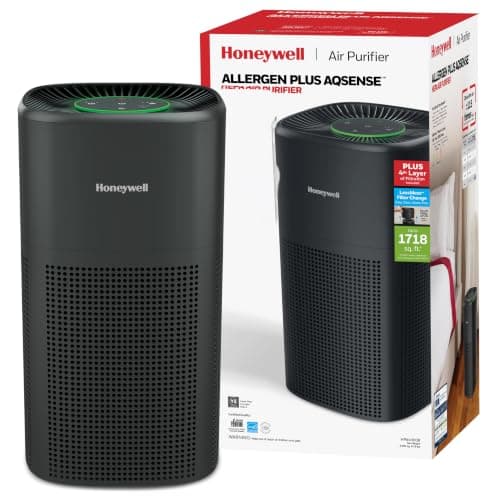 Cheaper to run, better classified Honeywell InSight HPA4300 229 certified CFM on 31 watts, recorded HEPA, in both registers. | True HEPA on the lowest power draw | 229CFM smoke AHAM VERIFIDE |
#ad We earn a commission if you buy through this link, at no extra cost to you. How this site is funded. Prices last checked September 23, 2026.
The alternatives worth weighing
Coway Airmega 450
Coway · model Airmega 450 (AP-2524B)
#ad We earn a commission if you buy through this link, at no extra cost to you. How this site is funded. Prices last checked September 23, 2026.
687 certified square feet with zero measured ozone and a vacuumable pre-filter. The step between the Airmega 400 and the ProX, and the cheapest certified way past 600 square feet.
443 smoke / 445 dust / 450 pollen CFM · 444 PM2.5
- Certified room size
- 687 sq ft
- Advertised coverage
- 3,285 sq ft in 60 minutes
- Energy / year
- 389 kWh
- Electricity / year
- $71
- Air per watt
- 6.7 CFM/W
- Power draw
- 72 W
- Noise
- 23.6-57.7 dB(A)
- Measured ozone
- 0 ppb
- Filter class
- HEPA-Type
- AHAM rule, 650 sq ft
- Clears it (434 needed)
No ionizer — filtration only
ENERGY STAR classifies this unit 'Fan and Filter' and measures 0.00 ppb ozone. Coway's specification lists no ionizing stage.
443 certified smoke CADR across 687 certified square feet — 18% more air and 18% more room — for $71 a year against the 400’s $67, with the same 0.00 ppb, the same absence of an ion stage, a vacuumable pre-filter, and a filter the register does classify HEPA-Type. The two compared in full.
The honest con: 57.7 dB(A) at the top of its range is the loudest figure we print, it stands 29 inches tall, and Coway publishes no replacement filter price for it — so the running-cost arithmetic above cannot be repeated for the bigger machine.
Honeywell InSight HPA4300
Honeywell · model HPA4300B
#ad We earn a commission if you buy through this link, at no extra cost to you. How this site is funded. Prices last checked September 23, 2026.
The efficiency winner among true-HEPA units at living-room size: 229 certified smoke CADR on 31 watts, zero measured ozone, and a filter the register classifies as HEPA rather than HEPA-Type.
229 smoke / 238 dust / 245 pollen CFM · 233 PM2.5
- Certified room size
- 354 sq ft
- Energy / year
- 185 kWh
- Electricity / year
- $34
- Air per watt
- 7.4 CFM/W
- Power draw
- 31 W
- Noise
- Not published
- Measured ozone
- 0 ppb
- Filter class
- HEPA
- AHAM rule, 350 sq ft
- Short (234 needed)
No ionizer — filtration only
Both registers classify this unit as fan-and-filter only.
229 certified smoke CADR across 354 certified square feet on 31 watts — $34 a year against the Coway’s $67, at 7.4 CFM per watt, the best figure on this site. It is in both registers and its filter is recorded HEPA, which the Coway’s is not.
The honest con: it covers a materially smaller room, and Honeywell publishes no noise figure, no filter interval and no filter price — so you can compute its electricity and nothing else.
Common questions
Is the Coway Airmega 400 worth it?
How much do Coway Airmega 400 filters cost per year?
What size room is the Airmega 400 for?
Does the Coway Airmega 400 produce ozone?
What about the Airmega 400S?
Sources
- ENERGY STAR certified room air cleaners database
- AHAM — air filtration standards and the two-thirds rule
- Coway Airmega 400 specification
- Coway Airmega 400/400S Max2 filter set listing
- EPA — Guide to Air Cleaners in the Home
Figures were read on the dates shown against each source. If one has changed, or if we have got something wrong, tell us and we will correct the page.
Read next
- Pet allergiesCoway Airmega 400 vs Airmega Mighty AP-1512HH376 certified CFM and 0.00 ppb ozone against 233 claimed CFM and an unmeasured bipolar stage — from the same brand.
- Pet allergiesThe Best Air Purifiers for PetsCertified CADR picks for a pet household, with annual running cost computed and every ionizer disclosed.
- Pet allergiesDo HEPA filters remove pet dander?What HEPA media actually captures, why 0.3 microns is the hardest case, and which units the register classifies HEPA-Type.
- Room sizeCoway Airmega 450 Review687 certified square feet with 0.00 ppb ozone, a vacuumable pre-filter and three filter options — against the loudest published top speed we print and no filter price.
- CADR & costCoway Airmega 400 vs LEVOIT Core 600S391 certified CFM against 376, for a fraction of the price — against washable pre-filters, a published filter schedule and a quieter range on the Coway.