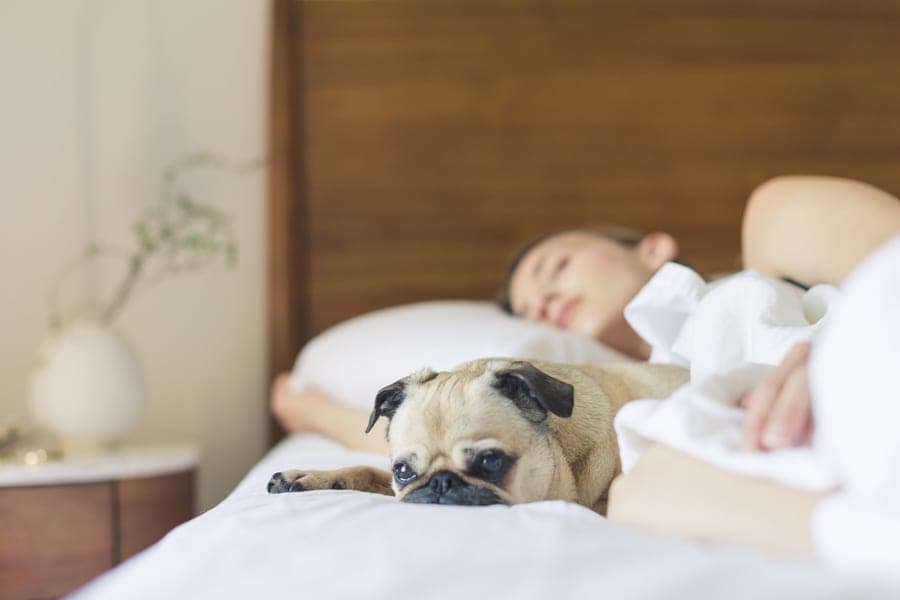
If you are allergic to your cat or your dog, the thing making you sneeze is not the fur. It is a protein — Fel d 1 from cats, Can f 1 from dogs — that rides on skin flakes and dried saliva and gets kicked back into the air every time somebody walks across the room. Hair is the visible symptom. The allergen is the invisible part, and it is what an air purifier is actually for.
That distinction matters because it changes what you should buy. A machine sold on "captures pet hair" is being sold on the easy half of the job. Hair is large, heavy and lands quickly; a vacuum handles it better than any purifier will. The airborne allergen fraction is the part that stays suspended, and clearing it is a function of how much air the machine moves through a filter per minute. That number has a name, it is measured under a published standard, and for a lot of popular units it has been verified by somebody other than the company selling the machine.
That number is Clean Air Delivery Rate, and it is the spine of every page in this section. We use the certified figure where one exists — from AHAM's own directory, or from EPA's ENERGY STAR database, both of which are public and both of which you can check in about a minute. Where no certified figure exists we say so and print the manufacturer's own number labeled as theirs. On this site an unlabelled CADR figure is a defect, not a shortcut.
Where cat and dog households diverge. Most roundups in this category treat "pet dander" as one thing and recommend the same machine to everyone. The research does not support that. Custovic and colleagues, measuring Fel d 1 in real British homes, found the majority of recovered airborne cat allergen riding on relatively large particles — but with a persistent smaller fraction that stays suspended far longer than dog allergen typically does. In practice that pushes cat households toward continuous operation at a fan speed you can actually live with, which makes noise and running cost decisive rather than secondary. Dog households, where shedding volume is usually the bigger problem, get more benefit from a washable pre-filter and a machine that does not choke on hair. We keep those pages separate because they reach different conclusions.
The three things worth checking before anything else. First, the certified room size — not the number on the box. Manufacturers routinely advertise coverage at one air change per hour, which is a nearly useless rate for an allergen that is being replenished continuously by an animal; AHAM's own suggested room size assumes 4.8 air changes per hour, and the gap between those two figures is often four or five times. One popular unit advertises 2,800 square feet and is certified for 574. Second, running cost, which nobody publishes and which varies by a factor of three across machines with nearly identical output. Third, whether the unit has an ionizer or plasma stage, and whether you can turn it off.
That last one is the reason every product card on this site carries an ionizer line. The EPA is unambiguous that portable cleaners which intentionally produce ozone should be avoided, and it names ionizers and plasma cleaners among the technologies that may emit it. Ozone is a lung irritant. A large share of people shopping for a pet-allergy purifier are asthmatic, and the single most-recommended pet unit in this category ships a plasma stage — which is fine if you know and can switch it off, and not fine if nobody told you.
Where to start. If you want the short version: read the roundup that matches your household, check the room-size figure against your actual room, and look at the ionizer line before you look at the price. If you want the long version, the method behind every ranking here is written out in full, including the parts where it runs out.