Do air purifiers help cats with asthma?
The patient here is the cat, which changes the brief. No veterinary authority we could find recommends a purifier by name — what they recommend is removing airborne irritants, and that is a job with a certified number attached.
#ad We earn a commission if you buy through this link, at no extra cost to you. How this site is funded. Prices last checked November 3, 2026.
Probably, indirectly, and for one reason: almost every trigger the veterinary sources name is airborne. Cornell’s Feline Health Center lists tobacco smoke, dusty kitty litter, aerosol sprays, pollen, mold and dust mites among the suspected culprits, and lowering airborne particle concentration is the one thing a certified machine measurably does. The part that is not optional is the ozone figure: 0.00 ppb measured, and no ion stage.
Every other page in this hub treats the cat as the source of the problem. This one treats the cat as the patient, and the brief changes: the goal is not to remove cat allergen, it is to remove everything else from the air the cat breathes.
What feline asthma is, and how common
Cornell’s Feline Health Center estimates that 800,000 or more cats in the United States have asthma — about one percent of the domestic feline population. The mechanism is recognizably the same as the human disease: an inflammatory narrowing of the lower airways, provoked by something inhaled, producing coughing, wheezing and labored breathing.
The list of suspected provocations is where this page gets its usefulness. Cornell names tobacco smoke and dusty kitty litter first, then vapors from household cleaning solutions and aerosol sprays, pollen from trees, weeds and grass, mold and mildew, dust mites, and smoke from fireplaces and candles — and says plainly that in many cases the specific cause is never identified. Its own clinician’s advice is to limit exposure to cigarette smoke, dust mites, irritating cat litter and other bronchial irritants, and to asthma-proof the home insofar as possible.
The gap we are not going to paper over
No veterinary authority we could find recommends an air purifier for a cat by name. Cornell’s page does not mention air filtration at all. There is no trial of HEPA filtration in asthmatic cats that we could locate, and this site does not invent evidence it cannot cite.
So the argument on this page is a chain, and it is worth seeing the links. The veterinary advice is to reduce exposure to specific airborne irritants. Most of the named irritants are particles or particle-borne. A machine with a certified Clean Air Delivery Rate measurably lowers airborne particle concentration in the room it is sized for. Therefore the machine serves the advice. What it does not do is treat a disease, and the step that is actually proven for an asthmatic cat is the one a vet prescribes.
Which triggers a filter reaches, and which it does not
A purifier is a room-air device. It removes what is airborne and in the room, and it does nothing about a source that keeps producing, which is why half of this table is about source control rather than machines.
| Trigger | Airborne? | What a filter does | What actually fixes it |
|---|---|---|---|
| Tobacco smoke | Yes, fine particulate | Removes the particle fraction continuously | Nobody smoking indoors |
| Dusty kitty litter | Partly — fines get airborne at the box | Catches the fines that stay up; a washable pre-filter takes the coarse load | A low-dust litter and gentler scooping |
| Aerosol sprays, cleaning vapors | Gases, not particles | Nothing without carbon, and carbon saturates | Stop using them in that room |
| Pollen | Yes, and it settles fast | Removes the airborne fraction; windows shut in season | Filtration is the main tool here |
| Mold and mildew | Spores, yes | Removes spores in the air | Find the moisture and fix it |
| Dust mite allergen | Mostly settled in soft furnishings | Reaches only the disturbed fraction | Wash the cat's bedding hot and often |
| Fireplace and candle smoke | Yes, and ultrafine | Removes particles; ultrafines are hardest | Do not burn them in the cat's room |
The pollen and mold rows are the ones where filtration does most of the work, because the particle sizes involved stay airborne long enough to be caught — which particles stay up and which settle.
The rule we will not bend for a cat’s room
That is a stricter line than the regulations require, and it is deliberate. California’s Air Resources Board certifies portable air cleaners against a limit of 50 ppb, so a machine measuring 2 or 3 ppb is legal, compliant and nowhere near a hazard. We still pass over those units here, for the same reason the bird-room page does: when a measured zero is available at the same price and the same CADR, a non-zero number is a choice nobody has to make — the ionizer and ozone question in full.
It rules out some good machines. The Blueair Max range measures 2 ppb and AHAM records an ion generator with no documented off switch. The Coway AP-1512HH’s ionizing stage is manufacturer-documented and the unit is in no ozone register at all. Both are recommended elsewhere on this site for households without an asthmatic animal, and neither appears below.
None of this is veterinary advice, and a cat showing respiratory signs needs a vet rather than a purchase.
Sizing it for the room the cat actually lives in
Cats sleep 12 to 16 hours a day, usually in the same two or three places, which makes the sizing question unusually easy: pick the room with the favorite sleeping spot in it and size for that room, not for the house.
AHAM’s two-thirds rule says the certified smoke CADR should be at least two-thirds of the floor area. A 200 square foot bedroom needs 134 CFM; a 350 square foot living room needs 234. This site sizes pet-scoped picks harder than that — at 6 air changes an hour rather than AHAM’s 4.8, because a continuously shedding, continuously breathing household keeps adding to the load — which puts the Honeywell InSight HPA4300 at 286 square feet and the Coway Airmega 400 at 470. That harder target is our judgment applied to AHAM’s published method, not a standard — do it for your own room.
One practical note that applies to cats and not to people: the machine will be investigated. A floor-standing unit with a top-mounted outlet becomes a warm place to sit, which blocks the airflow it was bought for. Give it 18 inches of clearance and expect to move it once.
What to change in the room, in order
Cornell’s advice is to asthma-proof the home insofar as possible, and that phrase hides an order of operations. Working down the trigger list, these are the changes that cost nothing and act on the source, before the machine that treats what is left.
1. The litter. It appears second on Cornell’s list and it is the one you control completely. Clay litters are the dustiest class; low-dust and non-clay alternatives exist and switching is a one-bag experiment. Pour slowly, scoop gently, and put the box anywhere other than the room the cat sleeps in. A purifier catches the fines that get airborne; nothing catches the cloud at the moment of pouring except not making it.
2. The aerosols. Cleaning sprays, air fresheners, dry shampoos and scented candles are gases and fine particulate, and a filter reaches only the particulate half — carbon handles some of the gas phase until it saturates, and nobody publishes how fast. The cheap fix is to stop using them in that room, which is free and complete.
3. The smoke. Tobacco smoke leads Cornell’s list. A certified machine measurably lowers the particulate load, and it is still the wrong tool: the only version of this that works is nobody smoking indoors. Fireplaces and candles sit in the same category.
4. The soft furnishings. Dust mite allergen lives in bedding rather than in the air, and the cat’s bed is the concentrated version of the problem. Hot washing it weekly does more for that trigger than any machine can, because most of the allergen never becomes airborne long enough to be filtered — why mite allergen is the hardest case for a purifier.
5. Then the machine, running continuously. Pollen and mold spores are the triggers filtration genuinely owns, and they arrive whether you change anything or not. Size it for the room with the sleeping spot in it, leave it on, and change the filter on schedule.
Noise, which matters more for a cat than for you
A machine the cat avoids is a machine filtering an empty room. Cats hear well above the human range and startle at broadband fan noise, so the published figure is worth something here — and almost nobody publishes one. Of the zero-ozone machines below, LEVOIT publishes 22-52 dB and Coway publishes 22-52 dB(A). Honeywell, Medify and Winix publish nothing, which is a real gap when the occupant cannot tell you it is too loud — what these machines actually sound like.
Quick picks
Every pick here measures 0.00 ppb of ozone and carries no ion generator. Within that constraint they are ranked on certified CADR against the room each is certified for.
| # | Product | Best for | Certified CADR | Price |
|---|---|---|---|---|
| 1 | 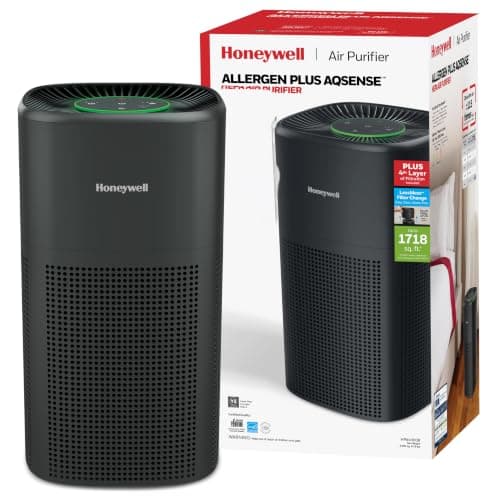 Best for the room the cat sleeps in Honeywell InSight HPA4300 229 certified CFM, 0.00 ppb measured, no ion stage — the three things that matter here. | True HEPA on the lowest power draw | 229CFM smoke AHAM VERIFIDE | |
| 2 | 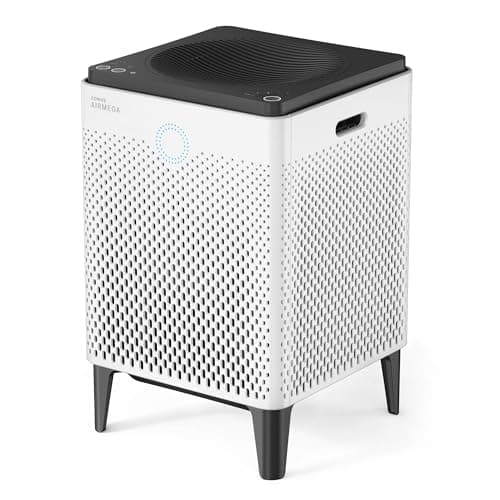 Best where the cat roams Coway Airmega 400 376 certified CFM across 583 certified sq ft, 0.00 ppb, washable pre-filters for litter dust. | Large rooms, verified Coway | 376CFM smoke ENERGY STAR verified | |
| 3 | 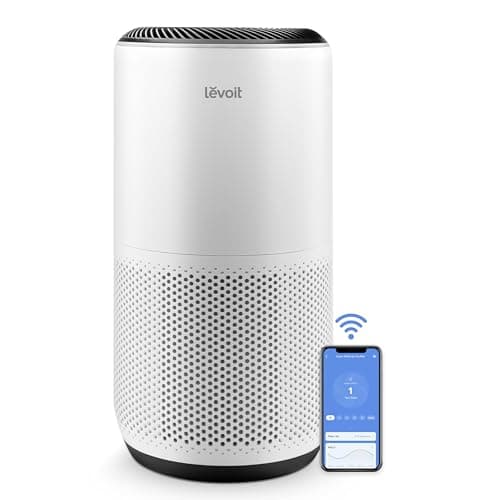 Best quiet pick LEVOIT Core 400S 22-52 dB published, 0.00 ppb measured, and a $49.99 filter you can price in advance. | Popular pick, mid-size rooms | 231CFM smoke ENERGY STAR verified | |
| 4 |  Most certified air with no ion stage Winix AT41 265 certified CFM across 410 certified sq ft, classified fan-with-filter, 0.00 ppb. | Pet allergies, whole living room | 265CFM smoke AHAM VERIFIDE | |
| 5 | 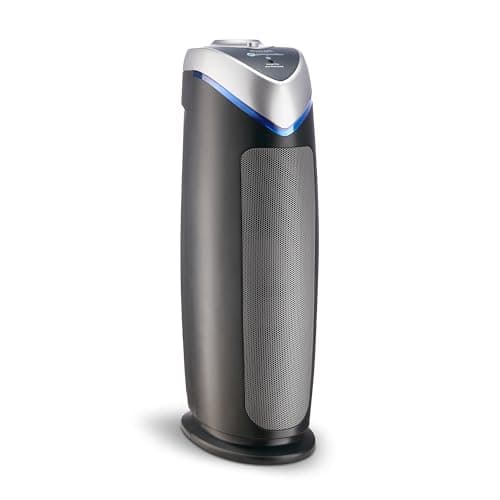 The one to avoid in a cat's room GermGuardian AC4825 A UV-C lamp as the selling point and no measured ozone figure from anyone. | Skip this one | 99CFM smoke AHAM VERIFIDE |
#ad We earn a commission if you buy through this link, at no extra cost to you. How this site is funded. Prices last checked November 3, 2026.
The machines, and the one to avoid
Honeywell InSight HPA4300
Honeywell · model HPA4300B
#ad We earn a commission if you buy through this link, at no extra cost to you. How this site is funded. Prices last checked November 3, 2026.
The efficiency winner among true-HEPA units at living-room size: 229 certified smoke CADR on 31 watts, zero measured ozone, and a filter the register classifies as HEPA rather than HEPA-Type.
229 smoke / 238 dust / 245 pollen CFM · 233 PM2.5
- Certified room size
- 354 sq ft
- Energy / year
- 185 kWh
- Electricity / year
- $34
- Air per watt
- 7.4 CFM/W
- Power draw
- 31 W
- Noise
- Not published
- Measured ozone
- 0 ppb
- Filter class
- HEPA
- AHAM rule, 250 sq ft
- Clears it (167 needed)
No ionizer — filtration only
Both registers classify this unit as fan-and-filter only.
229 certified smoke CADR across 354 certified square feet, 0.00 ppb measured ozone, no ion stage, and the filter recorded HEPA rather than HEPA-Type. At 7.4 CFM per watt it is also the cheapest here to leave running, at about $34 a year — and leaving it running is the entire point.
The honest con: no published noise figure, which matters in a room whose occupant cannot complain, and no filter price or interval, so the recurring cost is unknowable before you buy.
Coway Airmega 400
Coway · model Airmega 400 (AP-2015F)
#ad We earn a commission if you buy through this link, at no extra cost to you. How this site is funded. Prices last checked November 3, 2026.
The Coway that is actually in a certification register: 376 certified smoke CADR, 583 square feet, zero measured ozone. If you want a Coway, this is the one with third-party numbers.
376 smoke / 384 dust / 409 pollen CFM · 380 PM2.5
- Certified room size
- 583 sq ft
- Advertised coverage
- 3,120 sq ft in 60 minutes
- Energy / year
- 366 kWh
- Electricity / year
- $67
- Air per watt
- 6.1 CFM/W
- Power draw
- 66 W
- Noise
- 22-52 dB(A)
- Measured ozone
- 0 ppb
- Filter class
- Composite Filter
- AHAM rule, 450 sq ft
- Clears it (300 needed)
No ionizer — filtration only
ENERGY STAR classifies this unit 'Fan and Filter', 0.00 ppb measured ozone.
376 certified CFM across 583 certified square feet with 0.00 ppb measured and no ionizing stage, plus washable pre-filters — the right feature for litter dust and shed fur, because the coarse load gets rinsed off instead of clogging the media. Coway publishes 22-52 dB(A) and a $129 filter set on a 12-month cycle, so the whole annual bill is knowable: $196. Our full review.
The honest con: the most expensive machine here to buy and to own, and the register declines to classify its filter HEPA or HEPA-Type at all — it is recorded as a composite filter, which tells you less than the Honeywell’s entry does.
LEVOIT Core 400S
LEVOIT · model Core 400S (LAP-C401S)
#ad We earn a commission if you buy through this link, at no extra cost to you. How this site is funded. Prices last checked November 3, 2026.
The best-selling unit in the category, and a clean example of the coverage gap: ENERGY STAR certifies it for 358 square feet while the box advertises 1,718.
231 smoke / 240 dust / 259 pollen CFM · 236 PM2.5
- Certified room size
- 358 sq ft
- Advertised coverage
- 1,718 sq ft at 1 air change per hour
- Energy / year
- 237 kWh
- Electricity / year
- $43
- Air per watt
- 5.8 CFM/W
- Power draw
- 38 W
- Noise
- 22-52 dB
- Measured ozone
- 0 ppb
- Filter class
- HEPA-Type
- AHAM rule, 250 sq ft
- Clears it (167 needed)
No ionizer — filtration only
ENERGY STAR classifies this unit 'Fan and Filter' and measures 0.00 ppb ozone. LEVOIT markets it as ozone free.
231 certified CFM across 358 certified square feet, 0.00 ppb measured, no ion stage — and the published noise range that makes it the sensible choice for a nervous animal: 22-52 dB, with a sleep mode and a $49.99 filter you can price in advance. Our full review.
The honest con: ENERGY STAR classifies the filter HEPA-Type despite the “True HEPA” name, LEVOIT publishes no replacement interval, and it delivers less certified air per watt than the Honeywell above.
Winix AT41
Winix · model AT41
#ad We earn a commission if you buy through this link, at no extra cost to you. How this site is funded. Prices last checked November 3, 2026.
The best-evidenced pick for a pet household: the highest certified smoke CADR of any mid-price unit here, no ion generator, and a measured zero on ozone.
265 smoke / 259 dust / 244 pollen CFM · 261 PM2.5
- Certified room size
- 410 sq ft
- Energy / year
- 272 kWh
- Electricity / year
- $50
- Air per watt
- 5.6 CFM/W
- Power draw
- 45 W
- Noise
- Not published
- Measured ozone
- 0 ppb
- Filter class
- HEPA-Type
- AHAM rule, 380 sq ft
- Clears it (254 needed)
No ionizer — filtration only
AHAM classifies this model 'Fan with Filter' — no ion generator, unlike Winix's PlasmaWave line.
265 certified smoke CADR across 410 certified square feet, classified by AHAM as Fan with Filter — no PlasmaWave, unlike most of Winix’s range — with 0.00 ppb measured on the sibling AT40 that carries the same certified figures. The most air here without an ion generator.
The honest con: no listing for this exact model clears our ASIN bar, so the buy link is a tagged Amazon search rather than a product page — check the model number on arrival, because the AT40 is a different bundle. Winix also publishes no noise figure, no filter price and no interval, and 272 kWh a year is thirstier than the Honeywell for similar air.
GermGuardian AC4825
GermGuardian · model AC4825
#ad We earn a commission if you buy through this link, at no extra cost to you. How this site is funded. Prices last checked November 3, 2026.
Certified for 153 square feet, not the whole bedroom the packaging implies, and the second-least efficient unit here at 3.5 CFM per watt — only the Whirlpool WPPRO2000 is worse. It also runs a UV-C lamp you cannot switch off.
99 smoke / 116 dust / 129 pollen CFM · 111 PM2.5
- Certified room size
- 153 sq ft
- Energy / year
- 182 kWh
- Electricity / year
- $33
- Air per watt
- 3.5 CFM/W
- Power draw
- 30 W
- Noise
- Not published
- Filter class
- HEPA
- AHAM rule, 200 sq ft
- Short (134 needed)
UV-C lamp fitted
AHAM's current record leaves the technology field blank for this model; its 2023 printed directory classified GermGuardian units of this generation as 'Fan, Filter, PCO, and UVC'. The EPA notes that UV lights without adequate lamp coatings may emit ozone, and neither register publishes an ozone measurement for this model.
It is the best-selling purifier in the country and the wrong machine for this job twice over. 99 certified smoke CADR across 153 certified square feet is a home office, not the large room it is sold as — a 200 square foot bedroom needs 134 CFM under AHAM’s rule and this delivers 99.
The honest con: the selling point is a UV-C lamp, and no measured ozone figure for it exists from anybody, because GermGuardian appears in no ENERGY STAR listing. For a healthy household that is a gap; in a room with an asthmatic animal it is disqualifying — what the UV lamp is doing and the full review.
Common questions
Will an air purifier cure my cat's asthma?
What triggers feline asthma?
Is an ionizer or ozone air purifier safe for a cat with asthma?
Does an air purifier help with litter box dust?
Where should the purifier go?
Sources
- Cornell University College of Veterinary Medicine, Feline Health Center — "Feline Asthma: A Risky Business for Many Cats"
- EPA — Ozone Generators that are Sold as Air Cleaners
- EPA — Residential Air Cleaners: A Technical Summary, 3rd edition
- California Air Resources Board — list of CARB-certified air cleaning devices
- ENERGY STAR certified room air cleaners database
- AHAM — air filtration standards and the two-thirds rule
Figures were read on the dates shown against each source. If one has changed, or if we have got something wrong, tell us and we will correct the page.
Read next
- Pet allergiesAir purifiers for asthma in a pet householdWhy ionizer status outranks CADR when someone is asthmatic, with measured ozone figures for every unit.
- Pet allergiesThe Best Air Purifiers for Cat AllergiesWhy cat allergen needs continuous running, and the certified units that make that affordable and quiet.
- Pet allergiesDo air purifiers help with pet allergies?What the EPA and published research actually say about purifiers and pet allergy symptoms — hedges included.
- Pet allergiesThe Best Air Purifiers for PetsCertified CADR picks for a pet household, with annual running cost computed and every ionizer disclosed.