Activated carbon and pet odor
The one specification that decides whether a purifier touches the smell — and the one almost no manufacturer publishes.
#ad We earn a commission if you buy through this link, at no extra cost to you. How this site is funded.
Activated carbon removes odor by adsorption — gas molecules adhering to its internal surface area. Capacity is finite and scales with carbon mass, so a coated sheet holding tens of grams saturates quickly while a machine carrying hundreds of grams keeps working for months.
How adsorption differs from filtration
A HEPA filter is a sieve, roughly speaking. It physically intercepts particles carried in the airstream. Odor molecules are gas-phase, far smaller than any particle a mechanical filter targets, and they pass through HEPA media without interacting with it at all.
Activated carbon works on a different principle. Carbon is processed to create an enormous internal pore structure — a few grams can present a surface area measured in hundreds of square meters. Gas molecules that enter that structure adhere to the pore walls and stay there. That is adsorption, and the important property is that it is consumptive: each occupied site is permanently occupied.
Which is why mass is the whole specification
If capacity is a count of available sites, and sites are consumed as the filter works, then the total odor a carbon filter can remove over its life is essentially proportional to how much carbon is in it. Not the quality of the marketing, not the number of stages listed on the box — the weight.
A budget unit’s carbon layer is often a non-woven sheet impregnated with carbon dust, weighing in the tens of grams. A machine designed for odor carries granular or pelletized carbon in a cartridge, sometimes several hundred grams, occasionally more than a pound. Those two things are both truthfully described as “an activated carbon filter” and they are not remotely comparable.
How to read a carbon claim
- A published weight is the strongest signal, and a manufacturer who publishes one is usually publishing it because it is good.
- A separate carbon filter with its own replacement interval — shorter than the HEPA interval — implies real carbon mass. Coway publishes six months for deodorization against a year for HEPA, which is exactly the pattern adsorption predicts.
- “Carbon-infused pre-filter” or a combined three-in-one filter where the carbon is a layer usually means a small amount.
- A carbon stage sold as an optional upgrade is a genuine signal too — the pet and odor filter variants several manufacturers sell typically add real carbon over the standard cartridge.
Quick picks
The units whose carbon stage is documented by a register or by the manufacturer's own replacement schedule.
| # | Product | Best for | Certified CADR | Price |
|---|---|---|---|---|
| 1 | 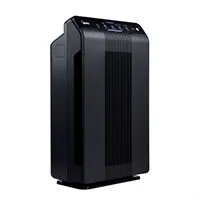 Real carbon stage Winix 5500-2 AHAM records the filter set as HEPA plus carbon, not a coated sheet. | Pet odor, if you switch PlasmaWave off | 239CFM smoke AHAM VERIFIDE | |
| 2 | No photo Carbon plus dust design Blueair DustMagnet 5440i HEPA type with activated carbon, recorded by AHAM. | Settled dust and shed hair | 216CFM smoke AHAM VERIFIDE | |
| 3 | No photo Dedicated odor stage Coway Airmega Mighty AP-1512HH A separate deodorization filter on its own six-month interval. | The popular default, unverified | 233CFM smoke Manufacturer-claimed |
#ad We earn a commission if you buy through this link, at no extra cost to you. How this site is funded.
Setting expectations properly
Carbon reduces airborne odor while the machine runs and while capacity remains. It does not deodorize carpet, upholstery or bedding, which are the reservoirs a persistent pet smell actually lives in and which re-emit continuously. And when the carbon saturates, performance falls off — not gradually enough to notice day to day, but obviously over months.
If a machine that used to help stops helping, the carbon is the first thing to check, well before you conclude the purifier was a waste of money. What replacement actually costs.
Common questions
How much activated carbon does an air purifier need for pet odor?
Does activated carbon expire?
Can you recharge or wash a carbon filter?
Sources
- AHAM VERIFIDE directory of certified room air cleaners
- EPA — Guide to Air Cleaners in the Home
- Coway Airmega Mighty AP-1512HH specification
Figures were read on the dates shown against each source. If one has changed, or if we have got something wrong, tell us and we will correct the page.
Read next
- Pet hair & odorThe Best Air Purifiers for Pet OdorWhy carbon mass decides odor performance, which units have it, and what a purifier cannot fix.
- Pet hair & odorUsing an air purifier for a cat litter boxA fixed odor and dust source, where placement beats power. What to buy and where to stand it.
- CADR & costWhat air purifier filters actually costFilter interval and price arithmetic, with the assumptions stated and the gaps admitted.