Using an air purifier for a cat litter box
A fixed source in a fixed place, which is unusual in this category — and it makes placement worth more than an extra 50 CFM.
#ad We earn a commission if you buy through this link, at no extra cost to you. How this site is funded.
Place the purifier close to the litter box, between it and the rest of the room, with clear space around the intake — proximity to a fixed source beats central placement. Choose a unit with a documented carbon stage for odor and a washable pre-filter for litter dust.
None of the seven competing roundups we examined while building this site has a page for this, which is odd, because the query cluster around it is substantial and the advice differs meaningfully from general room-purification advice.
Why this is not a normal purifier problem
Almost everything else in this category involves a diffuse source — an animal that moves around, dust that comes from everywhere, allergen already distributed through the room. A litter box is the opposite: a point source in a fixed location on a predictable schedule. That changes the optimization.
With a diffuse source, you size the machine to the room and put it somewhere sensible. With a point source, you can intercept. A modest machine standing between the box and the doorway does more useful work than a powerful one across the room, because it is treating air at the highest concentration it will ever have, before it dilutes into the rest of the space.
There are two problems here, not one
Odor is gas-phase and needs activated carbon. HEPA media does nothing for it whatsoever — the molecules pass straight through. The mechanism in full.
Litter dust is particulate and is a genuine HEPA job. Clay litters in particular throw a fine dust on every use, and it is one of the faster ways to load a filter. This is where a washable pre-filter earns its keep twice over.
A machine that only does one of the two will disappoint you at the other, which is the commonest complaint in this specific application.
Quick picks
Ranked for a point source at floor level: carbon stage, then intake geometry, then certified CADR for the room.
| # | Product | Best for | Certified CADR | Price |
|---|---|---|---|---|
| 1 | No photo Best for a litter corner Blueair DustMagnet 5440i Low intake vents at litter height, plus HEPA-type media with carbon. | Settled dust and shed hair | 216CFM smoke AHAM VERIFIDE | |
| 2 | 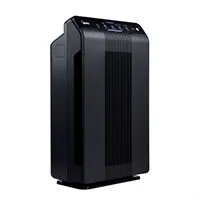 Best carbon for the smell Winix 5500-2 HEPA plus carbon per AHAM, and a washable pre-filter for litter dust. | Pet odor, if you switch PlasmaWave off | 239CFM smoke AHAM VERIFIDE | |
| 3 | No photo Best for a small utility room Honeywell InSight HPA4100 Certified for 169 sq ft on 16 watts, zero measured ozone. | Bedrooms up to about 170 sq ft | 109CFM smoke AHAM VERIFIDE |
#ad We earn a commission if you buy through this link, at no extra cost to you. How this site is funded.
Placement, specifically
- Close to the box, not in the room’s center. Intercept at the source.
- Between the box and where people are. If the box is in a bathroom, that means near the door rather than the far corner.
- At least 12 inches of clear space around intake and outlet. A purifier wedged behind the box is recirculating its own output.
- Not directly in the cat’s path. A machine that gets knocked over, or that a nervous cat avoids, changes litter behavior — which is a worse outcome than the smell.
- Off the floor if litter dust is heavy, on a low shelf, so the intake is not eating scattered litter granules.
General placement guidance covers the rest of the house.
The picks
Blueair DustMagnet 5440i
Blueair · model 5431112000 (DustMagnet 5440i)
#ad We earn a commission if you buy through this link, at no extra cost to you. How this site is funded.
The only unit here designed around where settled dust actually is — intake vents low on the body rather than on top. Its certified pollen CADR, 274, is its strongest number.
216 smoke / 231 dust / 274 pollen CFM · 227 PM2.5
- Certified room size
- 335 sq ft
- Energy / year
- 220 kWh
- Electricity / year
- $40
- Air per watt
- 5.9 CFM/W
- Power draw
- 37.3 W
- Noise
- Not published
- Measured ozone
- 1 ppb
- Filter class
- HEPA Type and Activated Carbon
Ion generator — fitted
AHAM classifies this model 'Fan Filter with Ion Generator'.
The intake geometry is genuinely right for this job — vents low on the body, at roughly litter height, rather than on top of the unit. Combined with a filter set AHAM records as HEPA Type with activated carbon, it addresses both halves of the problem.
335 certified square feet is far more than a bathroom needs, which means it can run on a low, quiet setting — useful, because a cat that will not use a box next to a roaring machine has created a new problem.
Winix 5500-2
Winix · model 5500-2
#ad We earn a commission if you buy through this link, at no extra cost to you. How this site is funded.
The unit almost every roundup in this category picks. Certified performance is real, but it ships PlasmaWave and it costs 31% more a year to run than Winix's own AT41 for less air movement.
239 smoke / 244 dust / 247 pollen CFM · 241 PM2.5
- Certified room size
- 370 sq ft
- Energy / year
- 356 kWh
- Electricity / year
- $65
- Air per watt
- 4.1 CFM/W
- Power draw
- 57.8 W
- Noise
- Not published
- Filter class
- HEPA + Carbon
PlasmaWave — can be switched off
AHAM classifies this model 'Fan Filter with Ion Generator'. Winix documents PlasmaWave as switchable, and the unit runs as a plain HEPA machine with it off.
AHAM records HEPA plus carbon, and Winix documents a washable pre-filter — the two features this application specifically needs. The carbon handles the ammonia smell; the pre-filter handles clay dust that would otherwise load the HEPA media quickly.
Run it on low and switch PlasmaWave off. $65 a year.
Honeywell InSight HPA4100
Honeywell · model HPA4100B
#ad We earn a commission if you buy through this link, at no extra cost to you. How this site is funded.
A small-room unit that clears AHAM's two-thirds rule for a 169 square-foot bedroom on 16 watts. Zero measured ozone, and classified HEPA rather than HEPA-Type.
109 smoke / 117 dust / 117 pollen CFM · 113 PM2.5
- Certified room size
- 169 sq ft
- Energy / year
- 95 kWh
- Electricity / year
- $17
- Air per watt
- 6.9 CFM/W
- Power draw
- 16 W
- Noise
- Not published
- Measured ozone
- 0 ppb
- Filter class
- HEPA
If the box lives in a bathroom, laundry or small utility room, you do not need a living-room machine. This is certified for 169 square feet on 16 watts — $17 a year — with zero measured ozone and a HEPA-classified filter.
It has no documented dedicated carbon stage, so it is the particulate answer rather than the odor answer. In a small, well-scooped room that is often enough.
The honest limit
A purifier makes a clean litter box unnoticeable. It does not make a dirty one acceptable, and no amount of carbon changes that — the source is generating faster than the machine can adsorb. The EPA’s general point applies exactly here: reducing or removing the source is the effective move, and filtration does not replace it.
Scoop daily. Then the machine has an easy job and does it well.
Common questions
Where should I put an air purifier for a litter box?
Will an air purifier get rid of litter box smell completely?
Does litter dust damage the purifier?
Sources
Figures were read on the dates shown against each source. If one has changed, or if we have got something wrong, tell us and we will correct the page.
Read next
- Pet hair & odorThe Best Air Purifiers for Pet OdorWhy carbon mass decides odor performance, which units have it, and what a purifier cannot fix.
- Room sizeWhere to place an air purifierClearances, proximity to the source, and the placement mistakes that quietly waste half a machine.
- Pet hair & odorActivated carbon and pet odorWhy 'includes activated carbon' means nothing without a weight, and how to read the claim.