Do UV air purifiers work?
The lamp is the most expensive thing in some of these machines and the least load-bearing. What EPA's own review of residential UVGI concluded, and why a dead allergen is still an allergen.
#ad We earn a commission if you buy through this link, at no extra cost to you. How this site is funded. Prices last checked November 3, 2026.
Not for allergies. EPA’s review of residential air cleaners found no research showing UV disinfection reduces dust mite or mold allergenicity, and concluded that typical home UVGI units cannot deactivate most airborne microorganisms because the exposure period is too short or the intensity too low — UVGI does not appear to be effective as a sole control device. Judge these machines on the filter, which is what is doing the work.
The lamp is a good story. Light that damages DNA is real physics, hospitals use it, and the box says “kills 99.9% of” something. The question this page answers is narrower and more useful: in a portable purifier in a home, does the lamp change the outcome for an allergic person?
How we judged it
We asked the same three questions we ask of any stage in a machine. Does it remove the thing that makes you sneeze? Is there a standardized test anyone can check it against? And does it produce anything you would not want? UV-C fails the first two and has an open question on the third, which is an unusually clean result for a feature decision.
The dose problem, which is the whole argument
UV-C deactivates a microorganism by penetrating it and altering its DNA, and how much damage it does depends on intensity multiplied by time. Intensity is fixed by the lamp. Time is fixed by how fast the fan moves air past it, and a purifier that delivers 229 cubic feet a minute is moving air past that lamp quickly on purpose.
EPA puts the mismatch in numbers. To achieve reliable deactivation of spores, the lighting power must be high and the exposure times must be long — on the order of minutes and hours rather than the few seconds typical of most UVGI air cleaners. Minutes against seconds is not a tuning problem; it is two or three orders of magnitude, and no amount of fan speed fixes it in the right direction.
A dead allergen is still an allergen
Even where UV works, it works on the wrong property. Allergy is a reaction to proteins, and killing the organism that carries them does not remove the proteins from the air. EPA says it directly: UVGI does not actually capture or remove particles, and dead or deactivated biological particles can still contain irritants, allergens, and/or toxins. For mold specifically, both dead and live fungal particles can cause allergic reactions in sensitive people.
That is why the agency’s summary of UVGI and allergies reads as flatly as it does: no research was found showing UV disinfection is effective in reducing dust mite and mold allergenicity, nor that UV radiation can remove gaseous pollutants, so UVGI cleaners might not be effective in reducing allergy and asthma symptoms. If mold is growing indoors, EPA’s answer is to remove it and fix the conditions that let it grow — what a purifier can and cannot do about mold.
The particle-size page explains why the filter is the stage that matters here: cat allergen rides on particles small enough to stay airborne for hours, and a filter takes them out of the air entirely — which allergens stay airborne.
There is no test to compare them on
The reason this site can rank filters is that ANSI/AHAM AC-1 exists and third parties run it. For UV there is nothing equivalent for the consumer: EPA notes there is no specific standard test method to rate and compare the effectiveness of UVGI cleaners installed in residential HVAC systems or portable air cleaners. Two standards exist for in-duct lamps — ASHRAE 185.1 and 185.2 — and neither describes the machine on your floor.
So a UV purifier’s germicidal claim cannot be compared with another UV purifier’s germicidal claim, by you or by us. Its CADR can be. That asymmetry is the practical reason to buy on CADR — what CADR actually means.
The byproduct question, bounded honestly
This is a question about a specific lamp in a specific machine, not a verdict on every UV product, and the honest position is that the figure which would settle it is usually missing. California’s Air Resources Board certifies air cleaners against a 50 ppb ozone limit under UL 867, and ENERGY STAR publishes a measured ozone figure for every unit it certifies. Where a UV machine appears in neither, nobody has measured it.
That is exactly the position of the one UV machine this site covers. GermGuardian appears in no ENERGY STAR listing at all, so no measured ozone figure for the AC4825 exists from anyone — on a product sold on its UV-C lamp — the full review, including the two AHAM variant entries.
The three claims on a UV box, decoded
“Kills 99.9% of viruses and bacteria.” Almost always a chamber or plate result for the lamp, not a result for the machine moving air at its rated speed, and the figure is about deactivation rather than removal. EPA notes there is no standard test method to rate the effectiveness of UVGI cleaners in homes at all, so the percentage cannot be compared with another manufacturer’s percentage or checked against anything.
“Hospital-grade UV.” Hospitals do use UVGI, and they use it in ways a bedroom appliance does not: upper-room installations sized to a calculated dose, in-duct arrays tested to ANSI/ASHRAE 185.1, or unoccupied-room decontamination running for a measured period. Each of those gives the lamp the exposure time the physics requires. A tower drawing 229 cubic feet a minute past a small lamp does not, and EPA says so.
“Reduces allergens.” This is the one to refuse outright for a purifier, because EPA looked for the evidence and reported its absence: no research or studies were found showing UV disinfection is effective in reducing dust mite and mold allergenicity. For the reader this site is written for, that is the only claim that mattered.
There is a fourth implied claim worth naming, which is that the lamp compensates for a weaker filter. It cannot, in either direction. A UV stage does not increase the airflow through the filter and does not improve the filter’s capture efficiency, so the machine’s certified CADR is whatever the fan and media produce — which is why the one UV machine this site covers is certified for 153 square feet while being sold for large rooms.
The practical rule follows from all three. Read the lamp as a line item you are paying for and then value it at zero: if the machine’s certified CADR, room size, measured ozone and filter class still make it the best buy, buy it in spite of the lamp. On the current record, no machine we cover passes that test.
There is a two-minute way to check any specific machine, and it is the same method this site uses. Search the model number in ENERGY STAR’s certified room air cleaner database and read the ozone emissions field, which is a measured figure in parts per billion. If the model is not there, check California’s list of CARB-certified air cleaning devices, which every portable air cleaner sold in that state must appear on, tested to a 50 ppb limit under UL 867. A machine in neither list has no third-party ozone figure at all — which is not proof of a problem, and is the absence of proof against one.
Where UV does earn its place
On wet surfaces inside ducted systems, which is the application the research actually supports. EPA cites work reporting a 99% reduction in microbial contaminants growing on exposed HVAC surfaces, against a reduction in airborne bacteria of only 25 to 30% in the same study — the gap being that surfaces get prolonged exposure and air in motion does not. Keeping cooling coils clean also improves their heat transfer, so the benefit is partly an efficiency one.
None of that is a reason to buy a portable UV purifier for a bedroom. It is a reason a commercial HVAC contractor might fit a lamp near a coil, which is a different product, a different budget and a different problem.
| Stage | Standard test | What it removes | Figure you can check |
|---|---|---|---|
| Mechanical filter | ANSI/AHAM AC-1 (CADR) | Particles — dander, pollen, dust, smoke | Certified smoke CADR in CFM |
| Activated carbon | None for capacity | Some gases, until it saturates | Nothing published by anyone |
| UV-C lamp | None for portable units | Nothing is removed; some microbes are deactivated | No consumer figure exists |
| Ion generator | UL 867 for ozone only | Charges particles; removal varies | Measured ozone, where certified |
Quick picks
Three machines that spend the money on the filter instead, and the UV machine we would skip — all ranked on certified CADR.
| # | Product | Best for | Certified CADR | Price |
|---|---|---|---|---|
| 1 | 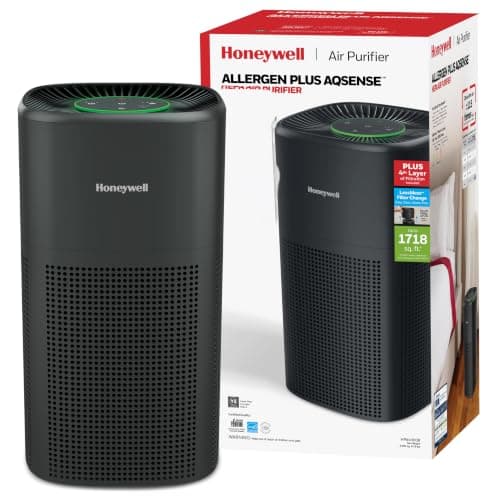 Best overall, no lamp Honeywell InSight HPA4300 229 certified CFM, filter recorded HEPA, 0.00 ppb measured, nothing to irradiate. | True HEPA on the lowest power draw | 229CFM smoke AHAM VERIFIDE | |
| 2 | 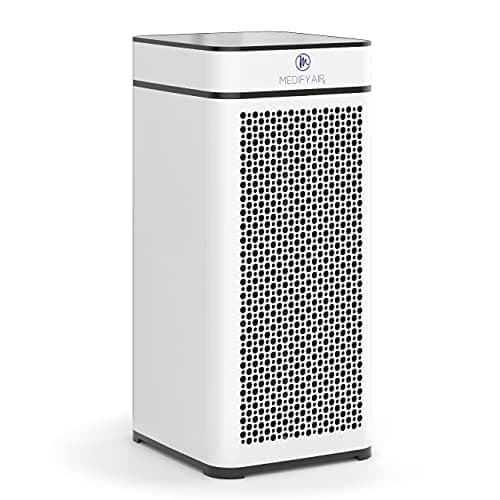 Best mid-price alternative Medify Air MA-40 245 certified CFM across 380 certified sq ft with a measured zero on ozone. | Straightforward mid-size coverage | 245CFM smoke ENERGY STAR verified | |
| 3 | 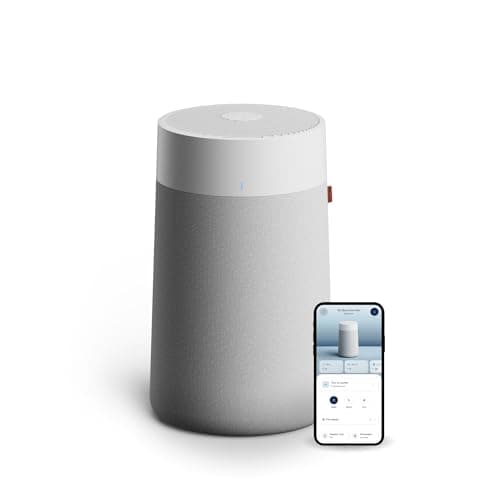 Best on running cost Blueair Blue Pure 311i Max 283 certified CFM at 8.4 CFM per watt — 193 kWh a year. | Mid-size rooms on a small electricity bill | 283CFM smoke AHAM VERIFIDE | |
| 4 | 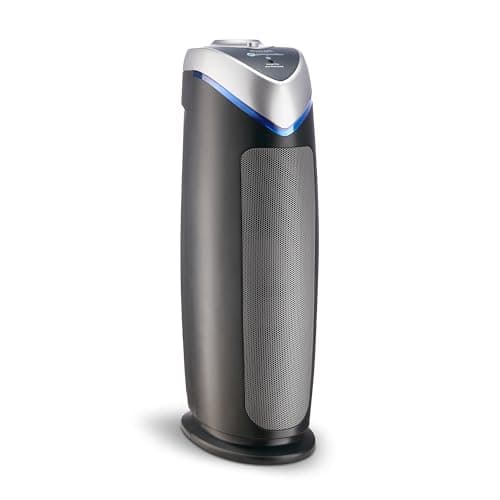 The UV machine we would skip GermGuardian AC4825 The UV-C lamp is the selling point and no ozone figure for it exists anywhere. | Skip this one | 99CFM smoke AHAM VERIFIDE |
#ad We earn a commission if you buy through this link, at no extra cost to you. How this site is funded. Prices last checked November 3, 2026.
What to buy instead of the lamp
Honeywell InSight HPA4300
Honeywell · model HPA4300B
#ad We earn a commission if you buy through this link, at no extra cost to you. How this site is funded. Prices last checked November 3, 2026.
The efficiency winner among true-HEPA units at living-room size: 229 certified smoke CADR on 31 watts, zero measured ozone, and a filter the register classifies as HEPA rather than HEPA-Type.
229 smoke / 238 dust / 245 pollen CFM · 233 PM2.5
- Certified room size
- 354 sq ft
- Energy / year
- 185 kWh
- Electricity / year
- $34
- Air per watt
- 7.4 CFM/W
- Power draw
- 31 W
- Noise
- Not published
- Measured ozone
- 0 ppb
- Filter class
- HEPA
- AHAM rule, 300 sq ft
- Clears it (200 needed)
No ionizer — filtration only
Both registers classify this unit as fan-and-filter only.
229 certified smoke CADR across 354 certified square feet at 7.4 CFM per watt, with the filter recorded HEPA rather than HEPA-Type, 0.00 ppb measured ozone and no ion stage. Everything it claims has a register entry behind it.
The honest con: Honeywell publishes no noise figure, no filter price and no interval, so the recurring cost is unknowable before purchase.
Medify Air MA-40
Medify Air · model MA-40-V4.0
#ad We earn a commission if you buy through this link, at no extra cost to you. How this site is funded. Prices last checked November 3, 2026.
Certified for 380 square feet with zero measured ozone. Middling efficiency, but a straightforward mechanical machine with nothing bolted on.
245 smoke / 257 dust / 263 pollen CFM · 250 PM2.5
- Certified room size
- 380 sq ft
- Energy / year
- 261 kWh
- Electricity / year
- $48
- Air per watt
- 5.6 CFM/W
- Noise
- Not published
- Measured ozone
- 0 ppb
- Filter class
- HEPA-Type
- AHAM rule, 350 sq ft
- Clears it (234 needed)
No ionizer — filtration only
ENERGY STAR classifies this unit 'Fan and Filter', 0.00 ppb measured ozone.
245 certified CFM across 380 certified square feet with 0.00 ppb measured and no ionizing stage, for about $48 a year. Our full review.
The honest con: ENERGY STAR classifies the filter HEPA-Type despite the marketing, and Medify publishes neither a noise figure nor a filter price, so it loses to the Honeywell on both provenance and running cost.
Blueair Blue Pure 311i Max
Blueair · model 3332111100 (Blue Pure 311i Max)
#ad We earn a commission if you buy through this link, at no extra cost to you. How this site is funded. Prices last checked November 3, 2026.
439 certified square feet on under 30 watts. The best power-to-coverage ratio at mid size, with the same ion-generator caveat as the rest of the Max range.
283 smoke / 314 dust / 365 pollen CFM · 298 PM2.5
- Certified room size
- 439 sq ft
- Energy / year
- 193 kWh
- Electricity / year
- $35
- Air per watt
- 8.4 CFM/W
- Power draw
- 29.6 W
- Noise
- Not published
- Measured ozone
- 2 ppb
- Filter class
- HEPA-Type
- AHAM rule, 250 sq ft
- Clears it (167 needed)
Ion generator — fitted
AHAM classifies this model 'Fan Filter with Ion Generator'; ENERGY STAR records 'Fan and Filter' with 2 ppb measured ozone.
283 certified CFM at 8.4 CFM per watt — about $35 a year, the cheapest serious machine here to run. Our full review.
The honest con: ENERGY STAR measures 2 ppb rather than zero and AHAM records an ion generator with no documented off switch, which is the opposite of what an allergic household wants even though the figure is far below any limit.
GermGuardian AC4825
GermGuardian · model AC4825
#ad We earn a commission if you buy through this link, at no extra cost to you. How this site is funded. Prices last checked November 3, 2026.
Certified for 153 square feet, not the whole bedroom the packaging implies, and the second-least efficient unit here at 3.5 CFM per watt — only the Whirlpool WPPRO2000 is worse. It also runs a UV-C lamp you cannot switch off.
99 smoke / 116 dust / 129 pollen CFM · 111 PM2.5
- Certified room size
- 153 sq ft
- Energy / year
- 182 kWh
- Electricity / year
- $33
- Air per watt
- 3.5 CFM/W
- Power draw
- 30 W
- Noise
- Not published
- Filter class
- HEPA
- AHAM rule, 200 sq ft
- Short (134 needed)
UV-C lamp fitted
AHAM's current record leaves the technology field blank for this model; its 2023 printed directory classified GermGuardian units of this generation as 'Fan, Filter, PCO, and UVC'. The EPA notes that UV lights without adequate lamp coatings may emit ozone, and neither register publishes an ozone measurement for this model.
The best-selling UV-C purifier in the country, and the clearest illustration of this page: 99 certified smoke CADR across 153 certified square feet — a home office, not the large room it is sold as — at 3.5 CFM per watt.
The honest con: the lamp is the selling point and there is no measured ozone figure for this machine in any register, because GermGuardian appears in no ENERGY STAR listing. It costs about $33 a year in electricity — within a few kWh of the Honeywell above, for well under half the certified air. The full case, in detail.
Common questions
Do UV air purifiers kill mold and bacteria?
Does UV help with allergies?
Is UV-C in an air purifier dangerous?
So is a UV air purifier a waste of money?
Where does UV genuinely do something?
Sources
- EPA — Residential Air Cleaners: A Technical Summary, 3rd edition (EPA 402-F-09-002)
- EPA — Guide to Air Cleaners in the Home
- EPA — Ozone Generators that are Sold as Air Cleaners
- AHAM VERIFIDE directory of certified room air cleaners
- ENERGY STAR certified room air cleaners database
Figures were read on the dates shown against each source. If one has changed, or if we have got something wrong, tell us and we will correct the page.
Read next
- AllergiesHEPA vs ionizers vs ozone generatorsWhat EPA advises about ionizers and ozone, with published measurements for every certified unit.
- AllergiesAir purifier vs ozone generatorWhy an ozone generator is not a stronger air purifier, and what EPA says about using them indoors.
- AllergiesThe Best Air Purifiers for Mold SporesCertified picks for airborne spores, with the honest caveat that moisture is the actual problem.
- AllergiesThe Best Air Purifiers for AllergiesThe flagship roundup: certified CADR, measured ozone, computed running cost, and the coverage claims checked against the registers.
- AllergiesAllergen particle sizes, explainedWhere each common allergen sits by particle size, and why 0.3 microns is the hardest case rather than the smallest.