How long does an air purifier take to clean a room?
It is a calculation, not an opinion — and the calculation has conditions attached that no product page mentions.
#ad We earn a commission if you buy through this link, at no extra cost to you. How this site is funded. Prices last checked November 3, 2026.
In a closed 200 square foot room with 8 ft ceilings, the Honeywell InSight HPA4300 reaches 8.6 air changes an hour — which removes 90% of airborne particles in about 16 minutes and 99% in about 32. That assumes nothing is adding more. With a shedding animal in the room it never finishes; it holds a lower level instead.
This is one of the few questions about these machines with an exact answer, and the exactness is the problem: the arithmetic is clean and the conditions it assumes are not what your room is like. Both halves are below.
The arithmetic, shown
A filter does not scoop particles out in a straight line. It treats a fixed share of the room’s air every minute, so what is left falls by the same proportion each minute — exponential decay, the same shape as a cooling cup of coffee.
Start with air changes per hour, which is certified CADR against room volume: CADR in cubic feet per minute, times 60, divided by floor area times ceiling height. The Honeywell InSight HPA4300 at 229 CFM in a 200 square foot room with 8 ft ceilings gives 8.6 air changes an hour. Then the time to remove a given fraction is minus the natural log of what is left, divided by that rate:
| Air changes/hour | 63% removed | 90% removed | 99% removed |
|---|---|---|---|
| 2 ACH | 30 min | 69 min | 138 min |
| 4.8 ACH (AHAM's sizing basis) | 12 min | 29 min | 58 min |
| 6 ACH (our pet-household target) | 10 min | 23 min | 46 min |
| 10 ACH | 6 min | 14 min | 28 min |
| 16 ACH | 4 min | 9 min | 17 min |
The 63% row is worth sitting with. A manufacturer claiming to clean a room in twelve minutes is typically quoting one air change at the highest fan speed, and one air change leaves more than a third of the particles behind. Reaching 90% takes 2 times as long as that first change, and 99% about 5 times.
Your room, and the machines we cover
Same calculation, applied to four certified machines across three real rooms. Every CADR here is third-party certified; every minute figure is our arithmetic on it.
| Machine | Certified CADR | 150 sq ft bedroom | 250 sq ft living room | 400 sq ft open plan |
|---|---|---|---|---|
| Blueair Blue Pure 211i Max | 435 CFM | 6 min | 11 min | 17 min |
| LEVOIT Core 600S | 391 CFM | 7 min | 12 min | 19 min |
| Honeywell InSight HPA4300 | 229 CFM | 12 min | 20 min | 32 min |
| GermGuardian AC4825 | 99 CFM | 28 min | 47 min | 74 min |
Notice what the table does and does not say. Doubling the CADR halves the time; doubling the room doubles it. Nothing about brand, filter marketing or app features appears anywhere in the calculation — only CADR, volume and time — what CADR actually means.
Four assumptions, all of them wrong in your house
A sealed room. CADR is measured in a sealed chamber, and the decay equation inherits that. An open door makes the effective volume the whole floor; a leaky window adds outdoor air, which usually helps with indoor particles and hurts during pollen season.
Perfect mixing. The equation assumes the air leaving the machine is instantly distributed. Real rooms have dead corners and short-circuits, which is why EPA tells you to place the unit so its clean air reaches the breathing zone without obstruction — put it behind a sofa and you get a well-filtered sofa — placement, properly.
No source. This is the big one. The decay curve describes a room where somebody stopped adding particles. A cat, a dog, a person walking on carpet, a candle or a pan of frying onions is a continuous input, and with an input the concentration does not fall to zero — it settles at a level where removal matches production.
The highest fan speed. Certified CADR is measured at the setting that produces it, which is usually the loudest. Running at medium does not deliver the certified number, so halve the speed and the minutes roughly double — which is where noise comes in.
Why it never finishes in a pet household
A shedding animal is the clearest case of a continuous source, and it changes the question from “how long until the air is clean” to “how low can this machine hold it”. That is why this site sizes pet-scoped picks at 6 air changes an hour rather than AHAM’s 4.8: more removal capacity against a constant input means a lower equilibrium, not a faster finish.
The practical reading for anyone with a cat or a dog is that the first twenty minutes matter less than the next eight hours. Continuous running at a moderate speed beats an intensive blast, because the blast is undone as soon as the animal moves — which is also the honest reason the annual electricity figures on this site assume continuous operation — what the trials in allergic households found.
Four things that change the clock
Ceiling height, which is pure arithmetic. The decay rate depends on volume, not floor area, and AHAM’s figures assume 8 feet. A 200 square foot room with a 10 ft ceiling holds 25% more air, so the same machine takes 25% longer: the Honeywell InSight HPA4300 goes from 16 minutes to 20. A vaulted ceiling or a mezzanine makes this the dominant term, which is why the calculator asks for the height.
Fan speed, which is not arithmetic you can do. Certified CADR belongs to one setting, usually the highest, and manufacturers rarely publish the delivered rate at lower speeds. Running at medium roughly doubles the minutes; at the lowest setting the honest answer is that nobody has published the number. That is also why the certified annual energy figures assume continuous running rather than bursts.
Filter loading, which works in both directions. A partly loaded pleated filter captures slightly better and resists airflow more, and the airflow loss wins: as pressure drop rises, the fan moves less air and the delivered clean air falls below the certified figure. A washable pre-filter helps by taking the coarse load off the HEPA media — the units that document one.
Where it sits, which decides whether mixing happens at all. The equation assumes clean air reaches every corner. Push the machine into an alcove and the air it has just cleaned is the air it draws back in — a short circuit that leaves the rest of the room on its own schedule. EPA warns about exactly this and calls it short-circuiting.
The number people confuse this with
“Captures 99.97% of particles” is a filter efficiency, measured on a single pass of air through the media, and it says nothing about time. A filter can be 99.97% efficient in a machine whose fan is far too small for your room, in which case the room clears slowly or not at all — the GermGuardian row above is that case exactly, and its filter is recorded HEPA by AHAM.
Clean Air Delivery Rate is the figure that folds the two together: filter efficiency multiplied by the airflow actually passing through it, reported as the cubic feet per minute of genuinely clean air the machine delivers. That is why every row of the table above starts from CADR and not from a capture percentage, and why a 99.97% claim on a box tells you nothing about how long you will be waiting.
What to do with the number
Before guests, or after cooking: twenty minutes on high with the door shut is most of the available benefit in a bedroom-sized room. Then turn it down.
If the time looks too long: the fix is capacity, not patience. Either a higher-CADR machine or a smaller room — closing a door is free and halves the volume — when a second machine beats a bigger one.
If you want to watch it happen: the readout on a machine with a sensor will show the curve, roughly. Treat it as a relative indicator rather than a measurement — what those sensors are and are not.
Quick picks
If the minutes above are the reason you are buying, these are the three machines that deliver them — ranked on certified CADR, which is the only term in the equation you can buy.
| # | Product | Best for | Certified CADR | Price |
|---|---|---|---|---|
| 1 | 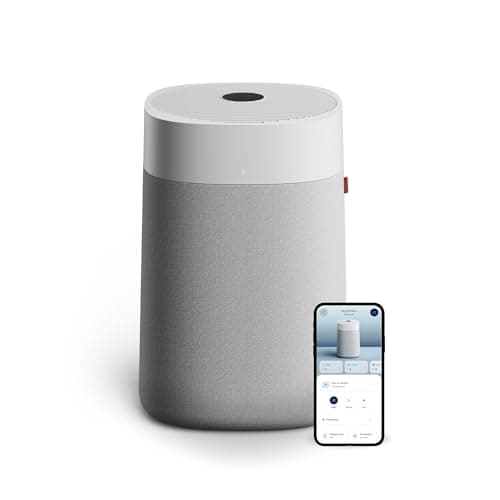 Fastest here Blueair Blue Pure 211i Max 435 certified CFM — 90% of the airborne particles out of a 200 sq ft room in about 8 minutes. | Open-plan spaces above 500 sq ft | 435CFM smoke AHAM VERIFIDE | |
| 2 | 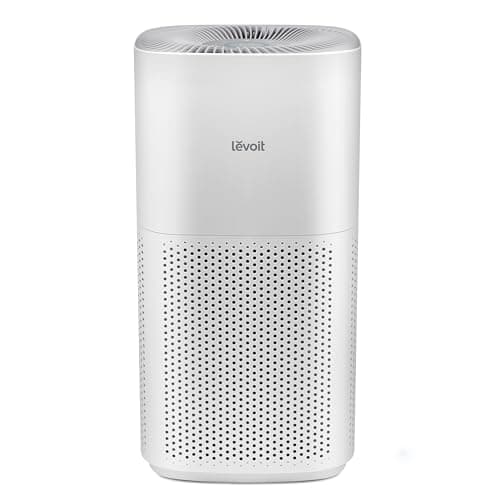 Fastest with a measured zero on ozone LEVOIT Core 600S 391 certified CFM and 0.00 ppb, with the noise range published. | Large open-plan rooms | 391CFM smoke ENERGY STAR verified | |
| 3 | 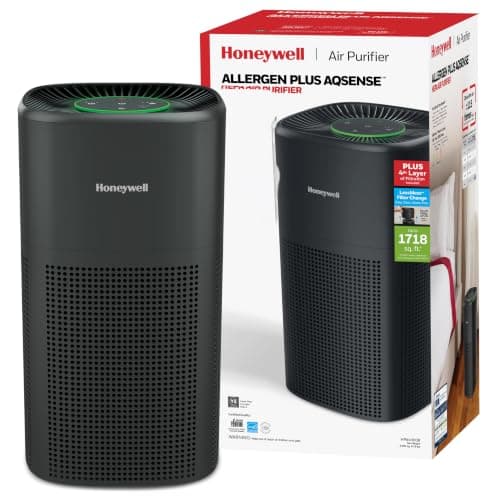 Best speed per watt Honeywell InSight HPA4300 229 certified CFM on 31 watts — 7.4 CFM per watt, the best here. | True HEPA on the lowest power draw | 229CFM smoke AHAM VERIFIDE |
#ad We earn a commission if you buy through this link, at no extra cost to you. How this site is funded. Prices last checked November 3, 2026.
The fastest machines we cover
Blueair Blue Pure 211i Max
Blueair · model 3613111100 (Blue Pure 211i Max)
#ad We earn a commission if you buy through this link, at no extra cost to you. How this site is funded. Prices last checked November 3, 2026.
The most air per watt of anything here and by some distance the largest certified coverage — 674 square feet. It does carry an ion generator, which is the reason it is not our asthma pick.
435 smoke / 453 dust / 450 pollen CFM · 444 PM2.5
- Certified room size
- 674 sq ft
- Energy / year
- 256 kWh
- Electricity / year
- $47
- Air per watt
- 9 CFM/W
- Power draw
- 44 W
- Noise
- Not published
- Measured ozone
- 2 ppb
- Filter class
- HEPA-Type
- AHAM rule, 500 sq ft
- Clears it (334 needed)
Ion generator — fitted
The two registers disagree: AHAM classifies this model 'Fan Filter with Ion Generator' while ENERGY STAR records it as 'Fan and Filter'. ENERGY STAR's measured ozone figure is 2 ppb. We report both rather than picking the flattering one.
435 certified smoke CADR is the highest figure on this site outside the commercial units: 8 minutes to 90% in a 200 square foot room and 17 in a 400. At 9 CFM per watt it is also the most efficient large machine here, about $47 a year. Our full review.
The honest con: AHAM records an ion generator with no documented way to switch it off and ENERGY STAR measures 2 ppb rather than zero — far below any limit, but not the measured zero an asthmatic household should hold out for. Blueair publishes neither a noise figure nor a filter schedule.
LEVOIT Core 600S
LEVOIT · model Core 600S (LAP-C601S-WUS)
#ad We earn a commission if you buy through this link, at no extra cost to you. How this site is funded. Prices last checked November 3, 2026.
391 certified smoke CADR is real large-room capability, and it is honest about needing 387 kWh a year to deliver it — the highest electricity bill of any LEVOIT we cover.
391 smoke / 398 dust / 436 pollen CFM · 394 PM2.5
- Certified room size
- 606 sq ft
- Advertised coverage
- 2,909 sq ft at 1 air change per hour
- Energy / year
- 387 kWh
- Electricity / year
- $71
- Air per watt
- 6 CFM/W
- Power draw
- 49 W
- Noise
- 26-55 dB
- Measured ozone
- 0 ppb
- Filter class
- HEPA-Type
- AHAM rule, 500 sq ft
- Clears it (334 needed)
No ionizer — filtration only
ENERGY STAR classifies this unit 'Fan and Filter', 0.00 ppb measured ozone.
391 certified CFM — 9 minutes to 90% in a 200 square foot room — with 0.00 ppb measured, no ion stage, 26-55 dB published and a $59.99 filter. Our full review.
The honest con: 387 kWh a year — $71 — is the highest electricity bill of any LEVOIT we cover, the filter is classified HEPA-Type despite the name, and no replacement interval is published.
Honeywell InSight HPA4300
Honeywell · model HPA4300B
#ad We earn a commission if you buy through this link, at no extra cost to you. How this site is funded. Prices last checked November 3, 2026.
The efficiency winner among true-HEPA units at living-room size: 229 certified smoke CADR on 31 watts, zero measured ozone, and a filter the register classifies as HEPA rather than HEPA-Type.
229 smoke / 238 dust / 245 pollen CFM · 233 PM2.5
- Certified room size
- 354 sq ft
- Energy / year
- 185 kWh
- Electricity / year
- $34
- Air per watt
- 7.4 CFM/W
- Power draw
- 31 W
- Noise
- Not published
- Measured ozone
- 0 ppb
- Filter class
- HEPA
- AHAM rule, 300 sq ft
- Clears it (200 needed)
No ionizer — filtration only
Both registers classify this unit as fan-and-filter only.
16 minutes to 90% in a 200 square foot room, on 31 watts — that is 7.4 CFM per watt, the best air-per-watt figure on this site, with the filter recorded HEPA and 0.00 ppb measured. Our full review.
The honest con: no published noise figure, no filter price and no interval, so neither the night-time question nor the recurring cost can be answered before you buy.
Common questions
How long should I run my air purifier before bed?
How many air changes per hour do I need?
Does it work faster with the door open?
Why does my room still smell after the purifier has run?
Is 'cleans a room in 12 minutes' on the box true?
Sources
- AHAM — air filtration standards and the two-thirds rule
- AHAM VERIFIDE directory of certified room air cleaners
- EPA — Residential Air Cleaners: A Technical Summary, 3rd edition
- EPA — Guide to Air Cleaners in the Home
- ENERGY STAR certified room air cleaners database
Figures were read on the dates shown against each source. If one has changed, or if we have got something wrong, tell us and we will correct the page.
Read next
- Room sizeAir purifier size calculatorEnter your room dimensions and get the minimum certified CADR, with the arithmetic shown.
- Room sizeWhere to place an air purifierClearances, proximity to the source, and the placement mistakes that quietly waste half a machine.
- Room sizeHow many air purifiers do I need?One per closed room you spend hours in. CADR is measured in a sealed chamber, so a machine does not clean the room next door and two units' figures never add.
- Room sizeThe Best Air Purifiers for a BedroomCertified picks with enough headroom to run quietly all night, and zero measured ozone.