How many air purifiers do I need?
The question behind it is usually whether one big machine can do the job of three small ones. Certification says no, and the reason is a doorway.
#ad We earn a commission if you buy through this link, at no extra cost to you. How this site is funded. Prices last checked September 23, 2026.
One per closed room you spend real hours in — typically the bedroom first, then the main living space. Not one per house, and not one giant machine for everything: CADR is measured in a sealed chamber, so a purifier does not treat the room next door, and two machines’ certified figures never add together.
Most people arrive at this question holding a machine advertised at 3,000 square feet and wondering why anyone would buy two. The advertised figure is the problem — and once you replace it with the certified one, the count answers itself.
Why the unit of measurement is a room, not a house
Clean Air Delivery Rate is measured in a sealed test chamber. The machine is rated on how fast it removes particles from that fixed volume of air, with no doorway for treated air to escape through and no untreated air arriving. Your home is not a sealed chamber, but a closed bedroom door is a reasonable approximation of one — which is exactly why bedrooms are where purifiers work best.
Air does move between rooms, and some of what a living-room machine cleans will drift down the hall. But it drifts slowly and it mixes with untreated air on the way, so the further a room is from the machine the less it gets. Nothing in the certification supports treating a hallway as a distribution system.
The arithmetic, per room
For each room you are considering, take the floor area and apply AHAM’s two-thirds rule: you want a certified smoke CADR of at least two-thirds of the square footage at an eight-foot ceiling. A 180 square-foot bedroom needs 120 CFM. A 300 square-foot living room needs 200. A 500 square-foot open plan needs 334.
| Home | Rooms that justify one | Typical total |
|---|---|---|
| Studio | The single living-sleeping space | 1 |
| 1-bedroom apartment | Bedroom; living area if it is a closed room | 1-2 |
| 2-bedroom apartment | Each used bedroom; living area if closed | 2-3 |
| 3-bedroom house | Each used bedroom, plus the main living space | 3-4 |
| Open-plan floor | The connected volume counts as one room | 1 correctly sized |
The honest short version for most households: buy one for the bedroom, live with it for a month, then decide whether the living room justifies a second. The bedroom is where the uninterrupted hours are, and it is the room where a closed door makes the certified figure mean something.
Which rooms actually justify one
Rank your rooms by hours spent in them with the door closed, not by size. That ordering puts the bedroom first in almost every household — eight uninterrupted hours, a closed door, and a body shedding skin and disturbing bedding all night. A home office comes second if you work from home, for the same reason.
Living rooms come next, and they are the room people buy for first. The catch is that a living room is usually open to a kitchen or hallway, so the certified figure is measured against a volume larger than the one you measured. Rooms you pass through — hallways, bathrooms, dining rooms used twice a week — do not justify a machine at all, whatever the floor area says.
One big machine or two small ones
For a single open space, one correctly sized machine wins on every axis: one filter to buy, one plug, and usually less electricity than two smaller units delivering the same air. The Airmega ProX certifies 577 CFM on 335 kWh a year — less electricity than two mid-size machines that together move less air.
For two separate rooms the calculation inverts, because the big machine simply cannot reach the second room. Two modest certified units in two bedrooms beat one flagship in the hallway between them, every time.
The test for whether you need a second one
Buy one, put it in the room that matters, and run it for two weeks at a middle speed with the door closed at night. Then ask three questions.
Did anything change in that room? If not, the problem may not be airborne, or the machine may be undersized for the space — check the certified CADR against the floor area before buying a second one that will do the same nothing in a different room.
Does the improvement stop at the doorway? That is the normal answer and it is the argument for a second unit. A machine treats the air in front of it; a hallway is not a duct.
Where do the affected hours actually happen? Eight hours asleep in one room beats two hours in another. Most households get more from a second bedroom unit than from a bigger living-room machine.
What about a whole-house system?
A furnace or air-handler filter treats every room the ducts reach, which is the one thing portables cannot do. It also only works while the blower runs, is limited by what pressure drop the system tolerates, and is not certified to ANSI/AHAM AC-1 — so there is no CADR figure to compare against the machines on this site and no measured ozone number either.
The two are not really alternatives. A better furnace filter is a reasonable baseline for a whole house; a certified portable is what raises the air-change rate in the specific room somebody is breathing in for eight hours. This site covers the portables because those are the ones with published, comparable, third-party numbers.
What each extra machine actually costs
Every unit you add is a purchase, an annual electricity bill and a filter schedule. Electricity across the machines below runs from $17 to $71 a year; filters are the half most manufacturers do not publish. Three machines is three filter schedules, and that is the cost people underestimate — what each manufacturer publishes about filter cost.
This is the argument for buying one good machine for the room that matters rather than three cheap ones for rooms you pass through. Undersized machines in four rooms is the most common way to spend $600 in this category and feel nothing change.
Quick picks
A sensible first machine, a second for a bedroom, and the one to buy if the space is genuinely open.
| # | Product | Best for | Certified CADR | Price |
|---|---|---|---|---|
| 1 | 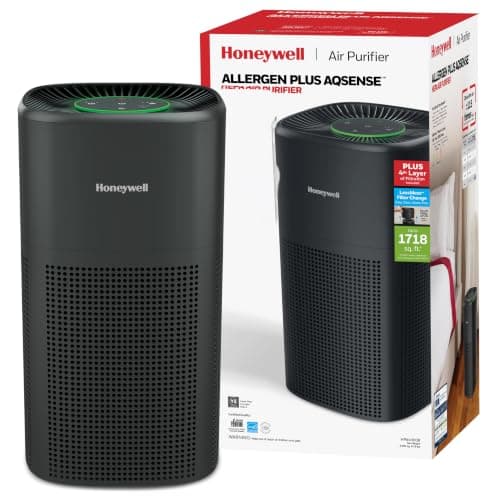 Buy this one first Honeywell InSight HPA4300 229 certified CFM across 354 sq ft on 31 watts, recorded HEPA. | True HEPA on the lowest power draw | 229CFM smoke AHAM VERIFIDE | |
| 2 | No photo The sensible second unit Honeywell InSight HPA4100 109 certified CFM for a bedroom, on 16 watts — the cheapest to run here. | Bedrooms up to about 170 sq ft | 109CFM smoke AHAM VERIFIDE | |
| 3 | 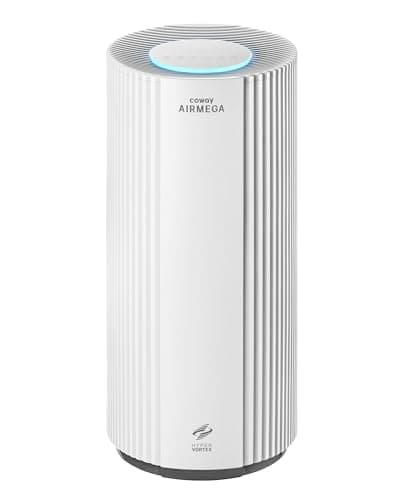 If the space is genuinely open Coway Airmega 450 443 certified CFM across 687 sq ft, 0.00 ppb, one machine instead of three. | Open-plan floors up to about 665 sq ft | 443CFM smoke ENERGY STAR verified |
#ad We earn a commission if you buy through this link, at no extra cost to you. How this site is funded. Prices last checked September 23, 2026.
What to buy, in the order we would buy it
Honeywell InSight HPA4300
Honeywell · model HPA4300B
#ad We earn a commission if you buy through this link, at no extra cost to you. How this site is funded. Prices last checked September 23, 2026.
The efficiency winner among true-HEPA units at living-room size: 229 certified smoke CADR on 31 watts, zero measured ozone, and a filter the register classifies as HEPA rather than HEPA-Type.
229 smoke / 238 dust / 245 pollen CFM · 233 PM2.5
- Certified room size
- 354 sq ft
- Energy / year
- 185 kWh
- Electricity / year
- $34
- Air per watt
- 7.4 CFM/W
- Power draw
- 31 W
- Noise
- Not published
- Measured ozone
- 0 ppb
- Filter class
- HEPA
- AHAM rule, 300 sq ft
- Clears it (200 needed)
No ionizer — filtration only
Both registers classify this unit as fan-and-filter only.
The first machine in most homes should cover the main room you sit in: 229 certified smoke CADR across 354 certified square feet on 31 watts — $34 a year, the best air-per-watt figure on this site, in both registers, filter recorded HEPA.
The honest con: no published noise figure, no filter price and no filter interval, so the running cost stops at electricity and you cannot check the bedroom question before you buy.
Honeywell InSight HPA4100
Honeywell · model HPA4100B
#ad We earn a commission if you buy through this link, at no extra cost to you. How this site is funded. Prices last checked September 23, 2026.
A small-room unit that clears AHAM's two-thirds rule for a 169 square-foot bedroom on 16 watts. Zero measured ozone, and classified HEPA rather than HEPA-Type.
109 smoke / 117 dust / 117 pollen CFM · 113 PM2.5
- Certified room size
- 169 sq ft
- Energy / year
- 95 kWh
- Electricity / year
- $17
- Air per watt
- 6.9 CFM/W
- Power draw
- 16 W
- Noise
- Not published
- Measured ozone
- 0 ppb
- Filter class
- HEPA
- AHAM rule, 169 sq ft
- Short (113 needed)
A second machine usually belongs in a bedroom, where the room is small and the hours are long. 109 certified CFM covers 169 square feet on 16 watts — $17 a year, the cheapest running cost we have recorded, with 0.00 ppb measured and a HEPA classification.
The honest con: it is genuinely small — above about 169 square feet it stops clearing the rule — and we could find no Amazon listing that names the model, so its buy button is a tagged search.
Coway Airmega 450
Coway · model Airmega 450 (AP-2524B)
#ad We earn a commission if you buy through this link, at no extra cost to you. How this site is funded. Prices last checked September 23, 2026.
687 certified square feet with zero measured ozone and a vacuumable pre-filter. The step between the Airmega 400 and the ProX, and the cheapest certified way past 600 square feet.
443 smoke / 445 dust / 450 pollen CFM · 444 PM2.5
- Certified room size
- 687 sq ft
- Advertised coverage
- 3,285 sq ft in 60 minutes
- Energy / year
- 389 kWh
- Electricity / year
- $71
- Air per watt
- 6.7 CFM/W
- Power draw
- 72 W
- Noise
- 23.6-57.7 dB(A)
- Measured ozone
- 0 ppb
- Filter class
- HEPA-Type
- AHAM rule, 650 sq ft
- Clears it (434 needed)
No ionizer — filtration only
ENERGY STAR classifies this unit 'Fan and Filter' and measures 0.00 ppb ozone. Coway's specification lists no ionizing stage.
When the “rooms” are one connected volume, one machine sized to the whole thing beats several: 443 certified smoke CADR across 687 certified square feet, 0.00 ppb measured, no ion stage, vacuumable pre-filter. The full record on it.
The honest con: $71 a year is real money, its published noise range tops out at 57.7 dB(A), and if your floor plan has doors in it this machine is the wrong answer however large it is.
The short version
Common questions
How many air purifiers do I need for a 2 bedroom apartment?
Can one air purifier do a whole house?
Do two air purifiers in one room add up?
Is it better to buy one big air purifier or two small ones?
Sources
- AHAM — air filtration standards and the two-thirds rule
- AHAM VERIFIDE directory of certified room air cleaners
- ENERGY STAR certified room air cleaners database
- EPA — Guide to Air Cleaners in the Home
Figures were read on the dates shown against each source. If one has changed, or if we have got something wrong, tell us and we will correct the page.
Read next
- Room sizeAir purifier size calculatorEnter your room dimensions and get the minimum certified CADR, with the arithmetic shown.
- Room sizeThe Best Air Purifiers for ApartmentsSizing for small connected spaces, dealing with neighbors' smoke and cooking, and keeping the bill down.
- Room sizeWhere to place an air purifierClearances, proximity to the source, and the placement mistakes that quietly waste half a machine.