Do you need an air purifier with an air quality sensor?
The light on the front is the most persuasive thing on the box and the least verified. What the one register field that records it says, and what happened when somebody checked the sensors against real instruments.
#ad We earn a commission if you buy through this link, at no extra cost to you. How this site is funded. Prices last checked November 3, 2026.
No. Buy on certified CADR for your room and take the sensor as a convenience. It is the one feature on this site no register reliably verifies, and when researchers measured the embedded sensors in four purifiers against reference instruments, the sensors generally underestimated PM2.5 — badly enough that the machines idled down to their lowest fan speed while the air was still bad.
Every other number on this site has somebody’s name against it: AHAM measured the CADR, EPA’s program measured the ozone, the manufacturer published the noise. The air quality sensor is the exception, and the exception is sold as the headline feature.
What would make a sensor worth paying for
Three things, and they are the same three we would ask of any instrument. It would have to be accurate enough to act on, which means tested against a reference by somebody who does not sell it. It would have to drive the fan correctly, since on most machines its real job is auto mode rather than the readout. And it would have to tell you something you could not infer from the certified CADR, the room size and the filter age.
None of the three is established for a consumer purifier sensor. That is not a claim that the sensors are useless; it is the reason the sensor cannot be the thing you choose on.
What EPA says about the sensor on the front
EPA’s residential air cleaner summary addresses these directly, and the wording is careful. Some consumer-grade air cleaners now include pollutant sensors or indicators, it says, but to date no studies were found that have investigated their performance over time. They may not be as accurate as professional-grade sensors, and they may provide useful indicators of relative pollutant concentrations — the phrase to notice is “relative”.
The same document’s list of what research still needs to do includes developing and validating accurate pollutant sensors for consumer air cleaners, specifically the ability to measure ultrafine particles and PM2.5 accurately over long periods. When the agency’s research agenda contains “build a sensor that works”, the one on the box in front of you is not the deciding feature.
What happened when somebody measured them
In 2023 a group at the 43rd AIVC conference ran four portable air cleaners with embedded sensors in a 20 cubic meter chamber, with cigarette smoke and burning candles as the pollutant sources and the ventilation off, and compared the machines’ own readings against reference instruments.
The embedded sensors generally underestimated the PM2.5 mass concentration. Only one machine’s sensor matched the reference, and only below its detection ceiling. None of them properly detected the ultrafine particles from a candle. And because the readings were low, the machines would quickly switch to the lowest fan speed although the PM2.5 mass concentration was still far too high.
The one register field that records it, and why we hedge it
ENERGY STAR’s certified room air cleaner database carries an automatic-mode field, which is as close as any third party comes to recording this feature. It is worth reading, and worth knowing what it is: a certifying partner’s declaration, not a performance test. Read on 2026-10-17, this is what it says about the machines we cover.
| Machine | Automatic mode recorded | Certified smoke CADR | Measured ozone |
|---|---|---|---|
| LEVOIT Core 400S | Air quality sensor, timer | 231 CFM | 0.00 ppb |
| LEVOIT Core 600S | Air quality sensor, timer | 391 CFM | 0.00 ppb |
| Honeywell InSight HPA4300 | Air quality sensor | 229 CFM | 0.00 ppb |
| Coway Airmega 400 | Air quality sensor | 376 CFM | 0.00 ppb |
| Coway Airmega ProX | Air quality sensor | 577 CFM | 0.00 ppb |
| Medify Air MA-40 | Timer only — no sensor | 245 CFM | 0.00 ppb |
| Honeywell HPA6000 | None | 257 CFM | 0.00 ppb |
| AirDoctor AD1500 | None | 170 CFM | 3.00 ppb |
Those two disagreements are the reason this page will not rank machines on the sensor. The register records no automatic mode for the AirDoctor AD1500, while AirDoctor’s own launch announcement for that model lists automatic air-quality sensing among its features. And it records none for the Blueair Blue Pure 211i Max, a machine whose retail listings and Blueair’s own regional product pages describe particle sensors measuring PM1, PM2.5 and PM10 driving an auto mode. We have not resolved either contradiction, and we are not going to guess which side is wrong.
Compare that with the CADR column, where AHAM and ENERGY STAR agree with each other to within rounding on every machine in the table, because both are reporting the output of the same standardized test — what CADR is and is not.
What the sensor is worth in money
The useful way to price a feature is to find two machines that differ mainly by it. The closest pair we cover is the LEVOIT Core 400S — sensor, timer, app, 231 certified CFM — and the Medify Air MA-40, which the register records with a timer and no sensor at 245 certified CFM across 380 certified square feet.
The Medify delivers more certified air across a larger certified room, and the LEVOIT answers back with figures the Medify does not publish at all: 22-52 dB and a $49.99 filter. That is a real trade, and notice that the sensor is not the deciding term in it. Prices move; both are mid-bracket machines, and the live figures are in the picks table below rather than typed into this paragraph.
What the thing behind the light actually is
The sensor in a consumer purifier is optical. Air is drawn past a light source, particles passing through the beam scatter some of it, a photodetector registers the flashes, and firmware converts that signal into a number it presents as a mass concentration in micrograms per cubic meter. Nothing in that chain weighs anything: the mass is inferred from scattered light by assuming a particle size distribution and a particle density.
That assumption is where the 2023 chamber results come from. When the real size distribution matches what the firmware assumes, the reading is reasonable. When it does not — candle smoke, cooking fumes and other ultrafine-dominated sources — the same scattered-light signal corresponds to a completely different mass, which is precisely what the study found when none of the four machines properly detected the ultrafine particles from a burning candle.
It also explains why a sensor can be useful and inaccurate at the same time. Direction and change are the easy part of the measurement; absolute concentration is the hard part. EPA’s phrasing — useful indicators of relative pollutant concentrations — is exactly the right level of confidence to place in the number on the display.
How to tell the machine is working without a sensor
Four checks, none of which need a readout, and all of which are more reliable than one.
Check the arithmetic once, at purchase. If certified smoke CADR clears two-thirds of the floor area, the machine delivers the clean air it was certified to deliver. That is a third-party measurement of this exact model, which is more than any onboard sensor gives you — the calculator does it.
Look at the filter. A HEPA cartridge that has gone gray is working; one that is still white after six months in a pet household is a sign the air is not reaching it — a blocked intake, a unit against a wall, or a room it is not actually treating.
Feel the outlet. On the setting you normally use, there should be an obvious column of moving air at arm’s length. If there is not, you are running a certified machine at an uncertified fraction of its rate.
Shut the door and time it. Twenty minutes on the highest setting in a closed bedroom-sized room is roughly a 90% reduction for a machine in the 200 to 250 CFM class, and you can compute it for your own room and machine — how long an air purifier takes to clean a room.
When a sensor genuinely helps
In a bedroom, for noise. If the alternative is running at a fixed medium speed all night, auto plus a night mode is quieter for most of it. You are buying sleep, not air — a real thing to buy — how loud these machines are.
For feedback on your own habits. EPA’s charitable reading is the right one: a relative indicator that jumps when you fry onions or light a candle teaches you where your indoor particles come from, which is worth more than its absolute accuracy.
Not for sizing, and not instead of arithmetic. A green light in a room two sizes too big for the machine means the sensor cannot see the problem, not that there is not one. The sizing calculator settles that question with numbers that were measured.
Quick picks
Three machines the register records with a sensor, and one it records without — all four ranked on the certified figures rather than on the light on the front.
| # | Product | Best for | Certified CADR | Price |
|---|---|---|---|---|
| 1 | 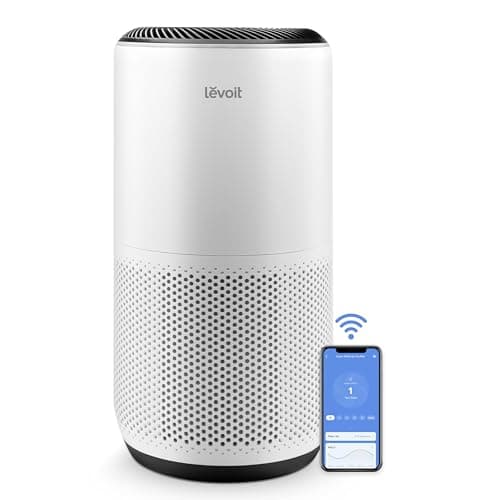 Best sensor-equipped pick LEVOIT Core 400S The register records an air-quality sensor and a timer, and LEVOIT publishes the noise and filter price. | Popular pick, mid-size rooms | 231CFM smoke ENERGY STAR verified | |
| 2 | 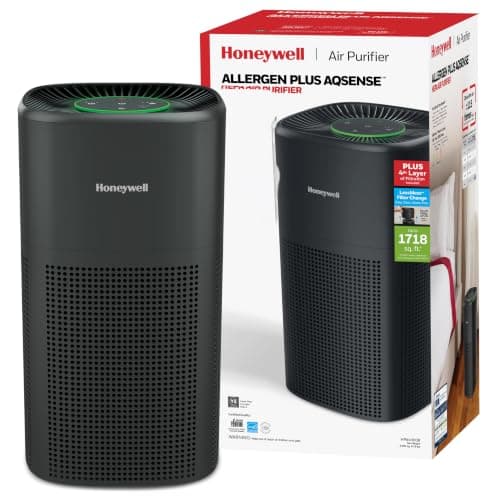 Best buy, sensor or not Honeywell InSight HPA4300 229 certified CFM at 7.4 CFM per watt — the best air per watt here, sensor included. | True HEPA on the lowest power draw | 229CFM smoke AHAM VERIFIDE | |
| 3 | 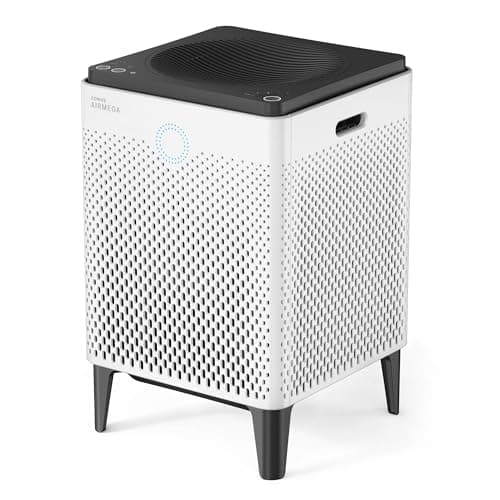 Best sensor in a large room Coway Airmega 400 376 certified CFM, 0.00 ppb, air-quality sensor recorded in the register. | Large rooms, verified Coway | 376CFM smoke ENERGY STAR verified | |
| 4 | 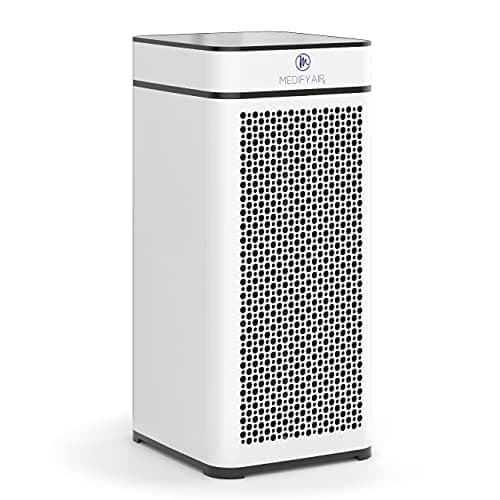 Best without a sensor Medify Air MA-40 245 certified CFM and 0.00 ppb for less money, with a timer and nothing to second-guess. | Straightforward mid-size coverage | 245CFM smoke ENERGY STAR verified |
#ad We earn a commission if you buy through this link, at no extra cost to you. How this site is funded. Prices last checked November 3, 2026.
If you want one anyway
LEVOIT Core 400S
LEVOIT · model Core 400S (LAP-C401S)
#ad We earn a commission if you buy through this link, at no extra cost to you. How this site is funded. Prices last checked November 3, 2026.
The best-selling unit in the category, and a clean example of the coverage gap: ENERGY STAR certifies it for 358 square feet while the box advertises 1,718.
231 smoke / 240 dust / 259 pollen CFM · 236 PM2.5
- Certified room size
- 358 sq ft
- Advertised coverage
- 1,718 sq ft at 1 air change per hour
- Energy / year
- 237 kWh
- Electricity / year
- $43
- Air per watt
- 5.8 CFM/W
- Power draw
- 38 W
- Noise
- 22-52 dB
- Measured ozone
- 0 ppb
- Filter class
- HEPA-Type
- AHAM rule, 300 sq ft
- Clears it (200 needed)
No ionizer — filtration only
ENERGY STAR classifies this unit 'Fan and Filter' and measures 0.00 ppb ozone. LEVOIT markets it as ozone free.
The register records an air quality sensor and a timer, and LEVOIT fills in the blanks most rivals leave: 22-52 dB and a $49.99 filter, on top of 231 certified CFM across 358 certified square feet with 0.00 ppb measured ozone.
The honest con: nobody has tested that sensor, the filter is classified HEPA-Type rather than HEPA despite the “True HEPA” name, and LEVOIT publishes no replacement interval — so you have a filter price and no schedule to multiply it by.
Honeywell InSight HPA4300
Honeywell · model HPA4300B
#ad We earn a commission if you buy through this link, at no extra cost to you. How this site is funded. Prices last checked November 3, 2026.
The efficiency winner among true-HEPA units at living-room size: 229 certified smoke CADR on 31 watts, zero measured ozone, and a filter the register classifies as HEPA rather than HEPA-Type.
229 smoke / 238 dust / 245 pollen CFM · 233 PM2.5
- Certified room size
- 354 sq ft
- Energy / year
- 185 kWh
- Electricity / year
- $34
- Air per watt
- 7.4 CFM/W
- Power draw
- 31 W
- Noise
- Not published
- Measured ozone
- 0 ppb
- Filter class
- HEPA
- AHAM rule, 300 sq ft
- Clears it (200 needed)
No ionizer — filtration only
Both registers classify this unit as fan-and-filter only.
229 certified CFM at 7.4 CFM per watt — the best air per watt on this site — with the filter recorded HEPA, 0.00 ppb measured and an air quality sensor recorded in the register. It would be our pick with the sensor deleted.
The honest con: no noise figure, no filter price and no interval published anywhere we could source, which makes the running cost stop at electricity.
Coway Airmega 400
Coway · model Airmega 400 (AP-2015F)
#ad We earn a commission if you buy through this link, at no extra cost to you. How this site is funded. Prices last checked November 3, 2026.
The Coway that is actually in a certification register: 376 certified smoke CADR, 583 square feet, zero measured ozone. If you want a Coway, this is the one with third-party numbers.
376 smoke / 384 dust / 409 pollen CFM · 380 PM2.5
- Certified room size
- 583 sq ft
- Advertised coverage
- 3,120 sq ft in 60 minutes
- Energy / year
- 366 kWh
- Electricity / year
- $67
- Air per watt
- 6.1 CFM/W
- Power draw
- 66 W
- Noise
- 22-52 dB(A)
- Measured ozone
- 0 ppb
- Filter class
- Composite Filter
- AHAM rule, 500 sq ft
- Clears it (334 needed)
No ionizer — filtration only
ENERGY STAR classifies this unit 'Fan and Filter', 0.00 ppb measured ozone.
376 certified CFM across 583 certified square feet, 0.00 ppb measured, washable pre-filters, a sensor in the register and the only complete annual bill on the site at $196.
The honest con: the most expensive machine here on both counts, and the register will not classify its filter HEPA or HEPA-Type at all.
Medify Air MA-40
Medify Air · model MA-40-V4.0
#ad We earn a commission if you buy through this link, at no extra cost to you. How this site is funded. Prices last checked November 3, 2026.
Certified for 380 square feet with zero measured ozone. Middling efficiency, but a straightforward mechanical machine with nothing bolted on.
245 smoke / 257 dust / 263 pollen CFM · 250 PM2.5
- Certified room size
- 380 sq ft
- Energy / year
- 261 kWh
- Electricity / year
- $48
- Air per watt
- 5.6 CFM/W
- Noise
- Not published
- Measured ozone
- 0 ppb
- Filter class
- HEPA-Type
- AHAM rule, 350 sq ft
- Clears it (234 needed)
No ionizer — filtration only
ENERGY STAR classifies this unit 'Fan and Filter', 0.00 ppb measured ozone.
245 certified CFM across 380 certified square feet with 0.00 ppb measured and no ion stage, for $48 a year. The register records a timer and no sensor, which is one fewer thing to be wrong. Our full review.
The honest con: Medify publishes no noise figure, no filter price and no interval, the register classifies the filter HEPA-Type despite the marketing, and without a sensor there is no night-time quiet mode decided for you — you pick a speed and live with it.
Common questions
Are air purifier air quality sensors accurate?
Is auto mode worth using?
How can I tell if my air purifier is working without a sensor?
Which air purifiers have an air quality sensor?
Does a sensor make the machine better at cleaning air?
Sources
- EPA — Residential Air Cleaners: A Technical Summary, 3rd edition (EPA 402-F-09-002)
- Andersen, Koust, Rasmussen & Rong (2023) — Evaluation of sensor-based air cleaners to remove PM2.5 and TVOC indoors, 43rd AIVC Conference
- ENERGY STAR certified room air cleaners database
- AHAM VERIFIDE directory of certified room air cleaners
Figures were read on the dates shown against each source. If one has changed, or if we have got something wrong, tell us and we will correct the page.
Read next
- CADR & costHow to Choose an Air PurifierThe whole selection method as a walkthrough: room first, certified CADR second, register third, ozone fourth, running cost last.
- CADR & costWhat CADR actually meansThe cornerstone explainer: what CADR measures, why it resists gaming, and certified versus claimed.
- CADR & costAre air purifiers worth it?Worth it for airborne particles in a room you spend hours in. Not worth it for gases, mold behind walls, or a room you cannot size correctly.
- CADR & costAir purifier vs furnace filterA MERV 13 filter is nearly as good as HEPA per pass and runs only when the blower does — under 25% of the year, per EPA. What that means for which you buy first.