Are Dyson Air Purifiers Worth It for Pet Allergies?
Dyson does not publish a CADR, and it has a considered argument for why. Here is that argument, what we could and could not verify, and what it means if a cat is the reason you are shopping.
#ad We earn a commission if you buy through this link, at no extra cost to you. How this site is funded.
Dyson appears in neither certification register. We searched both live on 2026-09-09: 252 AHAM-certified room air cleaners, 241 ENERGY STAR-certified models, no Dyson in either. Dyson publishes no CADR and explains why. The machines may well be excellent; you cannot size a room with them, and you cannot compare them.
This is the page this site was built to write, and it is the one question in the category that a publisher funded by affiliate commission has the least incentive to answer honestly: commission is a percentage of the sale, and a Dyson costs several times what our top picks do. So we are going to be careful to separate what we checked from what we think.
What we checked, and how you can repeat it
Two public registers underpin every number on this site. We queried both directly rather than relying on a cached copy, on 2026-09-09:
| Register | Certified models listed | Distinct brands | Dyson entries |
|---|---|---|---|
| AHAM VERIFIDE directory of certified room air cleaners | 252 | 33 | 0 |
| ENERGY STAR Certified Room Air Cleaners V3.0 | 241 | 72 | 0 |
For contrast, every machine we recommend on this page is in at least one of those two registers, which is where its CADR, its certified room size, its annual energy use and its measured ozone emission come from.
Dyson’s argument, in Dyson’s own words
Dyson is not quiet about this. It publishes a detailed case against the CADR test, and a buyer deserves to read it rather than a summary of it. On its own testing-standards page Dyson describes the industry test as “conducted in a compact chamber measuring just 28.5m³” in which “air quality is measured with only one sensor”, and says it “is conducted for 20 minutes in a small chamber, tracking just the speed of filtration, rather than the quality”. It adds a specific mechanical objection: “if particles aren’t captured first time, they are released back into the home.”
Its newsroom goes further on the setup. The chamber is “small, between 28m3 and 30m3” and “unrepresentative of a real-world environment”; the purifier sits in the middle of the room and is switched to maximum by hand rather than left on automatic; and there are “two fans – one wall-mounted and one ceiling fan – to aid air circulation”. The conclusion Dyson draws is that “a machine with a high CADR may actually struggle to clean the air properly when placed in a bigger room without a ceiling fan”.
Its alternative is POLAR, which Dyson describes as based on “a larger room size of 81m³” with “nine different sensors” continually collecting data, covering “5 particles and 11 gases removed”, and in which machines are tested on automatic mode so that “the test ends when the purifier deems the room ‘clean’ and switches itself off”.
Where Dyson is right
All of the factual claims above are accurate, and two of them are objections this site has made in its own words elsewhere.
The chamber really is small and there really are circulation fans. AHAM’s method measures how fast a machine can clean a well-mixed volume, not how well it serves the far corner of an irregular room with furniture in it. And AHAM’s suggested room size is derived arithmetically from the smoke CADR rather than measured in a room — what CADR actually measures, and what it does not says exactly that. A corner-placed machine in a real living room is a harder problem than the test poses.
Dyson is also right that filtration efficiency and airflow can be traded against each other, and that a single number compresses a lot. That is why we print the certified room size, the annual energy figure, the filter classification and the measured ozone alongside it rather than the CADR on its own.
Where the argument runs out
A criticism of a standard is not a substitute for one. Three problems remain, and none of them is about how well a Dyson cleans air.
POLAR is Dyson’s test. Dyson designed it, Dyson runs it, and Dyson runs it on Dyson machines. No independent body publishes POLAR results, and no competitor is tested under it. Whatever its methodological merits — and the larger chamber and nine sensors are genuine improvements on the things Dyson criticizes — it cannot rank a Dyson against a Coway, because the Coway has never taken the exam.
The machine ends its own test. Under POLAR the run finishes when the purifier’s own sensor decides the room is clean and shuts the machine off. That is a defensible way to measure real-world behavior. It is also a design in which the subject grades the paper, and it is not a choice a third-party certifier would make.
It leaves the buyer with nothing to compute. AHAM’s two-thirds rule converts a certified CADR into a room size in one multiplication. There is no equivalent operation you can perform with a POLAR result, because Dyson does not publish one as a number you can put in a formula. You are asked to accept a conclusion rather than given an input.
What Dyson does that the registers do not capture
Credit where it is due, because a page like this can slide into being unfair to a company whose engineering is genuinely good.
Whole-machine sealing. Dyson seals the entire airflow path to the H13 standard rather than certifying the filter media alone, adding high-pressure seals through the body so that air cannot bypass the cartridge. That addresses a real failure mode — leak paths around a filter — that the CADR test does not isolate, because CADR measures what comes out of the machine without asking which route it took.
Published noise figures. Dyson publishes decibel numbers for its machines. Several units we recommend, including both Honeywells, have no published noise figure we could source at all, and we say so on their cards. That is a real Dyson advantage in a bedroom.
Gas-phase work. The carbon and catalytic stages on the formaldehyde models address a class of pollutant that HEPA media does nothing about, and Dyson documents them in more detail than most.
The one number we print for everyone and cannot print for Dyson
Every product card on this site carries a measured ozone emission in parts per billion, taken from the ENERGY STAR register. Across the machines we cover those readings run from 0.00 to 5 ppb against a 50 ppb program limit, and the difference between a zero and a five is the single most common reason we rank one machine above another for an asthma household.
For Dyson that field is blank. Not zero — blank. Dyson markets mechanical filtration and carbon rather than an ion generator, which is a reasonable basis for expecting the figure to be low, and an expectation is not a measurement. EPA advises avoiding portable air cleaners that intentionally produce ozone because ozone is a lung irritant, and the register is how a buyer normally checks that. How the three technologies differ sets out why we weight this so heavily.
What this means if a pet is the reason you are shopping
Pet allergen is not a one-off load. A cat produces Fel d 1 continuously, it spreads onto every soft surface, and the machine has to keep up with a source that never switches off. That makes sizing the dominant variable — more than filter grade, more than brand — because an undersized machine in a continuous source is permanently behind.
Sizing needs a number. AHAM’s rule takes a certified CADR and a room area and returns an answer in one step; our size calculator does it with your ceiling height included. With a Dyson you have a room-size claim from the manufacturer and no independently verified input, so the honest position is that you are buying on trust rather than on arithmetic.
That is a legitimate thing to do. Plenty of good products are bought on trust. It is simply not a thing this site can rank, and our standing rule is that a model in neither register cannot take a top-pick slot — the same rule that keeps the category’s most-recommended machine, the Coway AP-1512HH, out of our winner tiles.
Quick picks
Certified alternatives at the sizes a pet household actually buys for, all in at least one public register.
| # | Product | Best for | Certified CADR | Price |
|---|---|---|---|---|
| 1 | No photo Best certified all-rounder Honeywell InSight HPA4300 229 certified CFM on 31 watts, recorded HEPA, 0.00 ppb measured ozone. | True HEPA on the lowest power draw | 229CFM smoke AHAM VERIFIDE | |
| 2 | No photo The direct Dyson cross-shop LEVOIT Core 400S 231 certified CFM, 0.00 ppb, and a published 22-52 dB noise range. | Popular pick, mid-size rooms | 231CFM smoke ENERGY STAR verified | |
| 3 | 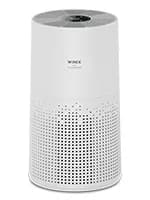 Best carbon stage for pet odor Winix C710 248 certified CFM with a carbon stage AHAM records, and no ionizer. | Lowest running cost at living-room size | 248CFM smoke AHAM VERIFIDE | |
| 4 | No photo For a large open-plan room Blueair Blue Pure 211i Max 674 certified sq ft at 9.0 CFM per watt — the most air per watt here. | Open-plan spaces above 500 sq ft | 435CFM smoke AHAM VERIFIDE |
#ad We earn a commission if you buy through this link, at no extra cost to you. How this site is funded.
The certified alternatives
Honeywell InSight HPA4300
Honeywell · model HPA4300B
#ad We earn a commission if you buy through this link, at no extra cost to you. How this site is funded.
The efficiency winner among true-HEPA units at living-room size: 229 certified smoke CADR on 31 watts, zero measured ozone, and a filter the register classifies as HEPA rather than HEPA-Type.
229 smoke / 238 dust / 245 pollen CFM · 233 PM2.5
- Certified room size
- 354 sq ft
- Energy / year
- 185 kWh
- Electricity / year
- $34
- Air per watt
- 7.4 CFM/W
- Power draw
- 31 W
- Noise
- Not published
- Measured ozone
- 0 ppb
- Filter class
- HEPA
- AHAM rule, 300 sq ft
- Clears it (200 needed)
No ionizer — filtration only
Both registers classify this unit as fan-and-filter only.
229 certified smoke CADR across 354 certified square feet at 7.4 CFM per watt, with 0.00 ppb measured ozone and a filter the register records as HEPA rather than HEPA-Type — a classification neither Blueair nor LEVOIT earns. $34 a year to run.
The honest con: no published noise figure and no washable pre-filter, and none of the app control, oscillation or air-quality display a Dyson buyer is partly paying for. On features this is not a comparable product; on verified air movement per watt it beats everything here.
LEVOIT Core 400S
LEVOIT · model Core 400S (LAP-C401S)
#ad We earn a commission if you buy through this link, at no extra cost to you. How this site is funded.
The best-selling unit in the category, and a clean example of the coverage gap: ENERGY STAR certifies it for 358 square feet while the box advertises 1,718.
231 smoke / 240 dust / 259 pollen CFM · 236 PM2.5
- Certified room size
- 358 sq ft
- Advertised coverage
- 1,718 sq ft at 1 air change per hour
- Energy / year
- 237 kWh
- Electricity / year
- $43
- Air per watt
- 5.8 CFM/W
- Power draw
- 38 W
- Noise
- 22-52 dB
- Measured ozone
- 0 ppb
- Filter class
- HEPA-Type
- AHAM rule, 300 sq ft
- Clears it (200 needed)
No ionizer — filtration only
ENERGY STAR classifies this unit 'Fan and Filter' and measures 0.00 ppb ozone. LEVOIT markets it as ozone free.
This is the machine people actually compare a Dyson against, and it answers the comparison with numbers: 231 certified smoke CADR across 358 certified square feet, 0.00 ppb measured ozone, no ion generator, and a published 22-52 dB noise range — the one specification where it meets Dyson on Dyson’s own terms. At $43 a year it is cheap to leave running.
The honest con: the register classifies its filter HEPA-Type despite the “True HEPA” name, it is absent from AHAM’s directory so it sits in one register rather than two, and it is a plain box with a fan in it.
Winix C710
Winix · model C710
#ad We earn a commission if you buy through this link, at no extra cost to you. How this site is funded.
Nearly the same air movement as the AT41 for a third less electricity a year. If you can find it, it is the cheapest certified 380-plus square-foot unit to run.
248 smoke / 252 dust / 262 pollen CFM · 250 PM2.5
- Certified room size
- 384 sq ft
- Energy / year
- 235 kWh
- Electricity / year
- $43
- Air per watt
- 6.2 CFM/W
- Power draw
- 45 W
- Noise
- Not published
- Measured ozone
- 1 ppb
- Filter class
- HEPA-Type
- AHAM rule, 350 sq ft
- Clears it (234 needed)
No ionizer — filtration only
AHAM classifies this model 'Fan with Filter'.
248 certified smoke CADR across 384 AHAM-certified square feet, with a carbon stage the register records — the part that addresses litter box and wet-dog odor, which HEPA media does nothing about. A certified 235 kWh a year, or $43, and no ion generator.
The honest con: ENERGY STAR classifies the filter HEPA-Type and measures 1 ppb of ozone rather than zero, and Winix publishes no filter interval or price for it that we could source — so half its running cost is unknown before you buy.
Blueair Blue Pure 211i Max
Blueair · model 3613111100 (Blue Pure 211i Max)
#ad We earn a commission if you buy through this link, at no extra cost to you. How this site is funded.
The most air per watt of anything here and by some distance the largest certified coverage — 674 square feet. It does carry an ion generator, which is the reason it is not our asthma pick.
435 smoke / 453 dust / 450 pollen CFM · 444 PM2.5
- Certified room size
- 674 sq ft
- Energy / year
- 256 kWh
- Electricity / year
- $47
- Air per watt
- 9 CFM/W
- Power draw
- 44 W
- Noise
- Not published
- Measured ozone
- 2 ppb
- Filter class
- HEPA-Type
Ion generator — fitted
The two registers disagree: AHAM classifies this model 'Fan Filter with Ion Generator' while ENERGY STAR records it as 'Fan and Filter'. ENERGY STAR's measured ozone figure is 2 ppb. We report both rather than picking the flattering one.
If the appeal of the Dyson is covering a big open-plan space, this is the certified answer: 674 certified square feet — the largest coverage we cover — at 9.0 CFM per watt, the best air-per-watt figure on this site, for $47 a year.
The honest con: AHAM classifies it “Fan Filter with Ion Generator” while ENERGY STAR records “Fan and Filter” and measures 2 ppb of ozone, and Blueair does not document the stage as switchable. We print both classifications; for an asthma household the Honeywell above measures zero.
Electricity costs on this page use 18.34¢ per kWh, the U.S. average residential price for June 2026 from the U.S. Energy Information Administration, Electric Power Monthly, Table 5.3. Your rate is on your bill and is probably not this one; multiply the kWh figure by your own rate and you have your number.
If you buy the Dyson anyway
That is a perfectly reasonable decision, and it is worth saying plainly that nothing on this page is evidence a Dyson cleans air badly. It is evidence that nobody outside Dyson has published a figure for how well it does. Those are different claims and we are only making the second one.
Two things worth doing if you go that way. Size conservatively rather than to the headline square footage, because an unqualified coverage claim in this category has historically meant a figure computed at one air change per hour. And price the filters before you commit — Dyson’s are sealed cartridges on a replacement schedule rather than something you rinse, and filter cost over three years reorders more purchase decisions than any other number we publish.
If you would rather buy something you can check, the cat-allergy roundup ranks certified machines for a continuously shedding source, and how we pick sets out the method in full, including the places it runs out.
Common questions
Do Dyson air purifiers help with cat allergies?
Is a Dyson air purifier good for pet hair?
LEVOIT Core 400S vs Dyson — which should I buy?
Why is Dyson not AHAM certified?
Do Dyson air purifiers produce ozone?
Sources
- AHAM VERIFIDE directory of certified room air cleaners
- ENERGY STAR certified room air cleaners database
- Dyson — air purifier testing standards (POLAR and CADR)
- Dyson newsroom — air purifier test standards: CADR and POLAR
- EPA — Guide to Air Cleaners in the Home
Figures were read on the dates shown against each source. If one has changed, or if we have got something wrong, tell us and we will correct the page.
Read next
- Pet allergiesThe Best Air Purifiers for Cat AllergiesWhy cat allergen needs continuous running, and the certified units that make that affordable and quiet.
- CADR & costWhat CADR actually meansThe cornerstone explainer: what CADR measures, why it resists gaming, and certified versus claimed.
- Pet allergiesThe Best Air Purifiers for PetsCertified CADR picks for a pet household, with annual running cost computed and every ionizer disclosed.