Honeywell vs Blueair
Two ranges that disagree about almost everything a register records. One is the most efficient thing here and ionizes the air; the other stops at mid-size and measures a flat zero on every model.
#ad We earn a commission if you buy through this link, at no extra cost to you. How this site is funded. Prices last checked November 3, 2026.
Blueair if the room is large and nobody in it has asthma; Honeywell if anyone does. Blueair’s Max range holds the best air-per-watt figures on this site and reaches 674 certified square feet against Honeywell’s ceiling of 398 — but every Blueair we cover carries an ion generator and measures 1 to 5 ppb of ozone, while every Honeywell measures 0.00 with no ion stage and a filter the register records as HEPA rather than HEPA-Type.
This is the cleanest brand split on the site after Honeywell against LEVOIT, and it splits along a different axis. The LEVOIT comparison is about what each company publishes; this one is about what the registers measured.
How we judged it
Range against range, on the four fields a certification program actually produces: certified smoke CADR and the room it is certified for, air delivered per watt, measured ozone, and how the register classifies the filter. Both brands are well represented in the registers — Honeywell in both AHAM and ENERGY STAR, Blueair in both — so unlike the Coway and Dyson comparisons on this site there is no absence to argue about. Everything below was measured by somebody other than the company selling the machine.
The two ranges, side by side
| Model | Smoke CADR | Certified room | CFM per watt | Measured ozone | Filter class | Ion stage |
|---|---|---|---|---|---|---|
| Honeywell InSight HPA4100 | 109 CFM | 169 sq ft | 6.9 | 0.00 ppb | HEPA | None |
| Honeywell InSight HPA4300 | 229 CFM | 354 sq ft | 7.4 | 0.00 ppb | HEPA | None |
| Honeywell HPA6000 | 257 CFM | 398 sq ft | 7.3 | 0.00 ppb | Not classified | None |
| Blueair Blue Pure 411i Max | 145 CFM | 225 sq ft | 8.2 | 2.00 ppb | HEPA-Type | Fitted |
| Blueair DustMagnet 5440i | 216 CFM | 335 sq ft | 5.9 | 1.00 ppb | HEPA-Type + carbon | Fitted |
| Blueair Blue Pure 311i Max | 283 CFM | 439 sq ft | 8.4 | 2.00 ppb | HEPA-Type | Fitted |
| Blueair Blue Pure 211+ | 348 CFM | 539 sq ft | 5.8 | 5.00 ppb | HEPA-Type | Fitted |
| Blueair Blue Pure 211i Max | 435 CFM | 674 sq ft | 9 | 2.00 ppb | HEPA-Type | Fitted |
Read down the last three columns and the comparison is already over in one direction, and down the first three it is already over in the other. That is unusual: most brand pairs on this site trade blows within a column. These two disagree column by column.
The shape of each range explains the table
Honeywell sells one idea at three sizes. The InSight line steps 109 to 229 to 257 CFM with the same fan-and-filter classification, the same measured zero and air-per-watt figures inside half a point of each other. Pick the size and you have picked the machine; there is no model in the range that behaves differently from the others.
Blueair sells two ideas at once. The Max i-series — 411i, 311i, 211i — is the current platform and holds the efficiency figures this brand is known for. The DustMagnet and the older Blue Pure 211+ are different machines built around different priorities, and they post 5.9 and 5.8 CFM per watt against the i-series’ 8.2 to 9. That is why a claim about “Blueair efficiency” needs a model number attached and a claim about Honeywell does not.
Matching either range to a real room
AHAM’s two-thirds rule turns the certified CADR into the largest room a machine covers. For the Honeywells that is 163, 343 and 385 square feet; for the Blueairs 217, 324, 424, 522 and 652.
Two readings follow. Below about 343 square feet the ranges overlap completely and the decision is the ozone column, not the capability. Above about 385 square feet Honeywell has nothing to offer and the decision makes itself — which is also the point at which this site would rather you looked at a brand that posts a zero at that size. In a pet household, size harder: at 6 air changes an hour rather than AHAM’s 4.8, the 211i Max covers 543 square feet and the HPA4300 286 — do it for your own room.
Where Blueair wins, and by how much
Reach. Honeywell’s largest certified room is 398 square feet. Blueair’s 211i Max is certified for 674 — 69% more room, and 69% more certified air. If your room is genuinely large, Honeywell does not make a machine for it and no amount of preference changes that — what actually covers a large room.
Air per watt, at the top of the range. 9 and 8.4 CFM per watt are the two best figures among every machine on this site except the Coway Airmega ProX. The 311i Max delivers 24% more certified air than the HPA4300 while using 193 kWh a year against 185 — more output for less electricity, which is the rarest combination in this category.
Electricity costs on this page use 18.34¢ per kWh, the U.S. average residential price for June 2026 from the U.S. Energy Information Administration, Electric Power Monthly, Table 5.3. Your rate is on your bill and is probably not this one; multiply the kWh figure by your own rate and you have your number.
The efficiency claim, properly qualified
“Blueair is the efficient brand” is true of the Max i-series and false of the rest of the range, and the gap is large enough to matter. The DustMagnet 5440i posts 5.9 CFM per watt and the older Blue Pure 211+ posts 5.8 — both below every Honeywell we cover, including the smallest.
So the honest version is narrower: Blueair’s current Max line is the most efficient mainstream range here, and two older or specialized Blueairs are among the least. Buying the brand does not get you the efficiency; buying the i-series does.
Where Honeywell is unbeaten
The ozone column. Every Honeywell in the table measures 0.00 ppb. Every Blueair measures something: 1 ppb on the DustMagnet, 2 on each of the Max models, 5 on the older 211+. None of that is dangerous — California’s Air Resources Board certifies portable air cleaners against a 50 ppb limit and these are a fraction of it — but EPA is clear that ozone is a lung irritant and that devices which generate it as a byproduct are worth knowing about.
The ion stage. AHAM classifies every Blueair Max model as carrying an ion generator, and this site has found no Blueair documentation saying it can be switched off. Every Honeywell is classified fan-and-filter. For a household with asthma in it, that is the difference between a machine you have to think about and one you do not — what the ionizing question actually turns on.
The filter field. The HPA4300 and HPA4100 are recorded HEPA; every Blueair is recorded HEPA-Type. Blueair markets HEPASilent, which is a real engineering approach rather than a filter grade, and the register is unmoved by it. The HPA6000 is the exception on Honeywell’s side — its filter field is blank rather than classified, which its own review covers in detail — the one place the two registers contradict each other.
What neither brand will tell you
Both are unusually quiet about the half of ownership that recurs. Neither publishes a noise figure for any model we cover. Neither publishes a replacement filter price paired with an interval, which is what you would need to compute a yearly cost — three machines on this site manage that and none of them is a Honeywell or a Blueair — the full table of what each manufacturer publishes.
Blueair does document a washable pre-filter on parts of the range in its own materials, and Honeywell documents a pre-filter and an activated carbon layer without quantifying either. Neither company gives you a carbon mass, so neither can be assessed on odor performance by anybody — why carbon mass matters.
Who each brand is actually for
Buy Honeywell if anyone in the house has asthma or a respiratory condition, if you want a filter the register calls HEPA rather than HEPA-Type, or if the room is under about 385 square feet and you would rather have the measured zero than the extra efficiency. The InSight HPA4300 is the machine this site recommends more than any other.
Buy Blueair if the room is larger than Honeywell reaches, if the electricity bill matters more to you than a 2 ppb reading, or if you want the most certified air available for a given wattage and nobody in the room has a reason to avoid an ion stage. Stay in the Max i-series; the efficiency argument does not survive outside it.
Buy neither if you want a large room and a measured zero. That combination exists and it is Coway: the Airmega 450 is certified for 687 square feet at 0.00 ppb with no ion stage — Blueair against Coway, in full.
Quick picks
Two from each range, ranked on certified CADR against the room each is certified for — with the ozone and ion-stage columns carried onto every card.
| # | Product | Best for | Certified CADR | Price |
|---|---|---|---|---|
| 1 | 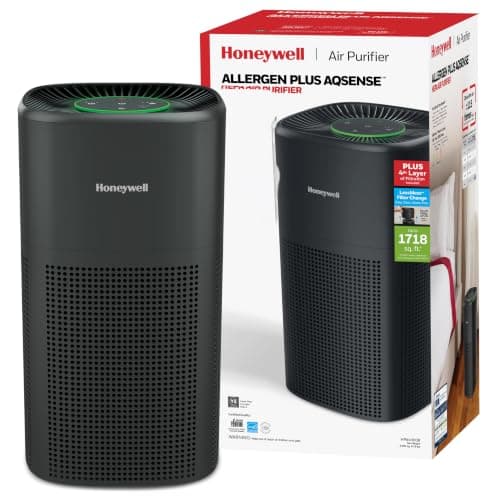 Best Honeywell, and the pick for an asthma household Honeywell InSight HPA4300 229 certified CFM, filter recorded HEPA, 0.00 ppb measured and no ion stage. | True HEPA on the lowest power draw | 229CFM smoke AHAM VERIFIDE | |
| 2 | 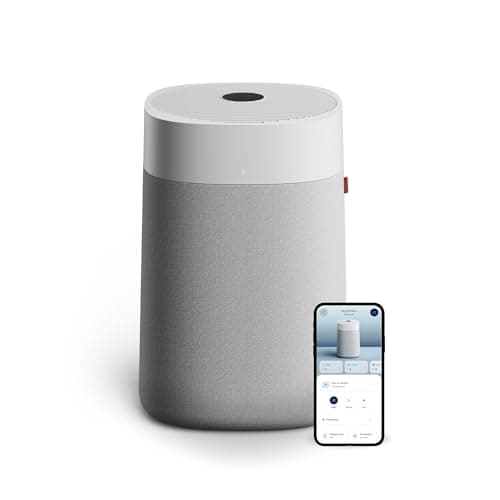 Best Blueair, and the most air here Blueair Blue Pure 211i Max 435 certified CFM across 674 certified sq ft at 9.0 CFM per watt. | Open-plan spaces above 500 sq ft | 435CFM smoke AHAM VERIFIDE | |
| 3 | 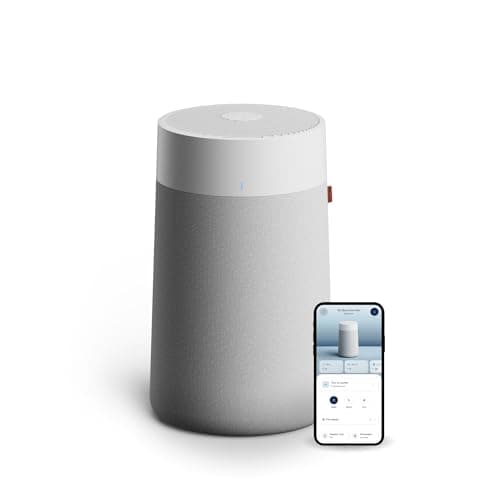 The Blueair for a bedroom-sized room Blueair Blue Pure 311i Max 283 certified CFM at 8.4 CFM per watt — 193 kWh a year. | Mid-size rooms on a small electricity bill | 283CFM smoke AHAM VERIFIDE | |
| 4 | 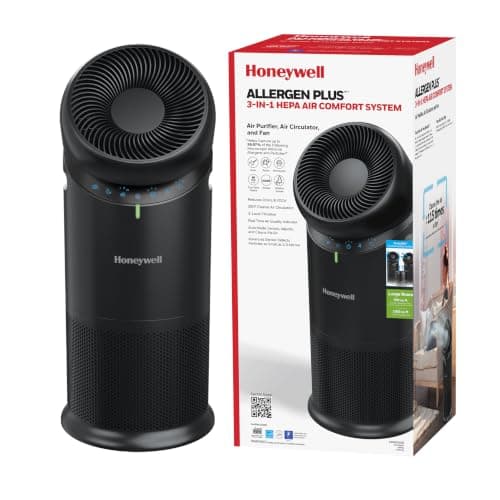 Honeywell's largest Honeywell HPA6000 257 certified CFM across 398 certified sq ft, still at 0.00 ppb. | Large living rooms, true HEPA | 257CFM smoke AHAM VERIFIDE |
#ad We earn a commission if you buy through this link, at no extra cost to you. How this site is funded. Prices last checked November 3, 2026.
The picks
Honeywell InSight HPA4300
Honeywell · model HPA4300B
#ad We earn a commission if you buy through this link, at no extra cost to you. How this site is funded. Prices last checked November 3, 2026.
The efficiency winner among true-HEPA units at living-room size: 229 certified smoke CADR on 31 watts, zero measured ozone, and a filter the register classifies as HEPA rather than HEPA-Type.
229 smoke / 238 dust / 245 pollen CFM · 233 PM2.5
- Certified room size
- 354 sq ft
- Energy / year
- 185 kWh
- Electricity / year
- $34
- Air per watt
- 7.4 CFM/W
- Power draw
- 31 W
- Noise
- Not published
- Measured ozone
- 0 ppb
- Filter class
- HEPA
- AHAM rule, 300 sq ft
- Clears it (200 needed)
No ionizer — filtration only
Both registers classify this unit as fan-and-filter only.
229 certified smoke CADR across 354 certified square feet at 7.4 CFM per watt, listed in both registers, filter recorded HEPA, 0.00 ppb measured, no ion stage, about $34 a year. Our full review.
The honest con: it is beaten on air per watt by both Blueair Max models and cannot reach their rooms at all, and Honeywell publishes no noise figure, filter price or interval — so the recurring cost is a blank.
Blueair Blue Pure 211i Max
Blueair · model 3613111100 (Blue Pure 211i Max)
#ad We earn a commission if you buy through this link, at no extra cost to you. How this site is funded. Prices last checked November 3, 2026.
The most air per watt of anything here and by some distance the largest certified coverage — 674 square feet. It does carry an ion generator, which is the reason it is not our asthma pick.
435 smoke / 453 dust / 450 pollen CFM · 444 PM2.5
- Certified room size
- 674 sq ft
- Energy / year
- 256 kWh
- Electricity / year
- $47
- Air per watt
- 9 CFM/W
- Power draw
- 44 W
- Noise
- Not published
- Measured ozone
- 2 ppb
- Filter class
- HEPA-Type
- AHAM rule, 600 sq ft
- Clears it (400 needed)
Ion generator — fitted
The two registers disagree: AHAM classifies this model 'Fan Filter with Ion Generator' while ENERGY STAR records it as 'Fan and Filter'. ENERGY STAR's measured ozone figure is 2 ppb. We report both rather than picking the flattering one.
435 certified CFM across 674 certified square feet at 9 CFM per watt — the most certified air of anything here outside the Coway ProX, for about $47 a year. Our full review.
The honest con: AHAM records an ion generator with no documented off switch, ENERGY STAR measures 2 ppb rather than zero, the filter is classified HEPA-Type, and Blueair publishes neither a noise figure nor a filter schedule.
Blueair Blue Pure 311i Max
Blueair · model 3332111100 (Blue Pure 311i Max)
#ad We earn a commission if you buy through this link, at no extra cost to you. How this site is funded. Prices last checked November 3, 2026.
439 certified square feet on under 30 watts. The best power-to-coverage ratio at mid size, with the same ion-generator caveat as the rest of the Max range.
283 smoke / 314 dust / 365 pollen CFM · 298 PM2.5
- Certified room size
- 439 sq ft
- Energy / year
- 193 kWh
- Electricity / year
- $35
- Air per watt
- 8.4 CFM/W
- Power draw
- 29.6 W
- Noise
- Not published
- Measured ozone
- 2 ppb
- Filter class
- HEPA-Type
- AHAM rule, 400 sq ft
- Clears it (267 needed)
Ion generator — fitted
AHAM classifies this model 'Fan Filter with Ion Generator'; ENERGY STAR records 'Fan and Filter' with 2 ppb measured ozone.
283 certified CFM across 439 certified square feet at 8.4 CFM per watt — more air than the HPA4300 on fewer kilowatt-hours, at $35 a year. Our full review.
The honest con: the same 2 ppb and the same undocumented ion stage as the rest of the Max range, which is exactly the trade this page is about — and the same two published blanks.
Honeywell HPA6000
Honeywell · model HPA6000B
#ad We earn a commission if you buy through this link, at no extra cost to you. How this site is funded. Prices last checked November 3, 2026.
More certified air movement than the HPA4300 for four more watts, and the same zero on ozone. The sensible step up if your room is nearer 400 square feet.
257 smoke / 262 dust / 285 pollen CFM · 259 PM2.5
- Certified room size
- 398 sq ft
- Energy / year
- 207 kWh
- Electricity / year
- $38
- Air per watt
- 7.3 CFM/W
- Power draw
- 34.9 W
- Noise
- Not published
- Measured ozone
- 0 ppb
- Filter class
- HEPA
- AHAM rule, 350 sq ft
- Clears it (234 needed)
257 certified CFM across 398 certified square feet at 7.3 CFM per watt with 0.00 ppb measured and no ion stage — the biggest room Honeywell certifies for, at about $38 a year. Our full review.
The honest con: its filter field is blank in both registers rather than classified HEPA, which is the one gap in Honeywell’s otherwise unbroken record — and 398 square feet is still well short of what the 211i Max covers.
Common questions
Is Blueair better than Honeywell?
Do Blueair purifiers produce ozone?
Which brand has the better filter?
Which is cheaper to run?
Which should I buy for a large room?
Sources
- AHAM VERIFIDE directory of certified room air cleaners
- ENERGY STAR certified room air cleaners database
- AHAM — air filtration standards and the two-thirds rule
- EPA — Ozone Generators that are Sold as Air Cleaners
- EIA — average retail price of electricity
Figures were read on the dates shown against each source. If one has changed, or if we have got something wrong, tell us and we will correct the page.
Read next
- CADR & costHoneywell vs LEVOITHoneywell wins filter classification and air per watt across the range. LEVOIT wins published noise, published filter prices and the biggest room. Ozone is a tie at zero.
- CADR & costBlueair vs LEVOITBlueair wins air-per-watt by a distance. Every Blueair here also has an ion stage and a measured ozone figure; every LEVOIT reads 0.00.
- CADR & costBlueair vs CowayBlueair: 8.2-9.0 CFM per watt and 2 ppb of measured ozone with an ion stage the registers dispute. Coway: 0.00 ppb, washable pre-filters, and the biggest certified machine here.
- AllergiesHoneywell InSight HPA4300 ReviewThe most efficient HEPA-classified unit here, with zero measured ozone and no ion stage. Particle-only though, and Honeywell publishes no noise figure, filter price or interval.
- Room sizeBlueair Blue Pure 211i Max ReviewThe highest certified output and the best air per watt on this site, against 2 ppb measured ozone and an ion stage the registers disagree about.