Honeywell HPA6000 Review
The bigger InSight-era Honeywell, and the only one a register credits with a carbon stage. It is also the one that quietly gives up an automatic mode and a little efficiency to get there.
#ad We earn a commission if you buy through this link, at no extra cost to you. How this site is funded. Prices last checked November 3, 2026.
The Honeywell to buy when you want more air than the HPA4300 and you care about odor — with the caveat that the carbon stage is recorded by one register and not the other. 257 CFM certified smoke CADR, 285 on pollen, 398 certified square feet, 0 ppb measured ozone and no ion stage, for $38 a year. It has no automatic mode and no Wi-Fi, which its smaller sibling does.
This page exists because of a gap the HPA4300 review opened. That machine is the best certified value on this site for a particle problem and it has no carbon stage on record, so it does nothing for smell. The obvious next question — is there a Honeywell that does? — had no answer here until now. There is, sort of, and the hedge in that sentence is the whole story.
The carbon stage, and why the answer is “sort of”
Both registers list this model. They do not describe its filter the same way.
| Register | Filter recorded | Supplemental stage |
|---|---|---|
| ENERGY STAR | HEPA, plus a second stage | Activated Carbon |
| AHAM VERIFIDE | HEPA | None — supplemental filter recorded as No |
Why it matters practically: carbon is the only mechanism in a portable machine that touches a gas, and odor is a gas. A HEPA filter captures particles and does nothing for smell. So the difference between the two records is the difference between a machine that might help with litter box or cooking odor and one that definitely will not — what carbon actually does, and how much of it you need.
Our own position: we would not buy this machine for odor. Where a manufacturer is serious about gases it says how much carbon is in the filter and what the carbon filter costs to replace, and Honeywell does neither. We would buy it for air, and treat any odor benefit as a bonus that one register thinks exists.
The certified record, in full
| Certified figure | Value | Register |
|---|---|---|
| Smoke CADR | 257 CFM | Both, in agreement |
| Dust CADR | 262 CFM | Both |
| Pollen CADR | 285 CFM — its best number | Both |
| PM2.5 CADR | 259 CFM | Both |
| Suggested room size | 398 sq ft | Both, in agreement |
| Annual energy use | 207 kWh | Both |
| Watts at the smoke setting | 34.9 W | AHAM |
| Integrated Energy Factor | 7.3 CFM/W | Both |
| Pollen CADR per watt | 8.01 CFM/W | ENERGY STAR |
| Dust CADR per watt | 7.36 CFM/W | ENERGY STAR |
| Smoke CADR per watt | 7.30 CFM/W | ENERGY STAR |
| Technology | Fan and filter only — no ion stage | Both |
| Measured ozone | 0 ppb | ENERGY STAR |
| Automatic mode | None | ENERGY STAR |
| Wi-Fi or app control | No | ENERGY STAR |
| ENERGY STAR Most Efficient | No | ENERGY STAR |
| Date certified | 2025-03-24 | ENERGY STAR |
| Markets | United States and Canada | ENERGY STAR |
The number that stands out
285 CFM on pollen is this machine’s own best certified number — notably higher than its smoke and dust figures — and the best pollen figure of any Honeywell we cover. ENERGY STAR puts it at 8.01 CFM per watt on pollen against 7.30 on smoke, so the same machine is meaningfully more efficient against the larger particle.
That is not a quirk of this unit so much as a property of particle size. Pollen grains are large and comparatively easy to intercept; smoke is the hardest of the three test aerosols, which is why this site ranks on the smoke figure rather than the flattering one. But if your complaint is seasonal and pollen-driven rather than year-round dust, the pollen column is the one that describes your problem — which allergens sit at which particle size.
What it gives up to the smaller machine
A review of a bigger sibling usually reads as a straight upgrade. This one does not, and the differences run in both directions.
| HPA6000 | HPA4300 | Which wins | |
|---|---|---|---|
| Smoke CADR | 257 CFM | 229 CFM | 6000 |
| Pollen CADR | 285 CFM | 245 CFM | 6000 |
| Certified room | 398 sq ft | 354 sq ft | 6000 |
| Efficiency | 7.3 CFM/W | 7.4 CFM/W | 4300 |
| Electricity a year | $38 | $34 | 4300 |
| Automatic mode | None | Air quality sensor | 4300 |
| Carbon stage | Recorded by ENERGY STAR only | None on either register | 6000 |
| Measured ozone | 0 ppb | 0 ppb | Tie |
Electricity costs on this page use 18.34¢ per kWh, the U.S. average residential price for June 2026 from the U.S. Energy Information Administration, Electric Power Monthly, Table 5.3. Your rate is on your bill and is probably not this one; multiply the kWh figure by your own rate and you have your number.
What nobody publishes
The same Honeywell silence that limits the HPA4300 applies here, and it is the reason neither machine can carry a total cost of ownership on this site.
No noise figure. Honeywell publishes none and neither register records one.
No filter interval and no verifiable filter price. AHAM’s record lists no certified replacement filters for the model and points to Honeywell’s own filter shop. Without both a price and an interval, the annual filter cost is not computable, and we will not estimate it — Coway publishes both for the Airmega 400, as Alen does for the 75i and Winix for the C610, which is why those are the machines whose yearly total we can state.
No carbon mass. If ENERGY STAR’s record is the accurate one and there is activated carbon in the filter, Honeywell does not say how much. Carbon performance against gases is largely a function of mass, so a credited stage of unstated size is a weak basis for an odor purchase.
Who should buy it, and who should not
Buy it if you want a fan-and-filter machine with a measured zero on ozone for a room up to about 385 square feet, and pollen or general particle load is the complaint. It is the biggest certified Honeywell we cover and it keeps the brand’s best property — HEPA classification with no ion stage.
Do not buy it if you want the machine to run itself, because it has no automatic mode; if running cost is the deciding factor, because the HPA4300 does more air per watt for less money a year; or if odor is the actual problem, because a credited-but-unquantified carbon stage is not a good enough reason to spend the difference when machines exist that document theirs.
Quick picks
The unit reviewed, its cheaper and more efficient sibling, and the three machines we would send an odor buyer to instead.
| # | Product | Best for | Certified CADR | Price |
|---|---|---|---|---|
| 1 | 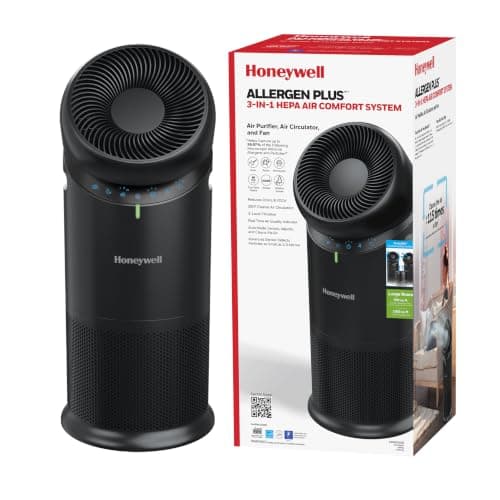 The unit reviewed Honeywell HPA6000 257 certified CFM, 285 on pollen, 0.00 ppb, and the only Honeywell here with carbon on any register. | Large living rooms, true HEPA | 257CFM smoke AHAM VERIFIDE | |
| 2 | 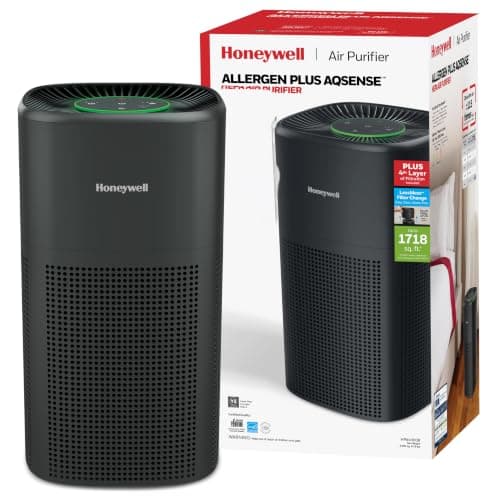 If you do not need the carbon Honeywell InSight HPA4300 Less air, but better efficiency, an automatic mode the 6000 lacks, and a lower bracket. | True HEPA on the lowest power draw | 229CFM smoke AHAM VERIFIDE | |
| 3 | 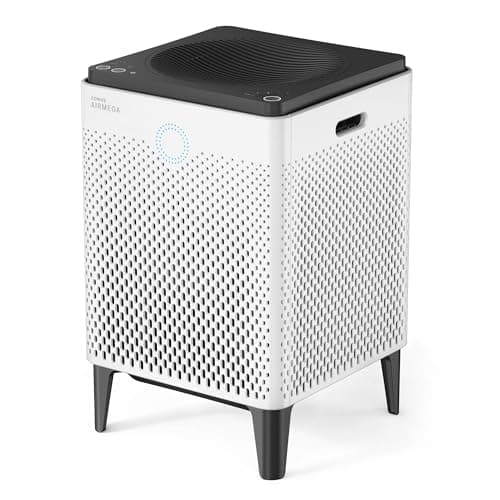 If odor is the main event Coway Airmega 400 376 certified CFM, carbon both registers agree on, washable pre-filters and a published filter price. | Large rooms, verified Coway | 376CFM smoke ENERGY STAR verified | |
| 4 | 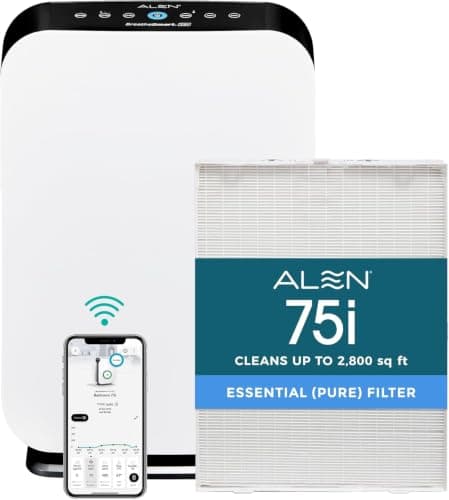 If you want the carbon priced and dated Alen BreatheSmart 75i 370 certified CFM and a named Odor filter Alen gives both a price and an interval for. | Very large rooms, long filter intervals | 370CFM smoke ENERGY STAR verified | |
| 5 | 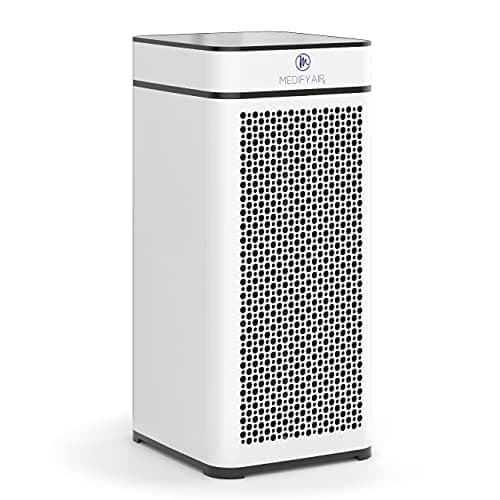 Same size class, nothing bolted on Medify Air MA-40 245 certified CFM across 380 sq ft with 0.00 ppb and no ion stage. | Straightforward mid-size coverage | 245CFM smoke ENERGY STAR verified |
#ad We earn a commission if you buy through this link, at no extra cost to you. How this site is funded. Prices last checked November 3, 2026.
The alternatives, and what each one buys you
Honeywell HPA6000
Honeywell · model HPA6000B
#ad We earn a commission if you buy through this link, at no extra cost to you. How this site is funded. Prices last checked November 3, 2026.
More certified air movement than the HPA4300 for four more watts, and the same zero on ozone. The sensible step up if your room is nearer 400 square feet.
257 smoke / 262 dust / 285 pollen CFM · 259 PM2.5
- Certified room size
- 398 sq ft
- Energy / year
- 207 kWh
- Electricity / year
- $38
- Air per watt
- 7.3 CFM/W
- Power draw
- 34.9 W
- Noise
- Not published
- Measured ozone
- 0 ppb
- Filter class
- HEPA
- AHAM rule, 385 sq ft
- Clears it (257 needed)
257 certified smoke CADR and 285 on pollen across 398 certified square feet on 34.9 watts — $38 a year. In both registers, filter recorded HEPA, 0 ppb measured, no ion stage, and a carbon stage ENERGY STAR credits it with.
The honest con: no automatic mode and no Wi-Fi, slightly worse efficiency than the cheaper HPA4300, AHAM disagrees that the carbon stage is there at all, and Honeywell publishes no noise figure, filter price or interval.
Honeywell InSight HPA4300
Honeywell · model HPA4300B
#ad We earn a commission if you buy through this link, at no extra cost to you. How this site is funded. Prices last checked November 3, 2026.
The efficiency winner among true-HEPA units at living-room size: 229 certified smoke CADR on 31 watts, zero measured ozone, and a filter the register classifies as HEPA rather than HEPA-Type.
229 smoke / 238 dust / 245 pollen CFM · 233 PM2.5
- Certified room size
- 354 sq ft
- Energy / year
- 185 kWh
- Electricity / year
- $34
- Air per watt
- 7.4 CFM/W
- Power draw
- 31 W
- Noise
- Not published
- Measured ozone
- 0 ppb
- Filter class
- HEPA
- AHAM rule, 343 sq ft
- Clears it (229 needed)
No ionizer — filtration only
Both registers classify this unit as fan-and-filter only.
Less air for less money to run: 229 certified CFM on 31 watts, 7.4 CFM per watt — the best figure of any HEPA-classified, ion-free machine we cover — at $34 a year, and it has the air-quality sensor this one lacks. Our full review.
The honest con: no carbon stage on either register, so no odor mechanism at all, and a materially smaller certified room at 354 square feet.
Coway Airmega 400
Coway · model Airmega 400 (AP-2015F)
#ad We earn a commission if you buy through this link, at no extra cost to you. How this site is funded. Prices last checked November 3, 2026.
The Coway that is actually in a certification register: 376 certified smoke CADR, 583 square feet, zero measured ozone. If you want a Coway, this is the one with third-party numbers.
376 smoke / 384 dust / 409 pollen CFM · 380 PM2.5
- Certified room size
- 583 sq ft
- Advertised coverage
- 3,120 sq ft in 60 minutes
- Energy / year
- 366 kWh
- Electricity / year
- $67
- Air per watt
- 6.1 CFM/W
- Power draw
- 66 W
- Noise
- 22-52 dB(A)
- Measured ozone
- 0 ppb
- Filter class
- Composite Filter
- AHAM rule, 470 sq ft
- Clears it (314 needed)
No ionizer — filtration only
ENERGY STAR classifies this unit 'Fan and Filter', 0.00 ppb measured ozone.
The machine to buy when the carbon question is the deciding one. 376 certified smoke CADR, 0 ppb measured, no ion stage, washable pre-filters on both faces, and the only published filter price in this category at $129 a set. Our full review.
The honest con: a much higher price bracket, $67 a year in electricity plus $129 in filters, and ENERGY STAR declines to classify its filter HEPA or HEPA-Type at all.
Alen BreatheSmart 75i
Alen · model BreatheSmart 75i
#ad We earn a commission if you buy through this link, at no extra cost to you. How this site is funded. Prices last checked November 3, 2026.
The highest certified smoke CADR here at 370, a genuinely long filter life, and an ionizer you can switch off. Alen publishes its ozone figure both ways, which almost nobody does.
370 smoke / 351 dust / 431 pollen CFM · 360 PM2.5
- Certified room size
- 574 sq ft
- Advertised coverage
- 2,800 sq ft every hour
- Energy / year
- 304 kWh
- Electricity / year
- $56
- Air per watt
- 6.9 CFM/W
- Power draw
- 55 W
- Noise
- 25-51 dBA
- Measured ozone
- 1 ppb
- Filter class
- HEPA-Type
- AHAM rule, 460 sq ft
- Clears it (307 needed)
Ionizer — can be switched off
Alen publishes '0 PPM when disengaged, less than 0.001 PPM with ionizer engaged'. ENERGY STAR measures 1 ppb.
370 certified smoke CADR across 574 certified square feet, and the one manufacturer here that treats carbon as a specification rather than a marketing word: a named Odor filter with both a price and a published replacement window. Our full review.
The honest con: much the highest price bracket on this page, an ionizer — switchable, and Alen publishes its ozone figure both ways, which almost nobody does — and $56 a year.
Medify Air MA-40
Medify Air · model MA-40-V4.0
#ad We earn a commission if you buy through this link, at no extra cost to you. How this site is funded. Prices last checked November 3, 2026.
Certified for 380 square feet with zero measured ozone. Middling efficiency, but a straightforward mechanical machine with nothing bolted on.
245 smoke / 257 dust / 263 pollen CFM · 250 PM2.5
- Certified room size
- 380 sq ft
- Energy / year
- 261 kWh
- Electricity / year
- $48
- Air per watt
- 5.6 CFM/W
- Noise
- Not published
- Measured ozone
- 0 ppb
- Filter class
- HEPA-Type
- AHAM rule, 380 sq ft
- Short (254 needed)
No ionizer — filtration only
ENERGY STAR classifies this unit 'Fan and Filter', 0.00 ppb measured ozone.
A straightforward mechanical alternative at almost exactly the same certified size: 245 CFM across 380 certified square feet, 0 ppb measured, no ion stage. Our full review.
The honest con: mid-pack efficiency at 5.6 CFM per watt and $48 a year, ENERGY STAR records the filter HEPA-Type rather than HEPA, and “medical grade” is marketing rather than a filter classification.
What this review cannot tell you
Certified CADR is measured on a new filter in a sealed chamber against tobacco smoke, dust and pollen. Your filter will be six months old and your door will open. And we cannot tell you which register is right about the carbon: both are official, both describe model HPA6000B, and neither publishes the working behind its entry.
What we can do is show every number we used and where it came from, including the one place the sources contradict each other, so you can reach your own conclusion from the same evidence we had.
Common questions
Does the Honeywell HPA6000 have a carbon filter?
Is the HPA6000 better than the HPA4300?
Is the Honeywell HPA6000 good for pollen?
Does the Honeywell HPA6000 have an auto mode or Wi-Fi?
How much does the HPA6000 cost to run?
Sources
- AHAM VERIFIDE directory of certified room air cleaners
- AHAM — air filtration standards and the two-thirds sizing rule
- ENERGY STAR certified room air cleaners database
- EPA — Guide to Air Cleaners in the Home
- Honeywell filters and accessories (the replacement source AHAM points to)
Figures were read on the dates shown against each source. If one has changed, or if we have got something wrong, tell us and we will correct the page.
Read next
- AllergiesHoneywell InSight HPA4300 ReviewThe most efficient HEPA-classified unit here, with zero measured ozone and no ion stage. Particle-only though, and Honeywell publishes no noise figure, filter price or interval.
- AllergiesThe Best Air Purifiers for PollenRanked on the certified pollen CADR rather than the smoke figure, which moves several machines up the table.
- CADR & costTrue HEPA vs HEPA-TypeWhy 'True HEPA' certifies nothing, and which units the registers actually classify as HEPA.
- CADR & costHoneywell vs CowayHoneywell: HEPA on every model, best efficiency under 400 sq ft, nothing published about noise or filters. Coway: certified to 894 sq ft with washable pre-filters — and one model in no register.