Coway Airmega 400 vs Airmega 450
Two certified Coways one size apart. The larger one wins by more than the size step: it is also the more efficient machine and the one with the clearer filter classification.
#ad We earn a commission if you buy through this link, at no extra cost to you. How this site is funded. Prices last checked September 23, 2026.
Buy the Airmega 450 if your space runs from about 564 to 664 square feet — the 400 cannot certifiably cover it and the 450 can. Under 564 square feet either machine does the job, and the 450 is still the more efficient one with the clearer filter classification; the 400’s only edge is a quieter published noise range. Both measure 0.00 ppb ozone with no ionizer.
These are the two Coways most large-room buyers end up choosing between, and both are in the ENERGY STAR register. That makes this a rarer comparison than it sounds: every airflow, room-size and energy figure in the first table below was measured under certification rather than copied from a box.
The usual assumption is that a bigger machine buys its coverage with efficiency. Here it does not. The 450 moves 18% more certified air across 18% more certified room on 6% more certified energy, and the register rates it the more efficient of the two.
The numbers, side by side
| Airmega 400 | Airmega 450 | |
|---|---|---|
| Smoke CADR | 376 CFM | 443 CFM |
| Dust CADR | 384 CFM | 445 CFM |
| Pollen CADR | 409 CFM | 450 CFM |
| PM2.5 CADR | 380 CFM | 444 CFM |
| Certified room size | 583 sq ft | 687 sq ft |
| Two-thirds-rule room | 564 sq ft | 664 sq ft |
| Annual energy (certified) | 366 kWh | 389 kWh |
| Electricity per year | $67 | $71 |
| Air per watt | 6.1 CFM/W | 6.7 CFM/W |
| Measured ozone | 0.00 ppb | 0.00 ppb |
| Ionizer | None | None |
| Filter classification | Composite Filter | HEPA-Type |
| Power draw (Coway) | 66 W | 72 W |
| Noise range (Coway) | 22-52 dB(A) | 23.6-57.7 dB(A) |
| Pre-filter (Coway) | Washable | Vacuumable |
| Filter interval (Coway) | 1 year, by usage | 1 year or more |
| Footprint and height (Coway) | 14.8 in square, 22.8 in tall | 13 in square, 29 in tall |
Electricity costs on this page use 18.34¢ per kWh, the U.S. average residential price for June 2026 from the U.S. Energy Information Administration, Electric Power Monthly, Table 5.3. Your rate is on your bill and is probably not this one; multiply the kWh figure by your own rate and you have your number.
Where the crossover falls
AHAM’s rule of thumb asks for a certified smoke CADR of at least two-thirds of the room’s floor area at an eight-foot ceiling. Run backward, the 400’s 376 CFM clears a room of up to 564 square feet and the 450’s 443 clears 664. ENERGY STAR’s own room figures, 583 and 687, run slightly higher because they are calculated at about 4.8 air changes an hour rather than the rule’s 5.
| Room | Airmega 400 | Airmega 450 | Meets the two-thirds rule? |
|---|---|---|---|
| 350 sq ft | 8.1 ACH | 9.5 ACH | Both, with room to spare |
| 450 sq ft | 6.3 ACH | 7.4 ACH | Both |
| 564 sq ft | 5.0 ACH | 5.9 ACH | Both — the 400 exactly |
| 620 sq ft | 4.5 ACH | 5.4 ACH | 450 only |
| 664 sq ft | 4.2 ACH | 5.0 ACH | 450 — exactly |
| 750 sq ft | 3.8 ACH | 4.4 ACH | Neither |
Two practical adjustments move both crossovers. A shedding pet or a dander-allergic sleeper is a reason to aim higher than the minimum: at the six air changes an hour we use for our pet-room picks, the 400 tops out near 470 square feet and the 450 near 553. And a ceiling higher than eight feet shrinks both in proportion — the size calculator takes ceiling height as an input.
The bigger machine is the more efficient one
ENERGY STAR’s Integrated Energy Factor — CFM per watt — puts the 400 at 6.1 and the 450 at 6.7. The 450 turns the same watt into more clean air. Its extra 18% of certified output costs 6% more certified energy, which at the national average rate is $4.22 a year: $67 against $71.
That is not how a size step usually goes, though it is not unique — the Blueair 211i Max and 311i Max run the same way. Neither Coway is efficient by the standard of the best machines we cover, either. The Airmega ProX certifies 10.2 CFM per watt and uses less electricity than both machines on this page while covering more room than either.
Coway’s spec sheets blur the gap in both directions
This is the section that justifies reading the register rather than the product pages. Coway publishes its own CADR for both machines, and for the 400 it is unusually modest: 328 smoke CADR against the 376 ENERGY STAR certifies, an understatement of 15%. Most gaps we record between a manufacturer’s page and a register run the other way. For the 450, Coway publishes 439 against a certified 443, which is close.
The result is that Coway’s own CADR figures make the 450 look 34% more powerful than the 400. Its advertised coverage figures — 3,120 and 3,285 square feet at one air change an hour — make the gap look like 5%. The certified figure is 18%. The 450’s advertised coverage is roughly what its own CADR works out to at an eight-foot ceiling; the 400’s does not follow from either of its CADR figures, which is one more reason to read the certified column first.
Composite Filter against HEPA-Type
The register records the 450’s filter as HEPA-Type. It records the 400’s as a “Composite Filter” and does not classify it HEPA or HEPA-Type at all, even though Coway describes the Max2 set as activated carbon plus HEPA. Neither machine is recorded as true HEPA.
How much that should weigh is easy to overstate. Certified CADR is measured on the whole machine, so the 376 and 443 above already reflect what each filter removes at full speed. What the classification adds is a clearer statement about the filter itself, and on that axis the 450 gives you one where the 400 does not — what HEPA-Type does and does not promise.
The practical filter differences are smaller than the label difference. Both document a pre-filter you can clean — washable on the 400, vacuumable on the 450 — which in a shedding household is the part that protects the main filter from hair. Both publish a one-year interval. The 450 is sold with a choice of three filter sets, including one Coway aims at smoke, where the 400 has a single Max2 set. We could not source a replacement price for either, so filter cost is a blank on both sides rather than a point for one.
Noise, and where each one fits
The 400 is the quieter machine on paper: 22-52 dB(A) against 23.6-57.7. At the bottom of the range that is a rounding difference. At the top it is 5.7 dB, a step most people would hear. Two cautions. At top speed the 400 is also moving less air, so the comparison flatters it. And Coway does not publish CADR at each fan speed, so there is no way to tell from published data which machine is quieter when both deliver the same airflow — how we read noise figures explains why that is the number a bedroom actually needs.
The two are also differently shaped. By Coway’s dimensions the 450 stands 29 inches tall on a 13-inch-square base; the 400 is 22.8 inches tall on a base 14.8 inches square. The 450 takes less floor and the 400 sits lower beside furniture — worth a tape measure if the machine is going into a corner.
What the register cannot settle: price
Do not assume the bigger machine costs more. When we checked in mid-September 2026, the 450 was not the more expensive of the pair on Amazon. Prices on both move often, so the buttons on the cards below carry today’s figures rather than this paragraph. If the 450 is still at or below the 400 when you look, the 400 has no remaining argument outside a small, quiet bedroom.
Quick picks
Both Coways, plus the one to buy if your space is past what either can certifiably cover.
| # | Product | Best for | Certified CADR | Price |
|---|---|---|---|---|
| 1 | 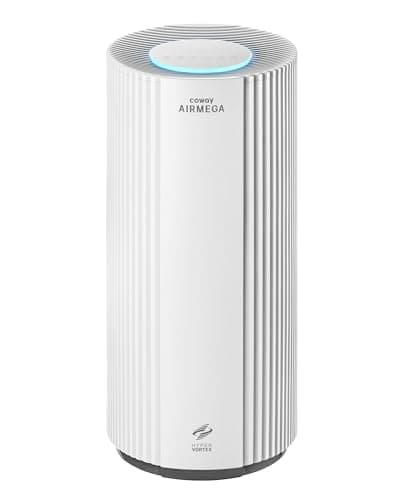 Best from 564 to 664 sq ft Coway Airmega 450 443 certified CFM across 687 sq ft, HEPA-Type, 6.7 CFM per watt, 0.00 ppb. | Open-plan floors up to about 665 sq ft | 443CFM smoke ENERGY STAR verified | |
| 2 | 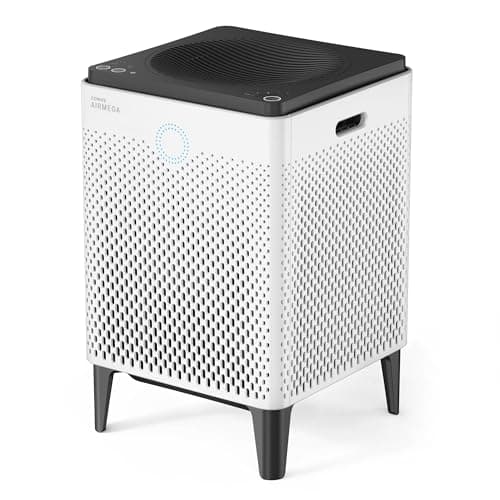 Enough machine under 564 sq ft Coway Airmega 400 376 certified CFM across 583 sq ft, 0.00 ppb, the quieter published range. | Large rooms, verified Coway | 376CFM smoke ENERGY STAR verified | |
| 3 | 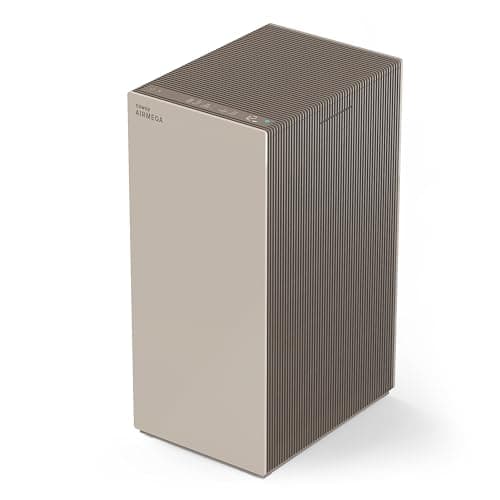 If your space is past 664 sq ft Coway Airmega ProX 577 certified CFM across 894 sq ft on less energy than either Coway here. | The largest room one machine can certifiably cover | 577CFM smoke ENERGY STAR verified |
#ad We earn a commission if you buy through this link, at no extra cost to you. How this site is funded. Prices last checked September 23, 2026.
The picks
Coway Airmega 450
Coway · model Airmega 450 (AP-2524B)
#ad We earn a commission if you buy through this link, at no extra cost to you. How this site is funded. Prices last checked September 23, 2026.
687 certified square feet with zero measured ozone and a vacuumable pre-filter. The step between the Airmega 400 and the ProX, and the cheapest certified way past 600 square feet.
443 smoke / 445 dust / 450 pollen CFM · 444 PM2.5
- Certified room size
- 687 sq ft
- Advertised coverage
- 3,285 sq ft in 60 minutes
- Energy / year
- 389 kWh
- Electricity / year
- $71
- Air per watt
- 6.7 CFM/W
- Power draw
- 72 W
- Noise
- 23.6-57.7 dB(A)
- Measured ozone
- 0 ppb
- Filter class
- HEPA-Type
- AHAM rule, 650 sq ft
- Clears it (434 needed)
No ionizer — filtration only
ENERGY STAR classifies this unit 'Fan and Filter' and measures 0.00 ppb ozone. Coway's specification lists no ionizing stage.
443 certified smoke CADR across 687 certified square feet at 6.7 CFM per watt, with 0.00 ppb measured ozone, no ion stage and a filter the register records as HEPA-Type. It wins every certified row in the table above, offers a choice of filter sets, and stands on the smaller base.
The honest con: 57.7 dB(A) is the loudest top end of any published noise range we print, its 29-inch height is harder to tuck out of sight, and at $71 a year it still costs more to run than the ProX while covering less room.
Coway Airmega 400
Coway · model Airmega 400 (AP-2015F)
#ad We earn a commission if you buy through this link, at no extra cost to you. How this site is funded. Prices last checked September 23, 2026.
The Coway that is actually in a certification register: 376 certified smoke CADR, 583 square feet, zero measured ozone. If you want a Coway, this is the one with third-party numbers.
376 smoke / 384 dust / 409 pollen CFM · 380 PM2.5
- Certified room size
- 583 sq ft
- Advertised coverage
- 3,120 sq ft in 60 minutes
- Energy / year
- 366 kWh
- Electricity / year
- $67
- Air per watt
- 6.1 CFM/W
- Power draw
- 66 W
- Noise
- 22-52 dB(A)
- Measured ozone
- 0 ppb
- Filter class
- Composite Filter
- AHAM rule, 500 sq ft
- Clears it (334 needed)
No ionizer — filtration only
ENERGY STAR classifies this unit 'Fan and Filter', 0.00 ppb measured ozone.
376 certified smoke CADR across 583 certified square feet with 0.00 ppb measured ozone and no ion generator, from a manufacturer whose own spec sheet undersells it. Its published 22-52 dB(A) range is the quieter of the two at both ends, and the Max2 set pairs activated carbon with the particle filter. How it compares with the Coway Mighty.
The honest con: less air per watt than the 450, a filter the register declines to classify HEPA or HEPA-Type, a single filter option, and nothing the 450 does not also give you. It makes sense only in a room under 564 square feet, and only if it is the cheaper of the two when you look.
Coway Airmega ProX
Coway · model Airmega ProX (AP-3522F)
#ad We earn a commission if you buy through this link, at no extra cost to you. How this site is funded. Prices last checked September 23, 2026.
The largest certified coverage on this site at 894 square feet, and the highest air-per-watt figure we have recorded at 10.2 CFM per watt — with a measured zero on ozone.
577 smoke / 586 dust / 450 pollen CFM · 581 PM2.5
- Certified room size
- 894 sq ft
- Advertised coverage
- 4,253 sq ft in 60 minutes
- Energy / year
- 335 kWh
- Electricity / year
- $61
- Air per watt
- 10.2 CFM/W
- Power draw
- 65 W
- Noise
- 23-46 dB(A)
- Measured ozone
- 0 ppb
- Filter class
- HEPA-Type
- AHAM rule, 800 sq ft
- Clears it (534 needed)
No ionizer — filtration only
ENERGY STAR classifies this unit 'Fan and Filter' and measures 0.00 ppb ozone. Coway's specification lists no ionizing stage.
Buyer-first: if neither machine reaches your room, the ProX certifies 577 CFM across 894 square feet, or 865 under the two-thirds rule, at 10.2 CFM per watt — the highest figure on this site. It uses less certified energy than either Coway above, 335 kWh or $61 a year, with 0.00 ppb measured ozone and a washable pre-filter. What to do past even this.
The honest con: it sits in a higher price bracket than either machine on this page, and in a room under 664 square feet its extra capacity is headroom you pay for without needing. The register classifies its filter HEPA-Type, not HEPA.
The verdict
Common questions
Is the Coway Airmega 450 better than the Airmega 400?
What size room is the Airmega 450 for?
Is the Airmega 400 quieter than the 450?
Do the Airmega 400 and 450 use the same filters?
Do either of these Coway air purifiers produce ozone?
Sources
- ENERGY STAR certified room air cleaners database
- AHAM — air filtration standards and the two-thirds rule
- Coway Airmega 400 specification
- Coway Airmega 450 specification
- Coway Airmega ProX specification
Figures were read on the dates shown against each source. If one has changed, or if we have got something wrong, tell us and we will correct the page.
Read next
- CADR & costCoway Airmega 400 vs Blueair Blue Pure 211i Max435 CFM across 674 sq ft at 9.0 CFM/W against 376 across 583 at 6.1 — and 2 ppb measured ozone against 0.00.
- Room sizeThe Best Air Purifiers for Large RoomsCertified for 500+ square feet, ranked on real coverage and what each costs to run.
- Room sizeThe Best Air Purifiers for 1,000 Square FeetNo certified single unit covers 1,000 sq ft. The Coway Airmega ProX reaches about 865; past that the answer is two machines in two zones.
- Room sizeCoway Airmega 450 Review687 certified square feet with 0.00 ppb ozone, a vacuumable pre-filter and three filter options — against the loudest published top speed we print and no filter price.
- CADR & costCoway Airmega 400 vs LEVOIT Core 600S391 certified CFM against 376, for a fraction of the price — against washable pre-filters, a published filter schedule and a quieter range on the Coway.