Coway Airmega 400 vs LEVOIT Core 600S
The cross-brand comparison large-room buyers actually run. On the certified numbers it is closer than the price gap suggests — and the deciding factors are not on the register at all.
#ad We earn a commission if you buy through this link, at no extra cost to you. How this site is funded. Prices last checked September 23, 2026.
Buy the LEVOIT Core 600S unless you have a shedding animal. It moves 4% more certified air across 4% more certified room, it is in both registers, its filter is classified where the Coway’s is not, and it costs a bracket less. Buy the Airmega 400 if hair is the problem: it is the one with washable pre-filters, a published filter schedule and the quieter published range.
This is the large-room cross-brand pair buyers actually put side by side, and the price gap makes it look like a mismatch. On the certified numbers it is not — the two machines are within a few percent of each other on every performance figure the registers publish. What separates them is a set of things certification does not measure at all.
The numbers, side by side
| Airmega 400 | Core 600S | |
|---|---|---|
| Smoke CADR | 376 CFM | 391 CFM |
| Dust CADR | 384 CFM | 398 CFM |
| Pollen CADR | 409 CFM | 436 CFM |
| PM2.5 CADR | 380 CFM | 394 CFM |
| Certified room size | 583 sq ft | 606 sq ft |
| Two-thirds-rule room | 564 sq ft | 586 sq ft |
| Registers listed in | ENERGY STAR only | ENERGY STAR and AHAM |
| Annual energy (certified) | 366 kWh | 387 kWh |
| Electricity per year | $67 | $71 |
| Air per watt | 6.1 CFM/W | 6.0 CFM/W |
| Measured ozone | 0.00 ppb | 0.00 ppb |
| Ionizer | None | None |
| Filter classification | Composite Filter — unclassified | HEPA-Type |
| Washable pre-filter | Yes, one per face | Not documented |
| Published filter interval | 12 months (page says 6-12) | Not published |
| Replacement filter price | $129 (set of 2) | $59.99 |
| Noise range (manufacturer) | 22-52 dB(A) | 26-55 dB |
| Footprint and height | 14.8 in square, 22.8 in tall | 12.3 in square, 23.6 in tall |
| Weight | 24.7 lb | 13.7 lb |
Electricity costs on this page use 18.34¢ per kWh, the U.S. average residential price for June 2026 from the U.S. Energy Information Administration, Electric Power Monthly, Table 5.3. Your rate is on your bill and is probably not this one; multiply the kWh figure by your own rate and you have your number.
On performance, there is barely a gap
The LEVOIT wins the airflow comparison, and the margin is small enough to be almost academic: 4% more smoke CADR, 4% more certified room. In practical terms a room that suits one suits the other: under the two-thirds rule they clear 564 and 586 square feet, and at the six air changes we use for pet rooms, 470 and 488.
Energy is a draw with a twist. The Coway certifies 366 kWh a year against the LEVOIT’s 387, so the expensive machine is the cheaper one to run — $67 against $71. That inverts the wattage on the boxes, where LEVOIT lists 49 W against Coway’s 66 W. The two are not measuring the same thing: a manufacturer’s wattage is a draw at some setting, while the register’s kWh figure comes from a defined test procedure. The certified figure is the comparable one, which is why this site quotes it.
Both machines measure 0.00 ppb with no ion generator, so the safety question that separates most pairs on this site is a tie here — why that figure usually decides our recommendations.
Where the LEVOIT wins outright
Two registers, not one. The Core 600S is listed by ENERGY STAR and, as of this month, by AHAM as well, with figures that match. The Airmega 400 is in ENERGY STAR only — not because Coway failed anything, but because Coway does not appear in AHAM’s directory at all. Two independent bodies publishing the same numbers is the strongest verification this category offers.
A filter the register will classify. ENERGY STAR records the LEVOIT’s filter as HEPA-Type. It records the Coway’s as a “Composite Filter” and declines to call it HEPA or HEPA-Type at all, so the filter-grade comparison this site makes on every other machine cannot be made for the Airmega 400 — what those classifications do and do not promise.
Price, by a wide margin. We do not print prices in prose because they move, but the gap here is structural rather than promotional: the LEVOIT has sat a full bracket below the Coway all year, close to half. At that distance the question stops being “which is better” and becomes “what does the Coway do that is worth the difference”.
Features, if you want them. App and voice control, a laser particle sensor, a PM2.5 readout and scheduling. This site does not rank on features because they do not move air, but they are real and the Coway’s are simpler. One caveat LEVOIT publishes itself: auto mode will not use the high or turbo speeds, so a machine left on auto never delivers its certified 391 CFM.
Where the Coway earns its premium
Washable pre-filters, one per face. The Airmega 400 pulls air through both sides, each behind a rinsable mesh. LEVOIT documents no washable pre-filter for the Core 600S at all. In a house with a shedding animal this is the single most valuable difference on the page: coarse hair and dander load a cartridge far faster than fine particulate, and a mesh you rinse is what stands between the hair and the filter you pay for — the machines that document one are a short list.
A filter schedule you can budget. Coway publishes both a price and an interval for the Max2 set, so the Airmega 400’s annual filter cost is arithmetic: $129 a year at the published twelve months. LEVOIT publishes a price and no interval, so the Core 600S’s annual filter cost cannot be computed at all. The LEVOIT cartridge is cheaper — $59.99 against $129 — but a cheaper filter on an unknown schedule is not obviously cheaper per year.
| Machine | Filter price | Published interval | Annual filter cost |
|---|---|---|---|
| Coway Airmega 400 | $129 (set of 2) | 12 months (product page says 6-12) | $129, or $258 at 6 months |
| LEVOIT Core 600S | $59.99 | Not published | Not computable |
Quieter at both ends. 22-52 dB(A) against 26-55 dB, on each manufacturer’s own figures. The four decibels at the bottom of the range are the ones that decide whether a bedroom machine stays switched on — how to read a dB range.
Carbon in the main cartridge. Coway describes the Max2 set as activated carbon plus HEPA, and the Core 600S carries a carbon layer in its three-stage cartridge too — so this one is closer to a draw than a win, but the Coway’s is the larger set of the two and is sold as a pair.
The other difference nobody lists: shape and weight
The Coway is a 24.7 lb box, 14.8 inches square and 22.8 inches tall, designed to sit against a wall and pull from both sides. The LEVOIT is 13.7 lb on a 12.3-inch square base, nearly a foot narrower and noticeably easier to move between rooms.
That matters more than it sounds. A machine that moves easily gets used in the room that needs it; a heavy one stays where it was first put. If the plan is one purifier that migrates between the living room by day and a bedroom at night, the lighter machine is the one that actually gets carried — though two rooms usually argue for two machines.
Quick picks
Both machines, plus the one to buy if the room is bigger than either covers.
| # | Product | Best for | Certified CADR | Price |
|---|---|---|---|---|
| 1 | 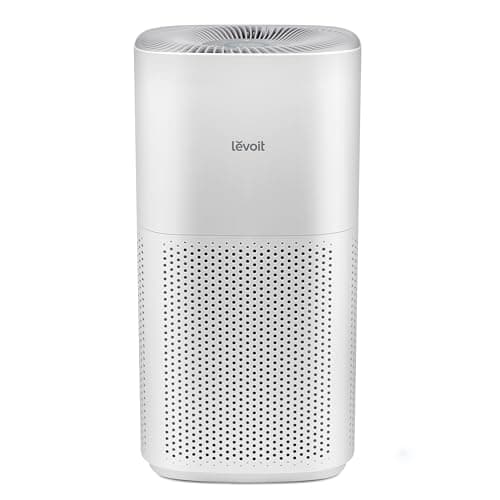 The one to buy for most rooms LEVOIT Core 600S 391 certified CFM across 606 sq ft, in both registers, 0.00 ppb measured. | Large open-plan rooms | 391CFM smoke ENERGY STAR verified | |
| 2 | 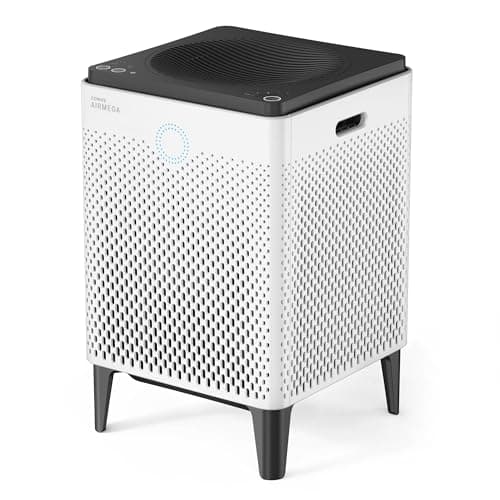 If a shedding animal lives there Coway Airmega 400 376 certified CFM with washable pre-filters and a published filter schedule. | Large rooms, verified Coway | 376CFM smoke ENERGY STAR verified | |
| 3 | 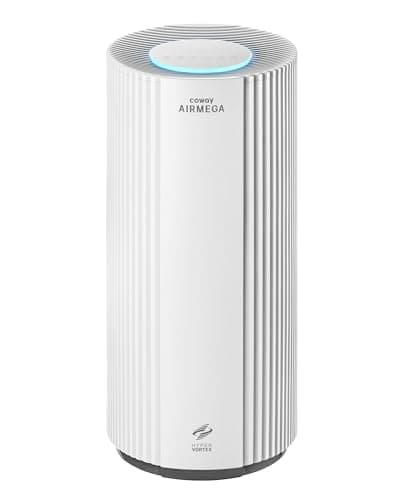 If the room is bigger than either Coway Airmega 450 443 certified CFM across 687 sq ft on about the same electricity. | Open-plan floors up to about 665 sq ft | 443CFM smoke ENERGY STAR verified |
#ad We earn a commission if you buy through this link, at no extra cost to you. How this site is funded. Prices last checked September 23, 2026.
The picks
LEVOIT Core 600S
LEVOIT · model Core 600S (LAP-C601S-WUS)
#ad We earn a commission if you buy through this link, at no extra cost to you. How this site is funded. Prices last checked September 23, 2026.
391 certified smoke CADR is real large-room capability, and it is honest about needing 387 kWh a year to deliver it — the highest electricity bill of any LEVOIT we cover.
391 smoke / 398 dust / 436 pollen CFM · 394 PM2.5
- Certified room size
- 606 sq ft
- Advertised coverage
- 2,909 sq ft at 1 air change per hour
- Energy / year
- 387 kWh
- Electricity / year
- $71
- Air per watt
- 6 CFM/W
- Power draw
- 49 W
- Noise
- 26-55 dB
- Measured ozone
- 0 ppb
- Filter class
- HEPA-Type
- AHAM rule, 550 sq ft
- Clears it (367 needed)
No ionizer — filtration only
ENERGY STAR classifies this unit 'Fan and Filter', 0.00 ppb measured ozone.
391 certified smoke CADR across 606 certified square feet, 0.00 ppb measured, no ion stage, now listed in both registers, with a filter the register classifies and a published dB range — at a price a bracket below the Coway. The full record on it.
The honest con: no documented washable pre-filter, which in a shedding household is the specification that decides filter life; no published replacement interval, so the annual filter cost cannot be computed; a noisier published range; and a second model code sold under the same name that measures 2 ppb.
Coway Airmega 400
Coway · model Airmega 400 (AP-2015F)
#ad We earn a commission if you buy through this link, at no extra cost to you. How this site is funded. Prices last checked September 23, 2026.
The Coway that is actually in a certification register: 376 certified smoke CADR, 583 square feet, zero measured ozone. If you want a Coway, this is the one with third-party numbers.
376 smoke / 384 dust / 409 pollen CFM · 380 PM2.5
- Certified room size
- 583 sq ft
- Advertised coverage
- 3,120 sq ft in 60 minutes
- Energy / year
- 366 kWh
- Electricity / year
- $67
- Air per watt
- 6.1 CFM/W
- Power draw
- 66 W
- Noise
- 22-52 dB(A)
- Measured ozone
- 0 ppb
- Filter class
- Composite Filter
- AHAM rule, 500 sq ft
- Clears it (334 needed)
No ionizer — filtration only
ENERGY STAR classifies this unit 'Fan and Filter', 0.00 ppb measured ozone.
376 certified smoke CADR across 583 certified square feet with 0.00 ppb measured, washable pre-filters on both faces, a published filter schedule and price, the quieter published range, and $67 a year in electricity. Our full review.
The honest con: it costs roughly twice the LEVOIT to buy and its filters cost more than twice as much per year, ENERGY STAR declines to classify its filter HEPA or HEPA-Type at all, and Coway’s own published CADR for it — 328 — is below the 376 the register certified.
Coway Airmega 450
Coway · model Airmega 450 (AP-2524B)
#ad We earn a commission if you buy through this link, at no extra cost to you. How this site is funded. Prices last checked September 23, 2026.
687 certified square feet with zero measured ozone and a vacuumable pre-filter. The step between the Airmega 400 and the ProX, and the cheapest certified way past 600 square feet.
443 smoke / 445 dust / 450 pollen CFM · 444 PM2.5
- Certified room size
- 687 sq ft
- Advertised coverage
- 3,285 sq ft in 60 minutes
- Energy / year
- 389 kWh
- Electricity / year
- $71
- Air per watt
- 6.7 CFM/W
- Power draw
- 72 W
- Noise
- 23.6-57.7 dB(A)
- Measured ozone
- 0 ppb
- Filter class
- HEPA-Type
- AHAM rule, 650 sq ft
- Clears it (434 needed)
No ionizer — filtration only
ENERGY STAR classifies this unit 'Fan and Filter' and measures 0.00 ppb ozone. Coway's specification lists no ionizing stage.
Buyer-first: both machines above run out at around 586 square feet. The Airmega 450 certifies 443 CFM across 687 square feet on about the same electricity as the Core 600S, with the same 0.00 ppb and a vacuumable pre-filter. The full record on it.
The honest con: its published range tops out at 57.7 dB(A), the loudest we print; Coway publishes no replacement filter price for it, so its filter bill is unquotable; and in a room either machine above already covers, it is capacity you pay to run and never use.
The verdict
Common questions
Which is better, the Airmega 400 or the Core 600S?
Do both of them produce zero ozone?
Which one is cheaper to own?
Which is quieter?
Do they cover the same size room?
Sources
- ENERGY STAR certified room air cleaners database
- AHAM VERIFIDE directory of certified room air cleaners
- AHAM — air filtration standards and the two-thirds rule
- Coway Airmega 400 specification
- LEVOIT Core 600S-P product specification
Figures were read on the dates shown against each source. If one has changed, or if we have got something wrong, tell us and we will correct the page.
Read next
- CADR & costLEVOIT vs CowayBrand-level comparison on certified coverage, running cost and which models are actually in a register.
- CADR & costThe Best Air Purifiers Under $300Under $300 buys genuine large-room coverage. Ranked on certified CADR, running cost and measured ozone — not on sticker price alone.
- CADR & costWhat air purifier filters actually costFilter interval and price arithmetic, with the assumptions stated and the gaps admitted.