The Best Air Purifiers for Small Pets
Rabbits, guinea pigs and birds produce a different problem from cats and dogs: bedding ammonia, hay dust and a fine powder that gets everywhere. One of these animals also makes the ozone question non-negotiable.
#ad We earn a commission if you buy through this link, at no extra cost to you. How this site is funded. Prices last checked September 24, 2026.
Buy for three things: documented activated carbon for bedding ammonia, a washable pre-filter for hay dust and feather down, and — if you keep birds — a measured 0.00 ppb with no ion stage, without exception. The Coway Airmega 400 covers all three; the LEVOIT Core 400S is the smaller-room version; the Honeywell HPA4300 is the efficiency pick if odor is not the main problem.
Nearly every air purifier roundup aimed at pets means cats and dogs. A hutch or a cage makes a different set of problems, in a smaller room, usually with the animal in it twenty-four hours a day — which changes both what you need and how careful you have to be.
Three problems, and what each one needs
Ammonia from bedding. Rabbit and guinea pig urine breaks down into ammonia, and ammonia is a gas. Certified CADR does not measure it and HEPA does not remove it. Only activated carbon adsorbs it, and only until the carbon loads up. This is the one problem on the page where the filter you are buying is the carbon stage rather than the HEPA one — how carbon works and how fast it saturates.
Hay and bedding dust. Timothy hay sheds a great deal of coarse dust, and paper or aspen bedding adds more. Coarse particles load a HEPA cartridge quickly, which is why a rinsable pre-filter matters more here than in almost any other room — the machines that document one.
Feather down. Powder-down species — cockatiels, cockatoos, African grays — produce a fine keratin dust continuously. It is light, it stays airborne, and it is squarely in the size range certified CADR is measured on. For this problem a purifier is unusually effective.
Why the cage itself changes the arithmetic
A cage concentrates the source. With a cat or a dog the allergen is distributed around the house; with a hutch or an aviary, almost everything — the ammonia, the hay dust, the down — is generated inside a few cubic feet in one corner of one room. That is good news for filtration, because the problem is local and a machine placed sensibly intercepts a lot of it.
It also means the room’s square footage understates the load. A 150 square-foot spare room with a rabbit in it has a harder job than the same room with a person in it, which is why the sizing below is deliberately conservative.
The rule we will not bend for a bird room
Birds have a respiratory system built for flight: air passes through the lungs in one direction and is exchanged far more efficiently than in a mammal. The practical consequence is that airborne irritants that mildly bother a person can be serious for a bird, which is why keepers are warned off overheated non-stick cookware.
Ozone is a lung irritant, and EPA advises against portable air cleaners that intentionally produce it. So in a room with a bird in it, this site will only recommend machines that the register measures at 0.00 ppb with no ion generator — no exceptions for a better CADR figure, no “2 ppb is a small number” reasoning. That rules out the Blueair Max range and every PlasmaWave Winix, both of which we recommend elsewhere — the ozone position in full.
How we judged
Certified CADR, sized for a small room. Most cage rooms are bedrooms or spare rooms of 120 to 250 square feet, which needs 134 CFM at 200 square feet under AHAM’s rule. We size higher — six air changes an hour, the same target we use for shedding pets — because a caged animal is a continuous source in a small volume.
Documented carbon. A named activated carbon stage, not a carbon-dusted pre-filter.
A washable pre-filter, because hay dust and down will otherwise eat cartridges.
A measured zero on ozone, mandatory for birds and preferable for everything else.
| Machine | Smoke CADR | Room at 6 ACH | Carbon | Washable pre-filter | Ozone |
|---|---|---|---|---|---|
| Coway Airmega 400 | 376 CFM | 470 sq ft | Yes | Yes, both faces | 0.00 ppb |
| LEVOIT Core 400S | 231 CFM | 288 sq ft | Yes | Not documented | 0.00 ppb |
| Honeywell InSight HPA4300 | 229 CFM | 286 sq ft | Pre-filter only | Not documented | 0.00 ppb |
| Coway Airmega Mighty AP-1512HH | 233 claimed | Not certifiable | Yes | Yes | Not measured |
Electricity costs on this page use 18.34¢ per kWh, the U.S. average residential price for June 2026 from the U.S. Energy Information Administration, Electric Power Monthly, Table 5.3. Your rate is on your bill and is probably not this one; multiply the kWh figure by your own rate and you have your number.
Sizing a cage room, with the arithmetic
Cage rooms are usually small, which tempts people into the smallest machine on the shelf. The load argues the other way: the animal is in that room all day, the bedding is generating ammonia continuously, and hay dust is thrown up every time the cage is disturbed. We size these the way we size rooms with shedding pets — six air changes an hour rather than AHAM’s general 4.8.
| Room | Two-thirds rule | At 6 air changes | What clears it |
|---|---|---|---|
| 120 sq ft | 80 CFM | 96 CFM | Almost any certified unit |
| 160 sq ft | 107 CFM | 128 CFM | HPA4100 and up |
| 200 sq ft | 134 CFM | 160 CFM | Core 400S, HPA4300 |
| 250 sq ft | 167 CFM | 200 CFM | HPA4300, AT41, Airmega 400 |
One adjustment specific to these animals: run the machine at a middle speed continuously rather than high in bursts. Rabbits and guinea pigs are prey animals and startle at sudden noise, and birds are sensitive to draft. A steady, moderate airflow does more for the air and less to the animal than a machine that cycles between silent and loud.
Quick picks
Carbon for the ammonia, a washable pre-filter for the hay dust, a measured zero for the birds.
| # | Product | Best for | Certified CADR | Price |
|---|---|---|---|---|
| 1 | 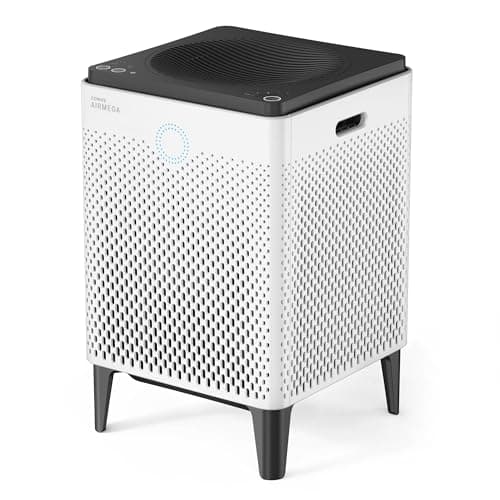 Best for a small-pet room Coway Airmega 400 376 certified CFM, carbon for ammonia, washable pre-filters, 0.00 ppb. | Large rooms, verified Coway | 376CFM smoke ENERGY STAR verified | |
| 2 | 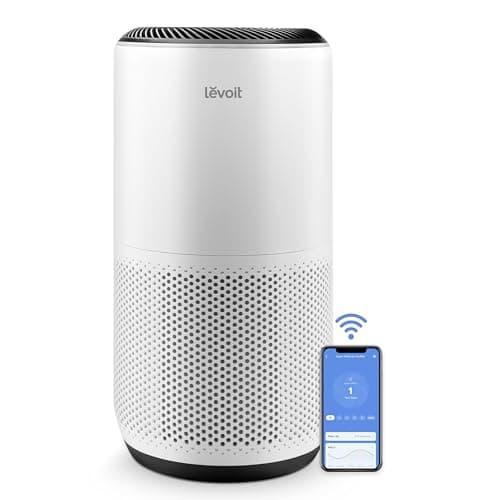 Best for one cage in a bedroom LEVOIT Core 400S 231 certified CFM with a carbon stage and 0.00 ppb measured. | Popular pick, mid-size rooms | 231CFM smoke ENERGY STAR verified | |
| 3 | 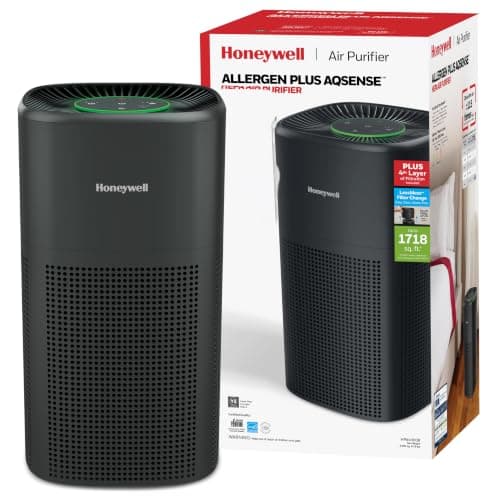 Best for a bird room Honeywell InSight HPA4300 229 certified CFM on 31 watts, recorded HEPA, no ion stage. | True HEPA on the lowest power draw | 229CFM smoke AHAM VERIFIDE |
#ad We earn a commission if you buy through this link, at no extra cost to you. How this site is funded. Prices last checked September 24, 2026.
The picks
Coway Airmega 400
Coway · model Airmega 400 (AP-2015F)
#ad We earn a commission if you buy through this link, at no extra cost to you. How this site is funded. Prices last checked September 24, 2026.
The Coway that is actually in a certification register: 376 certified smoke CADR, 583 square feet, zero measured ozone. If you want a Coway, this is the one with third-party numbers.
376 smoke / 384 dust / 409 pollen CFM · 380 PM2.5
- Certified room size
- 583 sq ft
- Advertised coverage
- 3,120 sq ft in 60 minutes
- Energy / year
- 366 kWh
- Electricity / year
- $67
- Air per watt
- 6.1 CFM/W
- Power draw
- 66 W
- Noise
- 22-52 dB(A)
- Measured ozone
- 0 ppb
- Filter class
- Composite Filter
- AHAM rule, 250 sq ft
- Clears it (167 needed)
No ionizer — filtration only
ENERGY STAR classifies this unit 'Fan and Filter', 0.00 ppb measured ozone.
The only machine here that answers all three problems at once: activated carbon inside the Max2 cartridge for ammonia, a washable pre-filter on each face for hay dust and down, 376 certified CFM, and 0.00 ppb measured with no ion stage — so it is safe to run in a bird room. Coway publishes the filter price too, at $129 a set. Our full review.
The honest con: it is a lot of machine for a hutch room — the most expensive pick here to buy and to re-filter — and ENERGY STAR declines to classify its filter HEPA or HEPA-Type at all.
LEVOIT Core 400S
LEVOIT · model Core 400S (LAP-C401S)
#ad We earn a commission if you buy through this link, at no extra cost to you. How this site is funded. Prices last checked September 24, 2026.
The best-selling unit in the category, and a clean example of the coverage gap: ENERGY STAR certifies it for 358 square feet while the box advertises 1,718.
231 smoke / 240 dust / 259 pollen CFM · 236 PM2.5
- Certified room size
- 358 sq ft
- Advertised coverage
- 1,718 sq ft at 1 air change per hour
- Energy / year
- 237 kWh
- Electricity / year
- $43
- Air per watt
- 5.8 CFM/W
- Power draw
- 38 W
- Noise
- 22-52 dB
- Measured ozone
- 0 ppb
- Filter class
- HEPA-Type
- AHAM rule, 200 sq ft
- Clears it (134 needed)
No ionizer — filtration only
ENERGY STAR classifies this unit 'Fan and Filter' and measures 0.00 ppb ozone. LEVOIT markets it as ozone free.
231 certified CFM covers about 288 square feet at six air changes an hour, which suits a single cage in a spare room. 0.00 ppb measured, no ion stage, a carbon third stage for ammonia, plus the two numbers most rivals do not publish: 22-52 dB and a $49.99 filter.
The honest con: LEVOIT documents no washable pre-filter, so hay dust goes straight onto the cartridge and shortens its life — and LEVOIT publishes no interval, so you cannot budget for how much.
Honeywell InSight HPA4300
Honeywell · model HPA4300B
#ad We earn a commission if you buy through this link, at no extra cost to you. How this site is funded. Prices last checked September 24, 2026.
The efficiency winner among true-HEPA units at living-room size: 229 certified smoke CADR on 31 watts, zero measured ozone, and a filter the register classifies as HEPA rather than HEPA-Type.
229 smoke / 238 dust / 245 pollen CFM · 233 PM2.5
- Certified room size
- 354 sq ft
- Energy / year
- 185 kWh
- Electricity / year
- $34
- Air per watt
- 7.4 CFM/W
- Power draw
- 31 W
- Noise
- Not published
- Measured ozone
- 0 ppb
- Filter class
- HEPA
- AHAM rule, 230 sq ft
- Clears it (154 needed)
No ionizer — filtration only
Both registers classify this unit as fan-and-filter only.
For a bird room, where the problem is airborne powder rather than smell, this is the efficient answer: 229 certified CFM on 31 watts — $34 a year — with 0.00 ppb measured, no ion stage, and a filter the register records HEPA rather than HEPA-Type.
The honest con: its carbon is a thin pre-filter layer rather than a carbon stage, so it is the wrong pick for a rabbit or guinea pig room where ammonia is the complaint, and Honeywell publishes no filter interval or price at all.
What matters more than the machine
Bedding changes beat filtration for ammonia, every time: the gas is generated continuously from a source you can simply remove twice a week. Ventilation beats both. A purifier is the third line, managing what is airborne between cleanings — and in a bird room, managing a powder that cleaning cannot reach because it is produced constantly.
Two practical notes. Keep the machine a few feet from the cage so the animal is not sitting in a draft, and expect to clean the pre-filter more often than the manual suggests: hay dust loads a mesh in weeks, not months.
Common questions
What air purifier is best for guinea pig or rabbit smell?
Are air purifiers safe for birds?
Do air purifiers help with bird dust?
Where should the purifier go in a small-pet room?
Sources
- AHAM VERIFIDE directory of certified room air cleaners
- ENERGY STAR certified room air cleaners database
- EPA — Guide to Air Cleaners in the Home
- AHAM — air filtration standards and the two-thirds rule
Figures were read on the dates shown against each source. If one has changed, or if we have got something wrong, tell us and we will correct the page.
Read next
- Pet hair & odorUsing an air purifier for a cat litter boxA fixed odor and dust source, where placement beats power. What to buy and where to stand it.
- Pet hair & odorActivated carbon and pet odorWhy 'includes activated carbon' means nothing without a weight, and how to read the claim.
- Pet hair & odorAir Purifiers With Washable Pre-FiltersThe cheapest performance upgrade in the category, with the filter-cost arithmetic worked out.