The Best Air Purifiers for Mold Spores
Filtration catches spores in the air. It does not touch the colony on the wall, and no purifier does — that part needs the moisture fixed.
#ad We earn a commission if you buy through this link, at no extra cost to you. How this site is funded.
An air purifier captures airborne mold spores while it runs, which reduces exposure. It does not remove mold from surfaces or stop it producing spores — mold grows because a surface is wet, so fixing the moisture comes first and filtration is a supporting measure.
This page is worth less to us than the others on this site, because the honest answer reduces the urgency of the purchase. We are going to give it anyway.
The order of operations
Mold is not an air-quality problem that happens to appear on walls. It is a moisture problem that expresses itself as mold. Spores are present in essentially every indoor environment; they germinate and colonize when they land somewhere persistently damp. That means:
- Find and fix the water. A leak, condensation, rising damp, a bathroom without extraction, a basement with no vapor barrier.
- Remove the existing growth properly, or have it removed if the area is large.
- Control humidity — a dehumidifier, not a purifier, is the appliance for this part.
- Then run a purifier to reduce the airborne spore load while the rest is happening and afterward.
The EPA puts it more generally: the most effective ways to improve indoor air are to reduce or remove sources of pollutants and to ventilate with clean outdoor air, and filtration does not replace either. Mold is the clearest case of that principle in this entire category.
What actually matters in a mold purifier
Mold spores are large as airborne particles go, typically a few microns across, which puts them well inside what any HEPA-grade filter handles comfortably. Filter grade is not the differentiator here. Three other things are:
- Certified coverage for the actual space. Mold problems live in basements, bathrooms and crawl-adjacent rooms, which are often larger or oddly shaped. Undersizing is the usual mistake.
- A real carbon stage, if the musty smell bothers you. That smell is gas-phase and HEPA does nothing for it.
- No ozone. Mold remediation is a context where ozone-generating devices get marketed aggressively, and EPA’s advice on those is unambiguous.
Quick picks
Ranked on certified coverage for the larger spaces mold usually occupies, then measured ozone, then running cost.
| # | Product | Best for | Certified CADR | Price |
|---|---|---|---|---|
| 1 | No photo Best overall Honeywell HPA6000 257 certified CFM, zero measured ozone, HEPA-classified filter. | Large living rooms, true HEPA | 257CFM smoke AHAM VERIFIDE | |
| 2 | No photo Best for a basement Blueair Blue Pure 211i Max 674 certified sq ft — enough for the large open spaces mold usually occupies. | Open-plan spaces above 500 sq ft | 435CFM smoke AHAM VERIFIDE | |
| 3 | No photo Best large-room alternative LEVOIT Core 600S 391 certified CFM across 606 sq ft, zero measured ozone. | Large open-plan rooms | 391CFM smoke ENERGY STAR verified | |
| 4 | 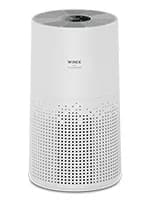 Best value Winix C710 248 certified CFM at 235 kWh a year, with carbon for the musty smell. | Lowest running cost at living-room size | 248CFM smoke AHAM VERIFIDE |
#ad We earn a commission if you buy through this link, at no extra cost to you. How this site is funded.
The picks
Honeywell HPA6000
Honeywell · model HPA6000B
#ad We earn a commission if you buy through this link, at no extra cost to you. How this site is funded.
More certified air movement than the HPA4300 for four more watts, and the same zero on ozone. The sensible step up if your room is nearer 400 square feet.
257 smoke / 262 dust / 285 pollen CFM · 259 PM2.5
- Certified room size
- 398 sq ft
- Energy / year
- 207 kWh
- Electricity / year
- $38
- Air per watt
- 7.3 CFM/W
- Power draw
- 34.9 W
- Noise
- Not published
- Measured ozone
- 0 ppb
- Filter class
- HEPA
257 certified smoke CADR across 398 certified square feet, 0.00 ppb measured ozone, and a filter the register classifies HEPA rather than HEPA-Type. At $38 a year it is cheap enough to run permanently, which matters because a mold-prone room stays mold-prone.
Blueair Blue Pure 211i Max
Blueair · model 3613111100 (Blue Pure 211i Max)
#ad We earn a commission if you buy through this link, at no extra cost to you. How this site is funded.
The most air per watt of anything here and by some distance the largest certified coverage — 674 square feet. It does carry an ion generator, which is the reason it is not our asthma pick.
435 smoke / 453 dust / 450 pollen CFM · 444 PM2.5
- Certified room size
- 674 sq ft
- Energy / year
- 256 kWh
- Electricity / year
- $47
- Air per watt
- 9 CFM/W
- Power draw
- 44 W
- Noise
- Not published
- Measured ozone
- 2 ppb
- Filter class
- HEPA-Type
Ion generator — fitted
The two registers disagree: AHAM classifies this model 'Fan Filter with Ion Generator' while ENERGY STAR records it as 'Fan and Filter'. ENERGY STAR's measured ozone figure is 2 ppb. We report both rather than picking the flattering one.
674 certified square feet is the only figure here that genuinely covers an average basement, and it does it on 44 watts.
AHAM classifies the model as carrying an ion generator; ENERGY STAR records fan-and-filter with 2 ppb measured ozone. If the basement is occupied by someone with asthma, the Honeywell above measures zero.
LEVOIT Core 600S
LEVOIT · model Core 600S (LAP-C601S-WUS)
#ad We earn a commission if you buy through this link, at no extra cost to you. How this site is funded.
391 certified smoke CADR is real large-room capability, and it is honest about needing 387 kWh a year to deliver it — the highest electricity bill of any unit we recommend.
391 smoke / 398 dust / 436 pollen CFM · 394 PM2.5
- Certified room size
- 606 sq ft
- Advertised coverage
- 2,909 sq ft at 1 air change per hour
- Energy / year
- 387 kWh
- Electricity / year
- $71
- Air per watt
- 6 CFM/W
- Power draw
- 49 W
- Noise
- 26-55 dB
- Measured ozone
- 0 ppb
- Filter class
- HEPA-Type
No ionizer — filtration only
ENERGY STAR classifies this unit 'Fan and Filter', 0.00 ppb measured ozone.
391 certified smoke CADR across 606 certified square feet, zero measured ozone, no ionizer. It costs $71 a year, which is high — 387 kWh — and LEVOIT publishes that figure openly.
Winix C710
Winix · model C710
#ad We earn a commission if you buy through this link, at no extra cost to you. How this site is funded.
Nearly the same air movement as the AT41 for a third less electricity a year. If you can find it, it is the cheapest certified 380-plus square-foot unit to run.
248 smoke / 252 dust / 262 pollen CFM · 250 PM2.5
- Certified room size
- 384 sq ft
- Energy / year
- 235 kWh
- Electricity / year
- $43
- Air per watt
- 6.2 CFM/W
- Power draw
- 45 W
- Noise
- Not published
- Measured ozone
- 1 ppb
- Filter class
- HEPA-Type
No ionizer — filtration only
AHAM classifies this model 'Fan with Filter'.
248 certified smoke CADR at 235 kWh a year is a good ratio, and AHAM records the filter set as HEPA plus carbon — the carbon being the part that addresses musty odor rather than spores.
ENERGY STAR measures 1 ppb ozone. AHAM classifies it fan-and-filter with no ion generator.
On the health question
Mold exposure and health is a genuinely contested area and not one we are qualified to adjudicate. What we can say is what the filtration does: reduce the airborne spore concentration in a room while the machine runs. Whether that changes how you feel depends on factors specific to you, and a clinician is the right person to ask about persistent symptoms in a damp building.
Common questions
Do air purifiers remove mold?
Will an air purifier help with a musty smell?
Should I use an ozone generator for mold?
Sources
- EPA — Guide to Air Cleaners in the Home
- AHAM VERIFIDE directory of certified room air cleaners
- ENERGY STAR certified room air cleaners database
Figures were read on the dates shown against each source. If one has changed, or if we have got something wrong, tell us and we will correct the page.
Read next
- AllergiesThe Best Air Purifiers for AllergiesThe flagship roundup: certified CADR, measured ozone, computed running cost, and the coverage claims checked against the registers.
- AllergiesAir purifier vs ozone generatorWhy an ozone generator is not a stronger air purifier, and what EPA says about using them indoors.
- CADR & costAir purifier vs humidifierWhich appliance solves which problem, and when you genuinely need two of them.